
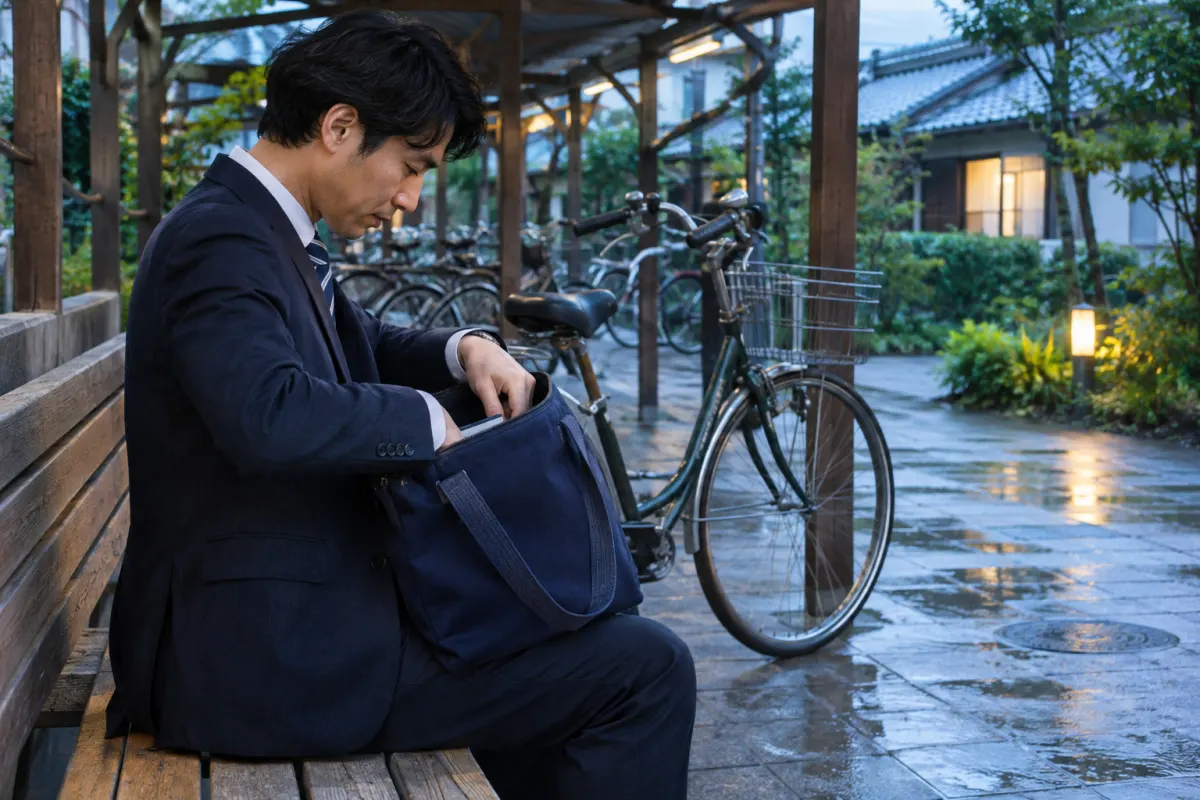
You often leave a needed item in yesterday's bag. Before going out, you want to make a point of checking today's bag. 出かける前に、かばんの中を確認するようにしています (でかけるまえに、かばんのなかをかくにんするようにしています) presents that check as something you consciously try to do. You are describing your routine and effort, rather than certifying that you have never forgotten anything. The rest of the conversation can explain what you actually check. You ni suru makes the conscious effort explicit.
You ni suru describes something you make a point of doing
Your bag is open on a bench by the door. Before leaving, you check for your keys and the notebook you need that day. 出かける前に、かばんの中を確認するようにしています describes the check as part of a routine you consciously maintain. It tells a listener what you try to make sure you do. The sentence can be true even if you have forgotten your notebook on a particular morning. If someone asks whether you actually checked today, answer that separately.
Find the action before the ending. 確認する (かくにんする) means “check” or “confirm.” It stays in its dictionary form before ようにする. For a habit you are trying to maintain, ようにしています is a common polite ending. Keep the whole check in your paraphrase. If you write “I am checking my bag right now,” you have shifted from describing a routine to reporting an action in progress. The open bag in a picture cannot decide which of those meanings the speaker intends. The words in the dialogue establish that.
Make two cards. On one, write “What do you make a point of doing before leaving?” On the other, write “What are you doing right now?” Have a partner ask one question without showing you the card. Answer with the appropriate description, then explain which question you thought you heard. If your answer to both questions is identical, make the contrast explicit in your own language before trying the Japanese again.

A negative action can be the habit you maintain
Perhaps you tend to put your keys into a different pocket every day and then spend time looking for them. You decide to avoid that. 毎日違う所に鍵を入れないようにしています (まいにちちがうところにかぎをいれないようにしています) describes an effort not to put your keys in a different place every day. The action is 入れる (いれる), “put in,” and the plain negative is 入れない. Keep the negative directly before ようにしています.
Compare that with 鍵を同じ所に入れるようにしています (かぎをおなじところにいれるようにしています), “I make a point of putting my keys in the same place.” In this scene the two descriptions can support the same practical aim. One names what you try to avoid, the other names what you try to do. Neither reports where the keys are at this moment. If a listener is helping you find them, give today's location or explain where you last remember seeing them.
Review the plain form in the Japanese grammar guide.

A change in ability is a different message
Your friend can now understand a station announcement that used to be difficult. 駅のアナウンスがわかるようになりました (えきのアナウンスがわかるようになりました) describes that change. The ending is ようになりました, from なる, rather than ようにしています, from する. It tells you something about the friend's present ability compared with before. It does not identify the practice routine that produced it.
Compare 毎日日本語を聞くようにしています (まいにちにほんごをきくようにしています), “I make a point of listening to Japanese every day.” The speaker is describing an effort. You could hear this sentence from someone who still finds announcements difficult. You could hear the sentence about understanding announcements from someone who learned through many different activities. To keep the distinction clear, ask two questions. What does the person deliberately do? What has changed? Each question invites different information.
In our bag example, a friend might ask whether you now remember your notebook more reliably. You could explain the checking routine, but that does not answer the question about results by itself. Say what happened on recent days if you want to report an improvement. The grammar helps you describe the effort. Your follow-up supplies evidence about how things have gone. This is useful in a learning diary too. A line about a practice routine and a line about a task you can now do need not be collapsed into one claim.
Use a KanaWay session to practise the verb, then describe your own routine
If you encounter 確認する during a KanaWay review session on Android, pause to say the dictionary form aloud. If that word doesn't come up, use it on paper. Try forming 確認するようにしています. Now change the intended routine and practise the plain negative with 忘れない (わすれない), “not forget.” 忘れないようにしています describes an effort to avoid forgetting. You still need context to say what the person tries not to forget. Add the object only after you know which routine you want to describe.
Put the device aside and write a question for a partner: “What do you make a point of doing before you leave home?” Have them answer in their own language first. Help them identify the action, the situation that prompts it, and whether they want to name an action they do or one they avoid. Then choose the Japanese verb and the appropriate plain form. A review prompt can help recall a word. It does not establish whether your routine description matches your life or whether someone else understood it. Learn Japanese Hub and KanaWay share a publisher. The conversation exercise is an activity alongside the app.
Try three short conversations
1. The notebook question. A friend asks how you try to avoid leaving your notebook at home. Describe a bag check before you go out. 出かける前に、かばんの中を確認するようにしています fits. If your friend then asks whether you checked this morning, reply about this morning. Your first sentence described a routine. It didn't report a specific check.
2. The keys go in one place. You are trying to stop putting your keys in a different pocket each day. Name the action you avoid with 入れないようにしています. Then give an affirmative version using the same place. 鍵を同じ所に入れるようにしています tells the listener what you consciously do. These versions can explain the same practical routine, but they highlight different choices. Ask the listener to say where they would look for the keys. If they give today's location as a fact, clarify that you have only described your usual effort.
3. A familiar announcement. Your friend says an announcement is now easier to understand. Choose between a sentence about making time to listen every day and a sentence about a change in understanding. 駅のアナウンスがわかるようになりました expresses the change. To describe practice, use 毎日日本語を聞くようにしています. Try a follow-up question to each answer. “What do you listen to?” fits the routine. “Which part can you understand now?” asks about the change. Both may be useful, but they don't request the same fact.
Transfer the distinction to preparing for a class
Before class, you check which handout to bring. 授業の前に、持ち物を確認するようにしています (じゅぎょうのまえに、もちものをかくにんするようにしています) describes making a point of checking your things. Suppose you now know the classroom number without looking it up. That is a separate change in knowledge. If you want to tell a classmate how you prepare, talk about the check. If you want to explain what has become easier, name the result.
Make a two-line diary entry after your next practice session. On the first line, record something you deliberately did or tried to maintain. On the second, record a concrete task you found easier, harder or unchanged. If you have no evidence of a change, leave that second line factual: you still needed the transcript, or you understood the same phrase as yesterday. You can describe a meaningful routine even when progress isn't visible in every session.
For the diary task, use the Japanese practice guide to choose a concrete recall prompt.
Questions about the method
Does ようにしています promise that I never miss a day?
It describes a consciously maintained practice. If someone needs an exact attendance record or a count of sessions, give that information separately.
Can I put a negative verb before it?
Yes. Use the plain negative, as in 入れないようにしています. Decide what action you are trying to avoid and make its meaning clear in context.
Is ようになる just another way to describe the same effort?
It describes a change, including a change in habit or ability. A person can make an effort before a change becomes apparent. Keep what they do and what has changed separate when reading an exchange.