Learn Japanese online with free guides and practice built around small, useful steps. Read your first words, make sense of a sentence and build a habit that fits your day.
を marks the object of this action: what you drink. It is pronounced o here, even though you type wo on a Japanese keyboard.
I drink tea.
The person is understood from the situation. Japanese often leaves out an obvious subject.
A FIELD NOTE YOU CAN TRY日本語 / 01
03 / YOUR NEXT CHAPTER
Less wondering where to start. More Japanese.
Wondering how to learn Japanese without getting lost in resources? Characters, useful words and Japanese grammar belong together. Follow a path that connects them, and put each new idea to work before moving on.
Preparing for N5? Start with a flexible four-week route: JLPT N5 study plan. It brings together tasks and review checks you can revisit. These free level guides cover N5 to N3; the KanaWay course is planned through N2 and N1.
Learning how to learn Japanese starts with the characters on a page, the meaning inside a sentence and the small exchanges that make it real.
Start anywhere. Each chapter brings an explanation, an example and something to try.
LANGUAGE, LIFE & THE EVERYDAY一歩ずつ。One step at a time.01
JAPANESE FOR BEGINNERS
Begin with something you can use.
THE LANGUAGE STARTS HEREこんにちは。A simple hello is already a beginning.
YOU DO NOT NEED TO KNOW EVERYTHING FIRST.
You do not need to understand the entire language before your first useful sentence. Start with a few characters, words that belong to a familiar situation and an explanation that connects them. A drink, a place and an action already give you something to read and say. The important first step is a small piece of Japanese whose meaning you can check, rather than a long list of resources you intend to use someday.
Our Japanese for beginners guide gives the first week a manageable shape. You meet kana, practise a simple introduction and begin connecting vocabulary with sentences. Each task has a reason and a way to inspect your attempt. Repeat a day when the material still needs attention. The plan is a starting structure, not a promise that every learner should move at the same speed.
日本語を勉強しています。にほんごを べんきょうしています。
“I’m studying Japanese.”
A useful introduction, even while you are still finding your words.
Give your first session one practical boundary: a single question you want to answer before you finish. Perhaps you want to know why a small character changes a word, how to make a familiar verb negative or what a short café exchange finally orders. Open the guide that answers that question, attempt its exercise and inspect the explanation. This creates a useful beginning and ending even when you only have a few minutes.
02
Give it a real setting.
If you are learning for a particular situation, start with that situation and follow its links back to the foundation. A self-introduction leads naturally to noun statements and questions. A shopping exchange gives numbers, demonstratives and adjectives a purpose. A fictional train journey helps you distinguish departure, arrival and meeting times. You can approach the same underlying language through a subject that matters to you while keeping the grammar and vocabulary connected.
03
Start where you are.
If you studied before and are returning after a break, begin with a brief check instead of automatically restarting everything. Read several familiar words, understand a short sentence and listen to a small exchange with support available. Notice which ability feels rusty. You may need to rebuild confidence with katakana while your basic grammar remains familiar, or reconnect words you can read with sounds you no longer recognise easily.
A GOOD FIRST SESSION
Choose one next task from that evidence. A useful session ends with a concrete change: you can distinguish two characters, explain a particle choice or recover a phrase in a recording. These small outcomes make progress easier to see than a growing total of pages opened. Keep the next step close enough that you can return without redesigning your entire study routine.
02
HIRAGANA, KATAKANA & KANJI
Three writing systems. One Japanese sentence.
Japanese combines hiragana, katakana and kanji, often within the same sentence. Hiragana appears in endings and grammatical elements as well as words. Katakana is common in borrowed terms and names. Kanji helps write many core vocabulary items. Learning how the scripts work together makes a sentence less mysterious than treating them as three unrelated alphabets to finish before reading anything meaningful.
あ
Hiragana
The everyday foundation: sounds, endings and small grammatical connections.
ありがとうarigatōthank you
Use the hiragana chart to establish the basic forms, then test them in words. Hide the romaji when you are ready to attempt recognition and reveal it to check. Practise a changed order so that the chart’s sequence does not supply the answer. When a character remains difficult, compare it with the form you confuse it with and then return to a word where the difference matters.
ア
Katakana
Meet familiar borrowed words in their Japanese spelling and rhythm.
コーヒーkōhīcoffee
The katakana chart follows the same practical approach with everyday vocabulary. A familiar English source does not remove the need to read the Japanese spelling carefully. コーヒー contains long-vowel marks, and small characters can change timing or combine with a preceding sound. Notice these details before guessing the word. A reliable recording helps connect the printed forms with the pronunciation they represent.
日
Kanji
Learn characters inside useful words, with the reading that belongs to that word.
日本にほん · nihonJapan
Bring kanji into useful vocabulary as it appears. Meet 水 as part of the word for water, with its reading and a short sentence, rather than trying to memorise every possible reading immediately. Furigana can support new words while you gradually recognise their written forms. The purpose of character study is access to language, so keep the chart, the word and the sentence in conversation with one another.
LOOK HOW THEY WORK TOGETHER
カフェで本を読みます。
I read a book at the café.
Katakana names the café.
Kanji appears in “book” and “read.”
Hiragana connects the words and completes the verb.
The two ー marks are part of the spelling. Read the whole word before reaching for its English source.
Check the explanation
Each ー extends the preceding vowel sound. コーヒー is kōhī: both the o and the i are long. Recognising the English word “coffee” is helpful, but the Japanese spelling tells you how to read it.
03
JAPANESE VOCABULARY
Give your words somewhere to belong.
A vocabulary list becomes more useful when its words share a purpose. Think of a small scene: getting breakfast, taking a train or meeting a classmate. Choose the words and actions needed to understand that scene. A handful of connected items can support several sentences, while a much larger random list may leave you unsure how to use any of them together.
For each new word, keep the reading, the relevant meaning and a short example. A Japanese dictionary can offer several senses, but you do not need to learn all of them in the first session. Select the sense that explains the sentence in front of you. When a later encounter reveals another use, add it with its own context. This keeps vocabulary notes focused and review prompts fair.
Check both recognition and recall. Can you understand the word when it appears in a sentence? Can you retrieve it when you imagine the situation and the answer is hidden? These questions reveal different strengths. If recognition is easy but recall is difficult, more passive rereading may not address the gap. Try a small, checked production task using grammar you already understand.
RECALLING IS ANOTHER.
Can you bring it back?
Our Japanese vocabulary guide explains how to choose entries, connect spelling with sound and manage review without chasing an arbitrary daily quota. The dictionary guide shows how to return from a lookup to the original sentence. Together, they help turn a saved definition into something you can meet again in reading, listening and everyday practice. The useful measure is what becomes available when you need it.
Cover one meaning above. Recall it, check it, then put the word back into a sentence. A small attempt is more useful than another untested glance.
JAPANESE GRAMMAR / THE CONNECTIONS MATTER
Words tell you what. Grammar tells you how they belong.
Grammar gives the words a relationship. It tells you who or what the sentence concerns, where an action happens, what receives that action and whether the statement is a question, a negative or a description of the past. Recognising several nouns can suggest a scene, but the smaller elements determine what the sentence actually says about it.
Begin by finding the predicate, usually near the end of a simple Japanese sentence. Then look at the particles attached to the surrounding words. In a sentence about reading a book at a library, the action, object and location have different jobs. Read the entire ending before deciding on the meaning. A small negative ending can reverse a statement that otherwise looks very familiar.
A SENTENCE, TAKEN APART
カフェでAt the caféPLACE
本をa bookOBJECT
読みますreadACTION
“I read a book at the café.”
で
The particle marks where the action happens. The café is the setting for reading.
GOING SOMEWHERE
図書館に行きます。
I go to the library.
に points to the destination in this sentence. The action is going.
DOING SOMETHING THERE
図書館で勉強します。
I study at the library.
で marks the place of the activity. The action is studying.
Our Japanese grammar resources use short contrasts so that one relationship is clear at a time. The に versus で workbook compares destinations, locations of existence and places where activities happen. It gives explanations after each attempt rather than expecting you to infer a rule from a score. You can keep the vocabulary familiar while concentrating on the grammatical choice.
Once a contrast makes sense, move it into another example. Change the place or action, explain your choice and check the result. This small variation shows whether you understand the relationship beyond the sentence that introduced it. Over time, connect grammar explanations with reading and listening, where the same forms appear as part of a message rather than as the isolated target of an exercise.
The same place can take a different particle because its relationship to the action changes. Check the whole sentence, not just the English word “at.”
04
JAPANESE READING PRACTICE
A few lines. A story to follow.
A WEEKEND MESSAGE土曜日
土曜日は公園に行く予定でした。
でも、雨です。
友達とカフェで会います。
THE MEANING
I had planned to go to the park on Saturday. But it is raining. I will meet my friend at a café.
FIRST PLANParkFINAL PLANCafé
An original practice message. The important detail is the change of plan.
READ FOR WHAT HAPPENS.
Japanese reading practice should give you something to find out. A daily routine can tell you when a person leaves home, how they travel and what happens after work. Before reading, choose a question that requires understanding those details. This makes the text more than a collection of words to look up and gives you a reason to follow the sequence of events.
Use furigana and translations as adjustable support. Try the Japanese first, then reveal help where needed. If every unfamiliar character blocks the message, leave more support visible and work with a shorter passage. If the reading is comfortable, hide a familiar reading or answer a question with the passage covered. The right amount of help depends on the purpose of that particular attempt.
Notice the turn in the story.
でも means “but” here. It introduces the rain that changes the plan. 予定でした describes what was planned before the change. The final sentence tells you what the friends will do instead.
Reading every word is useful. Connecting the sentences is what gives you the message. If you answer “the park” just because it appeared first, you miss the decision that follows.
Use a lookup to repair the message.
When you look up a word, return to the sentence and explain what you now understand. A dictionary entry is useful because it repairs the reading, not because it adds another item to a saved list. Pay attention to who performs each action, especially when names or pronouns are omitted. Follow changes in time and place so that the paragraph remains connected.
Try the same skill in a new setting.
Our beginner reading pages include short passages, comprehension checks and sentence notes. After working through a familiar passage, try another text with similar language and a different situation. That fresh example is a useful check of transfer. You want to understand how the Japanese communicates, not only remember the English story associated with one exercise you have already completed several times.
Separate what the text tells you from what you could reasonably imagine.
Check your reading
No clock time is given. The message supplies the day, the rain and the changed meeting place. It does not establish an exact time, a café name or what the friends will order.
JAPANESE LISTENING PRACTICE
Catch the words. Follow the change.
Japanese listening practice is about following a message as it unfolds. Recognising “station” is not enough if the speakers later decide on a café. The written exchange below lets you rehearse that skill: read the first suggestion, notice the reason for a change and find the arrangement they accept. Then use the same approach with a short recording whose transcript or explanation you can check.
THE LANGUAGE BETWEEN PEOPLE聞いてみよう。A conversation keeps moving. Follow it.
A WRITTEN REHEARSAL FOR LISTENING
One plan. A small change.
FIELD NOTE 01
READ THE EXCHANGEFurigana included
A
三時に、駅で会いましょう。
B
今日は雨ですね。 カフェにしませんか。
A
じゃあ、三時半にカフェで。
B
わかりました。
Read the English translation
ALet’s meet at the station at three.
BIt’s raining today, isn’t it? Shall we make it the café?
AThen, at the café at half past three.
BGot it.
Use the written example to practise tracking a change. Then try the same task with a short recording from the listening guide.
QUESTION 1 OF 3
Find the line that supports your answer.
Make a choice, then compare the first suggestion with the final agreement. It is fine to read the exchange more than once.
FROM HEARING TO UNDERSTANDING
01
Name what slipped past.
A missing word or a missed change?
If your answer is the station, ask what led you there. Perhaps 駅 was the first familiar word, and you stopped following the conversation too early. If the café is clear but the time is wrong, the difficulty is more specific. In an audio task, compare what you heard with the transcript: was a word new, was its sound unfamiliar, or did a later correction change the answer? Each possibility calls for a different repair.
02
Repair one short phrase.
三時 → 三時半 / three → half past three
Work on one phrase before replaying everything. In the example, 三時半 adds 半 to 三時 and moves the meeting from three to half past three. Read the whole expression, not just the number you recognised first. With a real recording, listen while checking the phrase in the transcript, then hide the text and listen again. The second attempt should test the detail you repaired, rather than repeat the same uncertainty.
03
Take it back to the sound.
One recording. One question to answer.
Choose beginner audio with a clear situation and accessible support. Our Japanese listening guide links to external materials with recordings; this page supplies a written preparation exercise. On your first pass, ask what the speakers are trying to do. On your next pass, find one place, time or decision. If the exchange remains opaque after checking the transcript, choose something shorter or more familiar. Films and music can still be enjoyable contact with Japanese without every minute becoming a test.
05 / YOUR JAPANESE STUDY ROUTINE
A little structure. Room for real life.
A useful session has a beginning, an attempt and something to return to. Start with the language you can almost use.
A Japanese study routine works better when you can name the task. “Study N5” is broad; “explain why the café takes で in this sentence” gives you something to attempt and check. Use JLPT N5, N4 and N3 to find suitable material, then choose a small ability inside it. Reading, listening and speaking need not develop at the same pace. Select your starting point from the task you can manage with a little support.
For a beginner foundation, use the N5 guide to connect familiar kana, everyday words and short sentence patterns. The N4 guide develops connections across sentences, while the N3 guide introduces longer reading and listening with more details to hold together. These are directions for choosing practice, not a promise about an exam result. You can return to a basic particle explanation while reading harder material; repairing a foundation is part of using the language.
A suggested pace. If a task needs longer, stay with it; finishing the idea matters more than finishing on time.
Selected a 15-minute plan: Follow one idea further.
Let the calendar support the learning.
The session note keeps one idea in view as the available time changes. With five minutes, follow the changed plan and repair one missed detail. With fifteen, connect the café example to particle practice. With thirty, carry the same attention to times and places into a new reading passage. Our four-week N5 study plan provides a wider sequence when you need it. Repeat or divide a task when the final check still feels uncertain.
Keep your own goals beside the test.
Keep a practical goal beside any examination goal. Ordering a drink, explaining a plan and composing a short message may need practice beyond a JLPT workbook. If you intend to take the test, use the organisers’ current information and sample materials for the examination itself, and add practice under suitable conditions. The JLPT does not directly assess spontaneous speaking or free composition. A study calendar can make room for those abilities as well as reading and listening.
FREE JAPANESE LEARNING RESOURCES
Open the page you need today.
Choose a resource by the question your last attempt raised. If you confused two kana, use the chart and its reading checks. If you knew the words but chose the wrong particle, open a worked contrast. If each sentence made sense but you lost the story, read a short passage for its sequence. Free Japanese learning resources become easier to use when each page has a job, rather than joining an ever-longer collection of bookmarks.
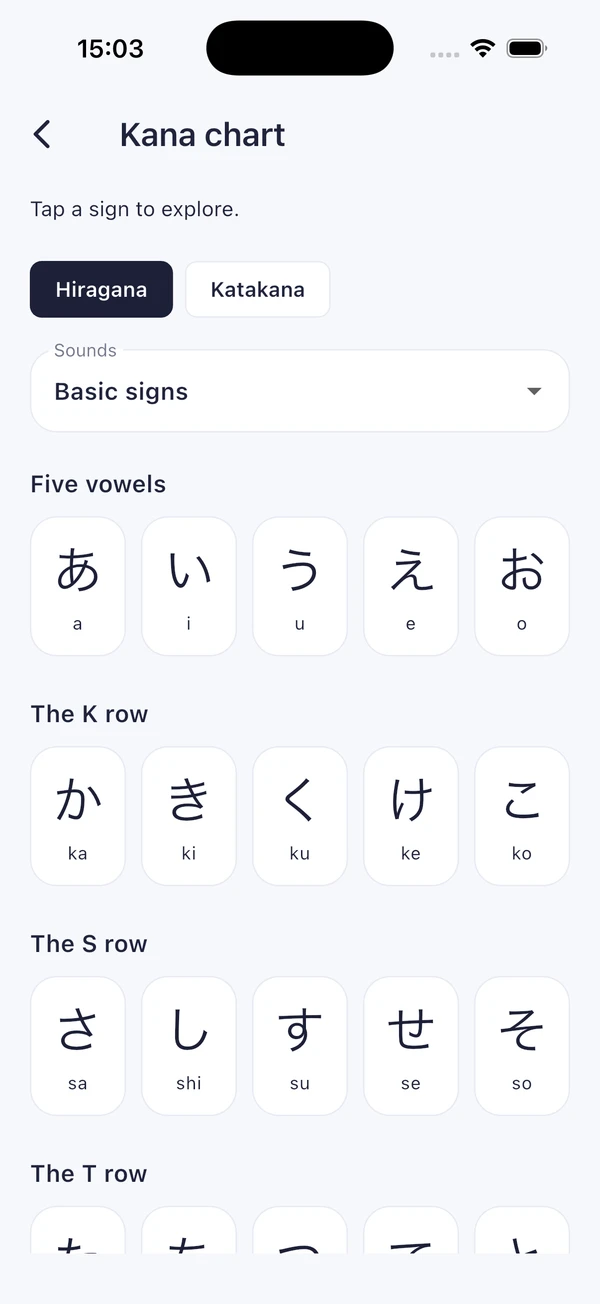
The four previews show the kind of attempt each resource supports. In the hiragana chart, recognise a character outside its usual row. In the に versus で workbook, explain why going to a library differs from studying there. In the daily-routine reading, keep the waking time separate from the departure time. The N5 study plan brings tasks into a sequence. Start with the question you can answer today, then follow the links your attempt makes useful.
Leave a note that describes the evidence. “I caught the café, but missed the half hour” is more useful tomorrow than “listening was difficult.” It suggests a return to the time expression, not a complete restart. Include the phrase you want to recognise and a small way to check it. You do not need a perfect streak or an elaborate record. When your time is limited, a precise note helps you resume the actual learning.
Free to read. No account needed.
The guides and exercises on Learn Japanese Hub are available without an account. You can use furigana when the reading needs support, inspect an explanation after an attempt and revisit earlier examples whenever they become relevant. The publication comes from the team behind KanaWay, but the free resources can also support another course or study routine. Choose a manageable task, make an attempt and return to the explanation with a question of your own.
A SMALL CHECK BEFORE YOU GO
What can you do with it now?
Use a fresh example to see what has become available. Earlier, the café sentence connected a place, a book and reading. The first check below keeps that pattern but changes the place to a park. The second asks you to bring back a word before seeing it, and the third asks for a particle choice. These are small observations about reading, recall and grammar, not a level test or a measure of everything you know.
01 / READ A FAMILIAR PATTERN
公園で 本を読みます。
Where does the reading happen?
Take it to a new setting.
In the first sentence, find the action and ask where it happens. If you can follow the familiar pattern with 公園 instead of カフェ, you have carried an idea into a new setting. If the park word blocks you, check its reading and return to the sentence; the grammar may already be clear. Change just one detail at a time so that you can tell whether the difficulty comes from the word, the written form or the relationship.
Check the meaning
“I read a book in the park.” 公園(こうえん) means park; で marks where the reading happens. Compare this with the café sentence from earlier: the place changes, while the action and its relationship stay the same.
02 / RECALL WITH LESS SUPPORT
a book ?
Can you bring back the Japanese word?
Notice which part needs a return.
Recalling “book” from English asks something different from recognising 本 on a page. If the answer feels obvious only after you reveal it, try retrieving it again after a short gap, then use it in a sentence. Unevenness is normal: a word can be easy to read and difficult to produce. Match the next task to that gap. More passive rereading is not the same attempt as bringing a word back without its written cue.
Reveal the word
本(ほん) means “book.” If you recognised it immediately but could not recall it, cover the answer and try again after a short gap. Then put the word back into 本を読みます: “I read a book.”
03 / CHOOSE YOUR NEXT QUESTION
図書館? 勉強します。
Would you choose に or で?
Let the attempt choose the next page.
For the final check, explain the relationship before revealing the answer. The library is where the studying happens, rather than a destination someone is moving toward. If that distinction is still uncertain, return to the particle workbook and compare two familiar verbs. If it is clear, make a new sentence with another place. End by choosing a useful return: one word, one contrast or one short passage. The guides remain references you can revisit, not a list to finish in one sitting.
Check the particle
Choose で: 図書館で勉強します。 means “I study at the library.” The library is where studying happens. With 行きます, “go”, 図書館に would instead mark a destination. Change the verb and check the relationship again.
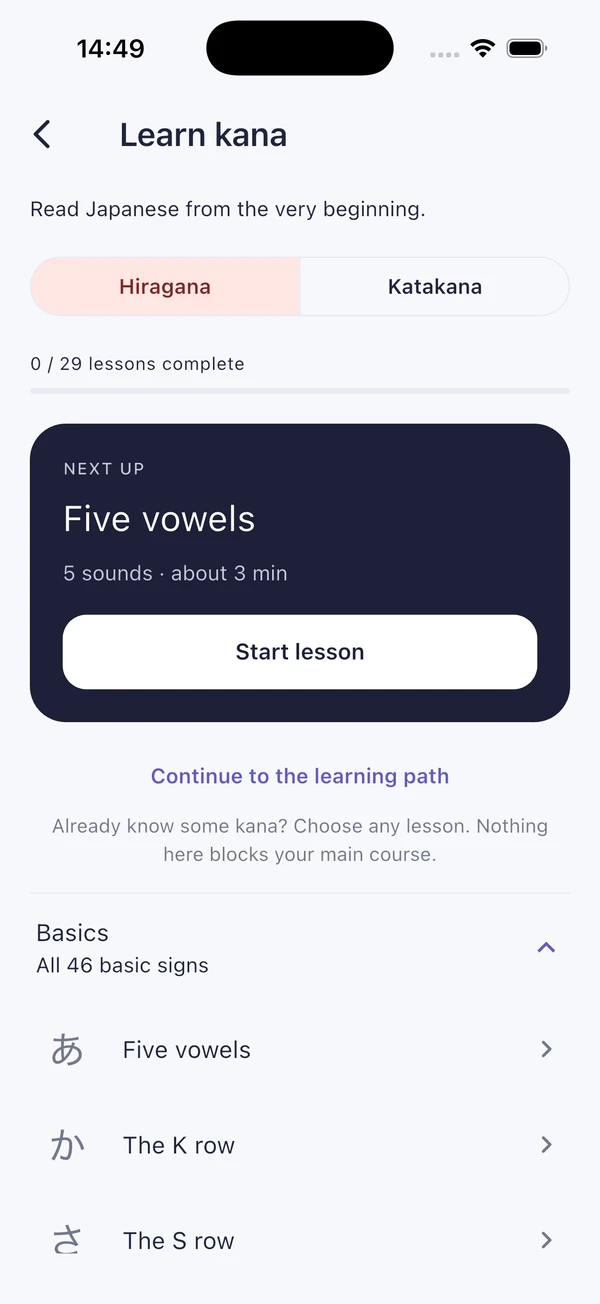
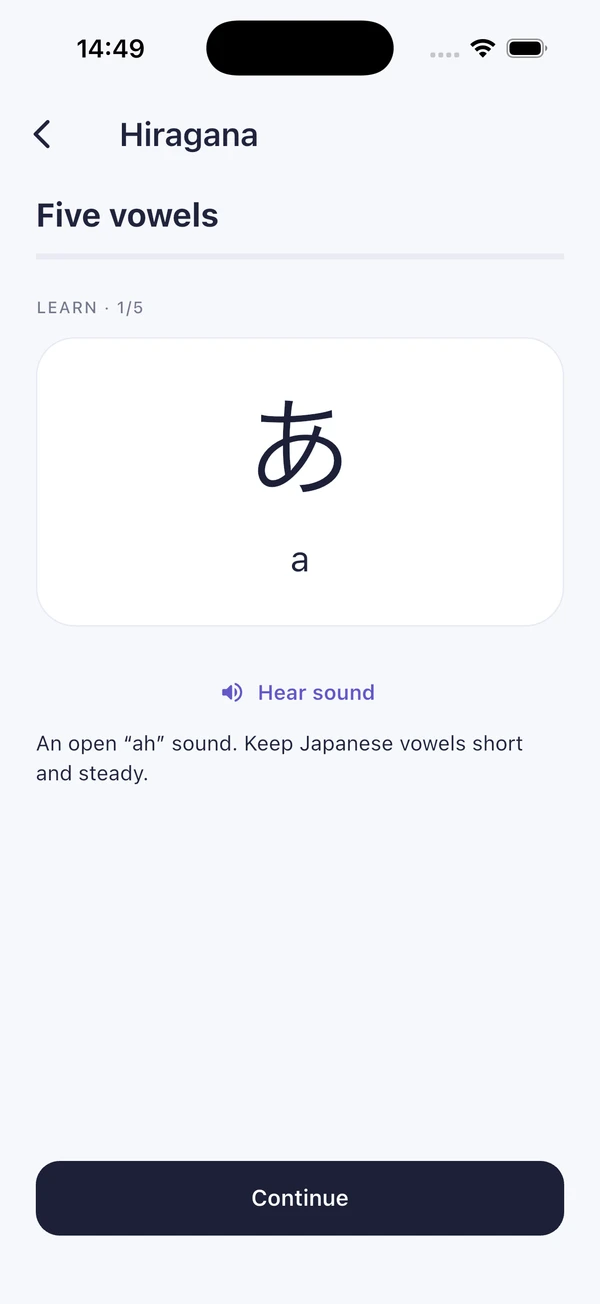
Learning can become fragmented when explanations, flashcards, dictionary searches and reading all live in separate places. KanaWay is being developed to connect these activities within one Japanese learning app. Its planned N5–N1 course contains 92 units and 460 structured lessons, with practice and review connected to the language introduced along the way. The app overview explains the product in more detail.
The learning design moves from meeting an idea to attempting it with less support. Vocabulary should return in sentences, grammar should explain a meaningful contrast and review should make earlier material available again. A large content count alone cannot do that work. The relationship between the activities matters because it helps you decide what to do after a correct answer, a mistake or an interrupted session.
01Learn02Practise03Review
FROM THE ACTUAL APPあ →
A clear next lesson. Earlier language close by.
Keep learning close, even away from Wi-Fi.
KanaWay also includes an offline dictionary in its planned feature set. Local study is useful when a commute or journey does not provide reliable connectivity. The first three N5 units are planned as the free starting portion, while the wider course belongs to the full offering. The app is still upcoming; verified download links, current availability and purchase details will be added when they can be confirmed.
Your first useful lesson can begin here.
You can explore real app screens on the overview page while using the website’s free lessons now. The publication and the app share a preference for connected practice, clear explanations and manageable returns. You do not need to wait for a release to begin learning Japanese online. Start with one useful guide, make an attempt and let the result tell you where to go next.
Begin with kana, then meet common kanji inside words you already understand. Learning 水 in 水を飲みます gives the character a useful context. More on this: Learning kanji.
Can I learn without taking the JLPT?+
Yes. JLPT levels can help organise your study, but conversation, travel and reading are valuable goals on their own. Use these as guides rather than deadlines: The JLPT learning path and JLPT N5 study plan. The N5 plan includes kana, grammar and reading tasks even if you are not taking the exam.
How are Learn Japanese Hub and KanaWay connected?+
Learn Japanese Hub is published by the team behind KanaWay. The free guides are available now; KanaWay is in development as an app for daily lessons, practice and review. Learn more: About Learn Japanese Hub.
Can I download KanaWay now?+
Not yet. KanaWay is still in development. We will add a verified App Store link when it becomes available. The free guides are available now. App details: The KanaWay app.
From the team behind Learn Japanese HubKanaWay
A little Japanese. A part of your day.
Meet KanaWay, our upcoming Japanese learning app. A place for lessons, practice and review to come together — and for your next small discovery.