
You have chosen a walk for tomorrow, but you have not taken it yet. You want to state your intention without presenting the walk as an accomplished event. Tsumori helps you make that distinction. It gives your listener information about what you mean to do, not proof that the action will happen or that every practical arrangement has been confirmed.
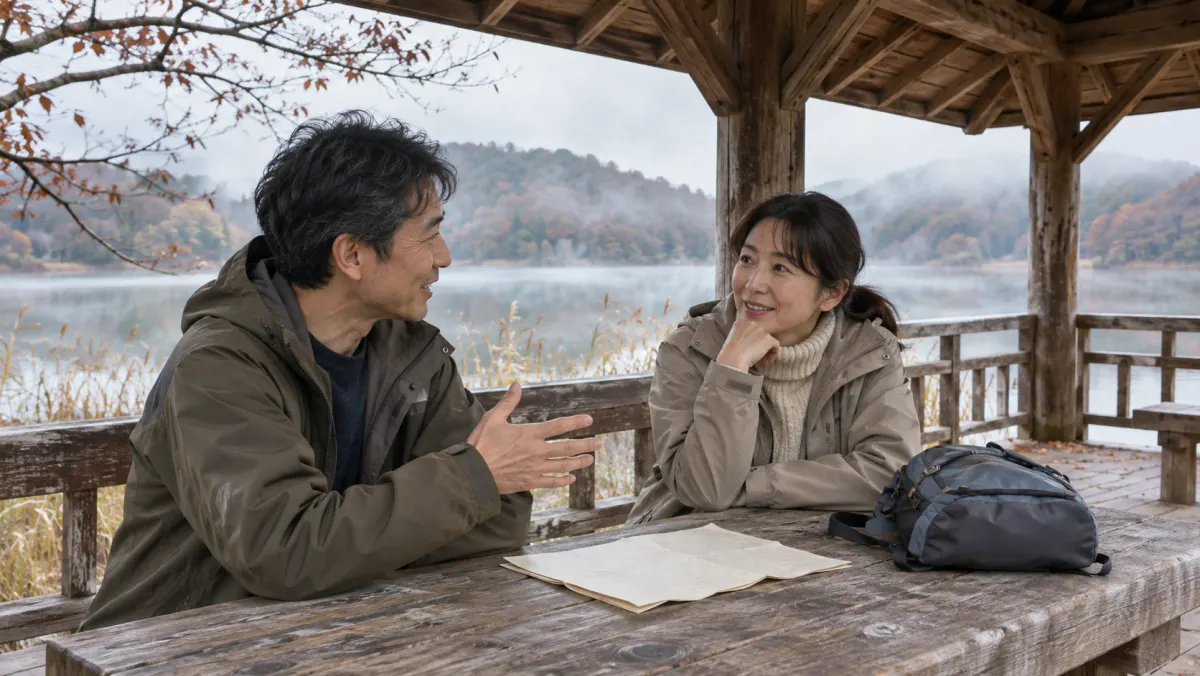
This lesson follows fictional adults spending a quiet weekend by a lake. They talk about walking, taking a bag and reading a book. Each exercise supplies the speaker's intended action explicitly. The photographs illustrate the setting; they cannot reveal anybody's private plans. You can complete the sentence work on paper. A separate dictionary step is useful only when a missing word prevents you from expressing the intention accurately.
Start with a stated intention and tsumori
明日は湖のそばを歩くつもりです。Ashita wa mizuumi no soba o aruku tsumori desu. “Tomorrow, I intend to walk beside the lake.” 明日, ashita, establishes tomorrow as the time setting. 湖のそば, mizuumi no soba, means beside the lake. The verb 歩く, aruku, supplies the action, and つもりです, tsumori desu, presents the speaker's intention politely.
The particle を is read o here. With 歩く it can mark the space traversed, rather than an object that somebody picks up. Keep that connection in the model phrase instead of translating every o as the English word “to.” You are describing where the walking will take place, while the whole sentence remains an account of the speaker's intended action.
Separate three facts in your notes: the action intended, its time setting, and what has actually happened. The first sentence supplies the first two. It does not supply completion. If another person asks what happened yesterday, simply repeating this tomorrow sentence would not answer the question, even if its verb form were correct. Meaning comes before speed of repetition.
Keep the plain verb before the polite ending
In this affirmative intention pattern, the ordinary dictionary form comes directly before tsumori desu. 歩く, aruku, stays 歩く in 歩くつもりです. Do not insert the polite 歩きます, arukimasu, before tsumori. The polite ending of this model is already supplied by desu at the end of the construction.
The Japan Foundation's explanation of tsumori describes future plans and intentions, including the nonpast plain-verb connection. This lesson concentrates on straightforward statements about your own intention. Other meanings of tsumori, reported intentions and more sensitive questions about somebody else's plans need their own context. A beginner pattern should not become a rule for every sentence containing the same word.
Write 歩く → 歩くつもりです in two spaces, then read the complete result. Next try 読む, yomu, “read”: 読むつもりです, yomu tsumori desu. You have changed the intended action while keeping the construction stable. Our verb conjugation guide provides a broader reference for distinguishing the dictionary form from the polite form.
A useful check is to cover only the construction's final part. Can you retrieve the intended verb without guessing from the sound of the model sentence? Then uncover tsumori desu and reconnect it. If you needed the entire model to remember aruku, record that as a vocabulary gap. If aruku was available but you chose arukimasu before tsumori, record a form-connection gap instead.
Make the intended action specific
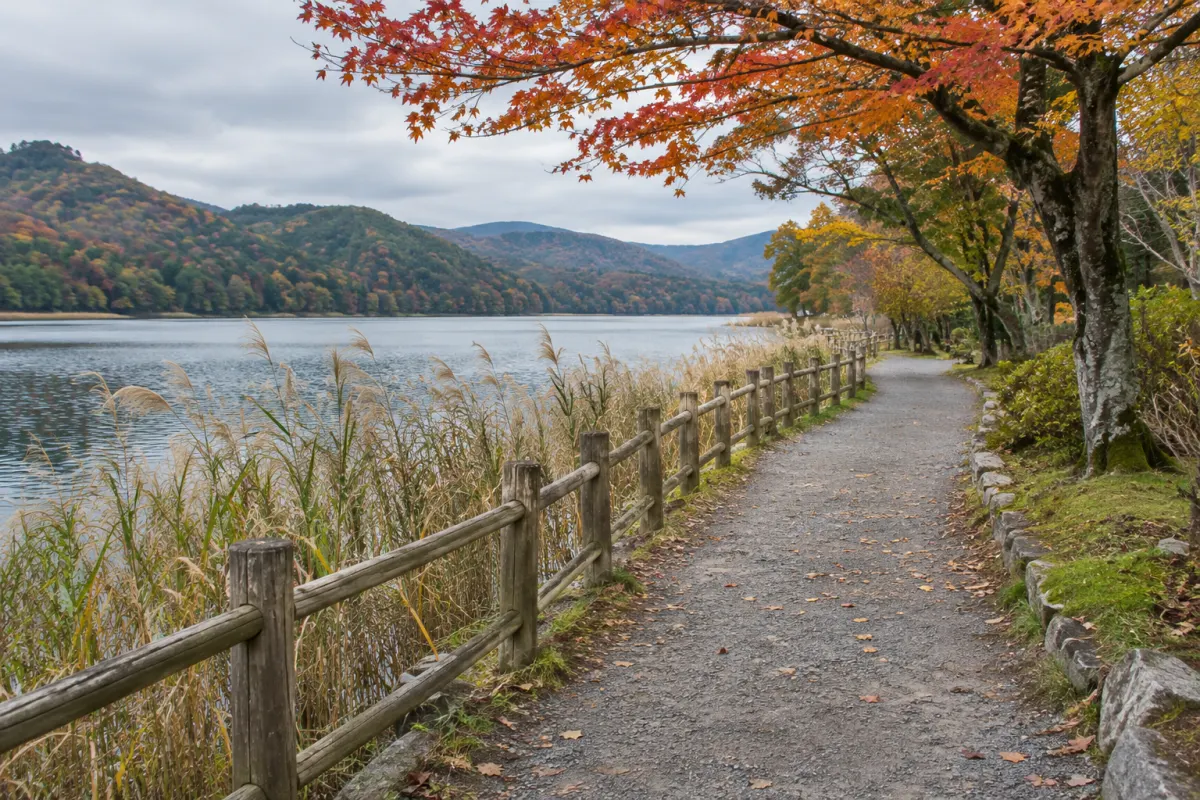
明日はこのかばんを持っていくつもりです。Ashita wa kono kaban o motte iku tsumori desu. “Tomorrow, I intend to take this bag along.” このかばん, kono kaban, identifies this bag. 持っていく, motte iku, expresses taking it along or away with the speaker in this context. Keep the whole activity together when you build the intention statement.
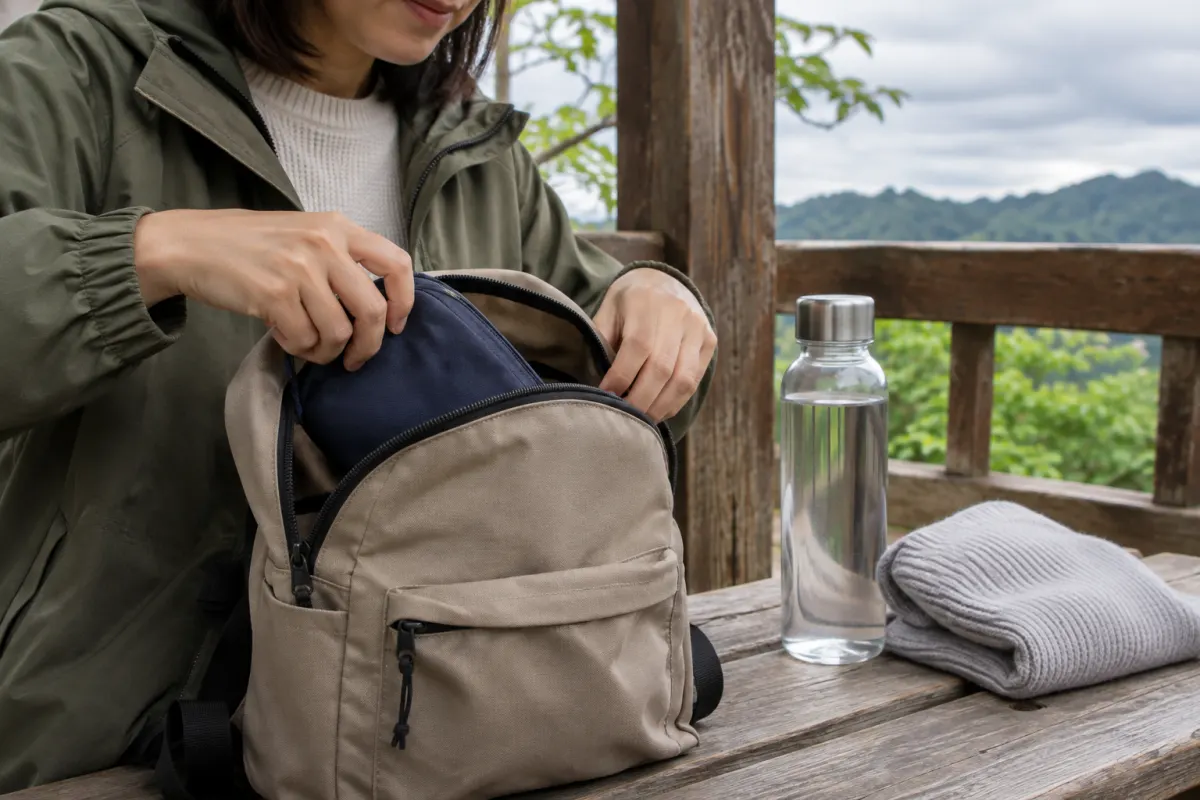
Compare the walk sentence with the bag sentence. An intention to walk does not automatically tell us which bag will be taken. A visible backpack in a photograph does not settle that either. The exercise needs a separate supplied fact about the bag before you can include it in an answer. Do not reward yourself for adding plausible details that the prompt never provided.
This is why a short meaning note is useful before writing Japanese. For one task, write “tomorrow: intends to walk beside the lake.” For another, write “tomorrow: intends to take this bag along.” Underline the different actions. A correct tsumori ending on the wrong activity still communicates the wrong intention, so your answer check must include the verb and its surrounding phrase.
An intention not to act still needs the action
明日は湖のそばを歩かないつもりです。Ashita wa mizuumi no soba o arukanai tsumori desu. “Tomorrow, I intend not to walk beside the lake.” The negative plain form 歩かない, arukanai, comes before tsumori desu. This is the negative-action model practised here. The speaker states an intention concerning not doing that activity.
Do not treat “the speaker has not told us a plan” as equivalent to this sentence. Missing information is not a stated intention not to act. Likewise, not knowing whether a person will walk tomorrow gives you no basis for supplying arukanai. Keep an “unknown” option in your exercise notes so that the task tests interpretation rather than forcing every situation into yes or no.
This lesson does not collapse all negative expressions involving tsumori into a single interchangeable formula. It also does not teach a prohibition addressed to another person. Our speaker is talking about their own intended action. The earlier negative-request lesson solves a different communication problem. Here, keep the speaker, the action and the scope of negation explicit before selecting an ending.

Use a dictionary for the missing word, then return
This website and KanaWay share a publisher. KanaWay is in development. Its planned learning tools include a dictionary alongside lessons and practice. The official local app information describes a lookup followed by returning to the original sentence to check whether the meaning fits. That is the limited supporting workflow used here; no released lake-walk lesson, particular word collection or automatic intention marking is promised.
If you cannot retrieve 歩く, first attempt the action word from the supplied meaning. Then consult an appropriate dictionary entry or a reliable word note. Check the reading and meaning that match “walk” in this task. Return immediately to the intention sentence and build 歩くつもりです. Looking up a verb does not establish that you have chosen the correct sentence construction.
If the word was familiar but you used a polite verb before tsumori, another definition lookup is not the main repair. Compare the two forms and try a new intention prompt. Our vocabulary guide explains how an attempted retrieval and a check can support learning without turning every error into a request for more word repetition.
You can use the same procedure with a covered paper note while the app is being developed. Keep the dictionary task separate from the sentence task: one checks a word's reading and meaning, the other checks what you intend to say and how the parts connect. Neither a successful lookup nor a familiar picture proves that a complete intention sentence is accurate.
Six prompts with enough information to answer
First, the speaker's own note says “tomorrow: intends to walk beside the lake.” Write a complete polite intention statement. Second, the note says “tomorrow: intends not to walk beside the lake.” Keep the same setting and change the action to its negative plain form before adding the construction.
Third, the note explicitly says that the speaker intends to take this bag along tomorrow. Produce the bag sentence, preserving kono kaban and motte iku. Fourth, a photograph shows an adult beside a lake but there is no statement about tomorrow. Can you conclude that the person intends to walk there? Explain what information is missing.
Fifth, a learner writes arukimasu immediately before tsumori desu. Replace only the verb form needed for this affirmative model. Sixth, a speaker states a tomorrow intention and a learner translates it as “I walked beside the lake yesterday.” Identify the two changes of meaning introduced by that translation. Do not solve it merely by checking whether both versions contain a word for walking.
Attempt every item before reading the answers. A blank response is more informative than copying a model and calling it recall. Note separately any missing word, incorrect connection or unsupported conclusion. The tasks are practice with supplied fictional facts, not a proficiency score or evidence about what a real person actually plans to do.
Check your statement, not just its last words
For the first prompt: 明日は湖のそばを歩くつもりです。Ashita wa mizuumi no soba o aruku tsumori desu. For the second: 明日は湖のそばを歩かないつもりです。Ashita wa mizuumi no soba o arukanai tsumori desu. Compare aruku and arukanai directly. The setting remains tomorrow beside the lake; the stated intention concerning the action changes.
For the third: 明日はこのかばんを持っていくつもりです。Ashita wa kono kaban o motte iku tsumori desu. For the fourth, the answer is “not known from the given information.” The picture establishes a scene, not a private intention. For the fifth, use aruku before tsumori desu in this model.
For the sixth, the translation changes tomorrow to yesterday and intention to an accomplished event. Neither change is justified. Return to the original message and explain it before producing the Japanese again. Our sentence structure guide can help you keep the time setting, activity phrase and final predicate connected.
Questions about the method
Does an intention prove that the action will happen?
No. This construction presents an intention in the context practised here. It does not prove completion or confirm every arrangement. If the question concerns what actually happened, look for separate information about the event.
Can I infer somebody's plan from their bag or photograph?
No. The exercise must give the intended action or a statement that supports it. A bag may suggest possibilities, but it does not tell you what somebody means to do tomorrow. Leave an unsupported intention unknown.
Is this a universal way to ask everyone about plans?
No. We practise statements about the speaker's own intentions. Questions addressed to somebody who requires particular respect, and descriptions of a third person's private intentions, need appropriate register and evidence. Do not turn this model into a universal conversation template.