
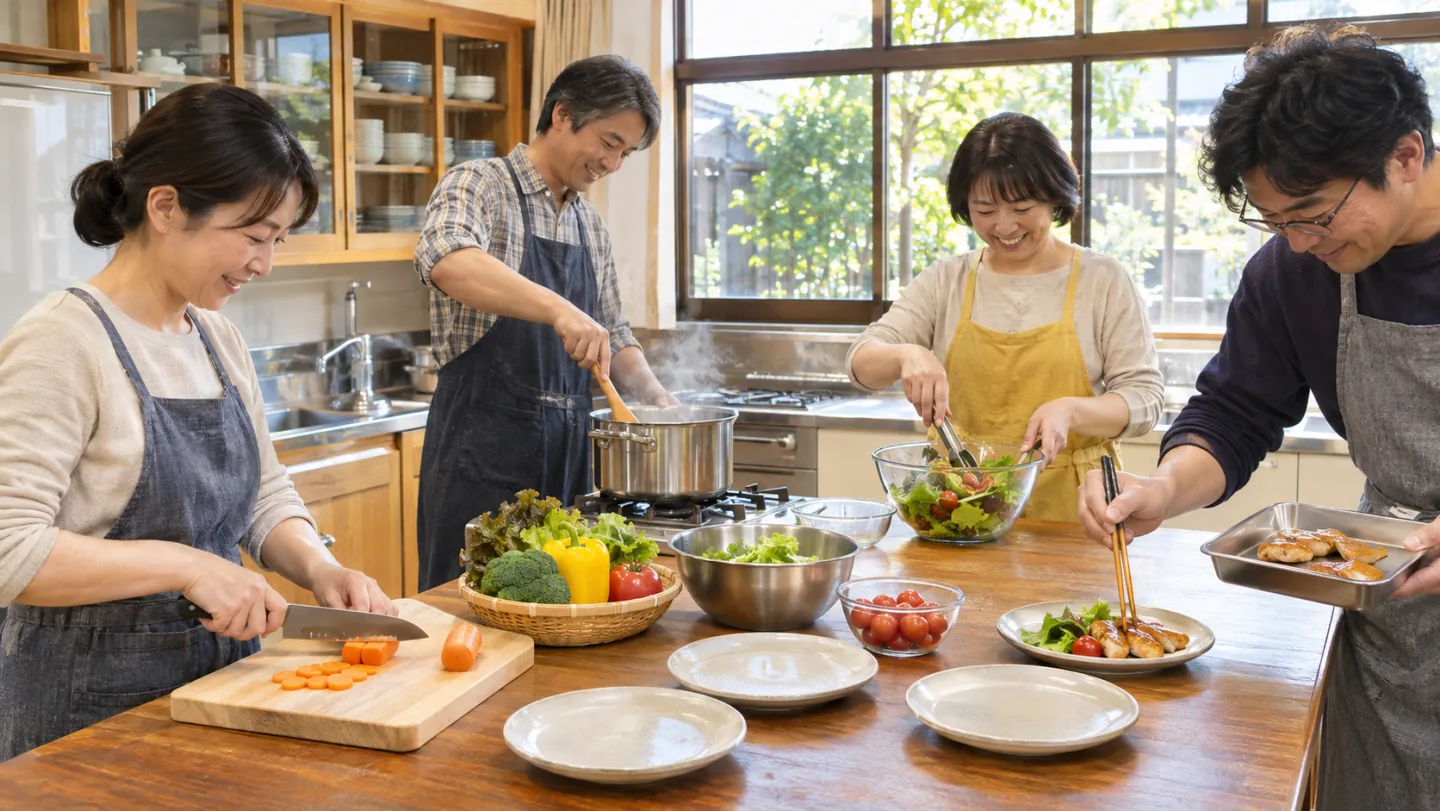
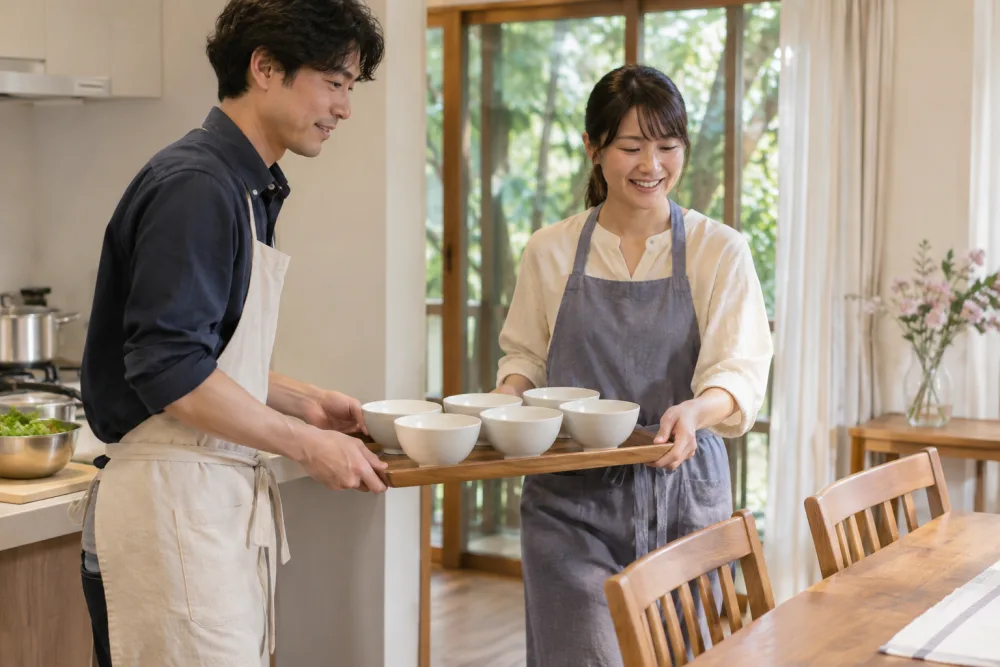
One person is setting the table while another watches the rice. ご飯が炊けたら、呼んでください (ごはんがたけたら、よんでください) asks the cook to call you when the rice is ready. The rice isn't ready yet. The ending たら sets the point at which the request applies. With a different first clause, the same pattern can express a genuine uncertainty. Work out whether the speaker expects the event or is making a plan in case it happens. Tara links the two steps.
Tara links a trigger to the next step
In the kitchen, the rice and the table can be ready at different times. You can lay out the bowls while the rice cooks, but you want a call before you bring the hot pot over. In ご飯が炊けたら、呼んでください, the first part supplies the trigger. The second says what someone should do once that trigger is met. Put the two clauses on separate lines and draw an arrow from the rice being ready to the cook calling you. The arrow is a reading aid. You don't need to translate it as “then” every time.
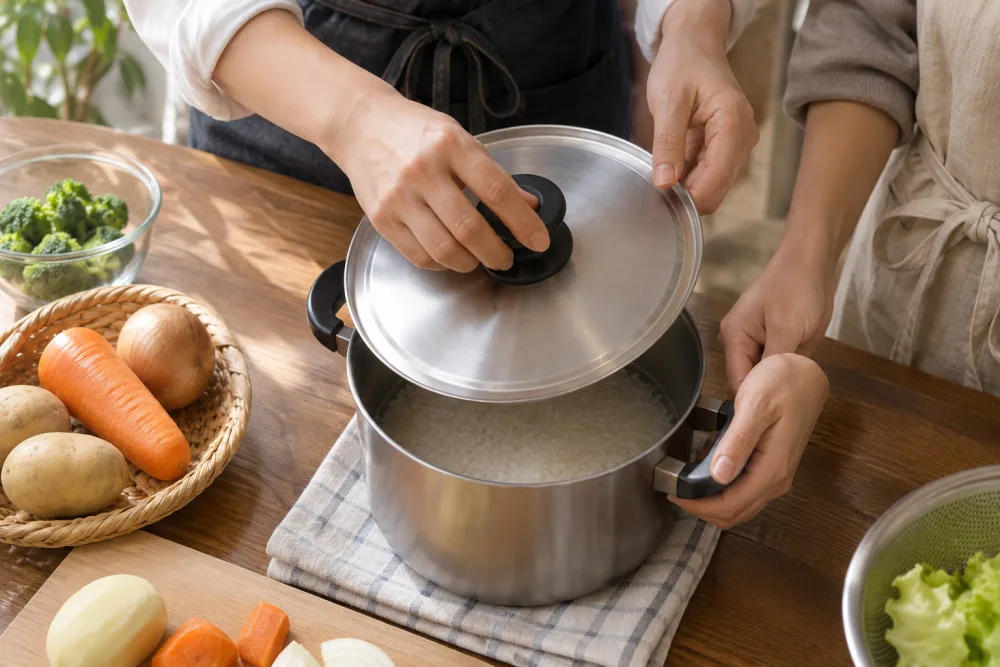
Start with 炊ける (たける), “be cooked” in this context, and recall 炊けた (たけた). Add ら to make 炊けたら. The first clause does not report that the rice is already cooked. Here it sets a point in the future at which the request applies. If the cook calls before the rice is ready, they may still have a reason to call you, but they have not followed this particular instruction. This is a way to test your interpretation without relying on a memorized English label.
The verb in the second part also deserves attention. 呼んでください (よんでください) is a request to call or get someone's attention. In our kitchen exchange, “call me” can simply mean tell me from the next room. You don't need to imagine a telephone. If you really want someone to call on the phone, you can make that action explicit. The grammar identifies when the request applies. The situation and the choice of verb give the request its practical meaning.
Choose “when” or “if” after reading the scene
Consider 時間があったら、お茶をいれましょう (じかんがあったら、おちゃをいれましょう). A natural English version is “If we have time, let's make tea.” The group may run out of time. The first clause gives a condition, and the second proposes something to do if it is met. Notice that the English word “if” doesn't make たら a different construction from the one used for the rice. In both cases, you look to the first clause before acting on the second. What changes is how sure the speakers are about the first event.
Now consider a second group that always has tea after clearing the table. If everyone expects to finish in good time, “when” may be the natural word in a sentence like 片づけが終わったら、お茶をいれましょう (かたづけがおわったら、おちゃをいれましょう), “When we've finished clearing up, let's make tea.” The speaker treats the end of clearing as the point for the next task. If the group has been told that they might have to leave abruptly, “if we finish clearing up” might instead fit a particular exchange. The phrase does not tell you how the group feels about the odds. Use what was said before it.
Try reading the rice sentence without any time words added in English. Paraphrase it as two instructions to yourself: wait for the rice to be ready, and call at that point. That paraphrase checks the sequence even if you haven't decided between “when,” “once,” or “after.” For the tea example, add a question in your notes: do we know that we will have time? If the answer is no, retain the uncertainty in your translation.
The Japan Foundation Irodori grammar notes describes the conditional form in tara and its temporal uses. Use the Japanese grammar guide to review verb forms before building a condition.
A negative condition is still a condition
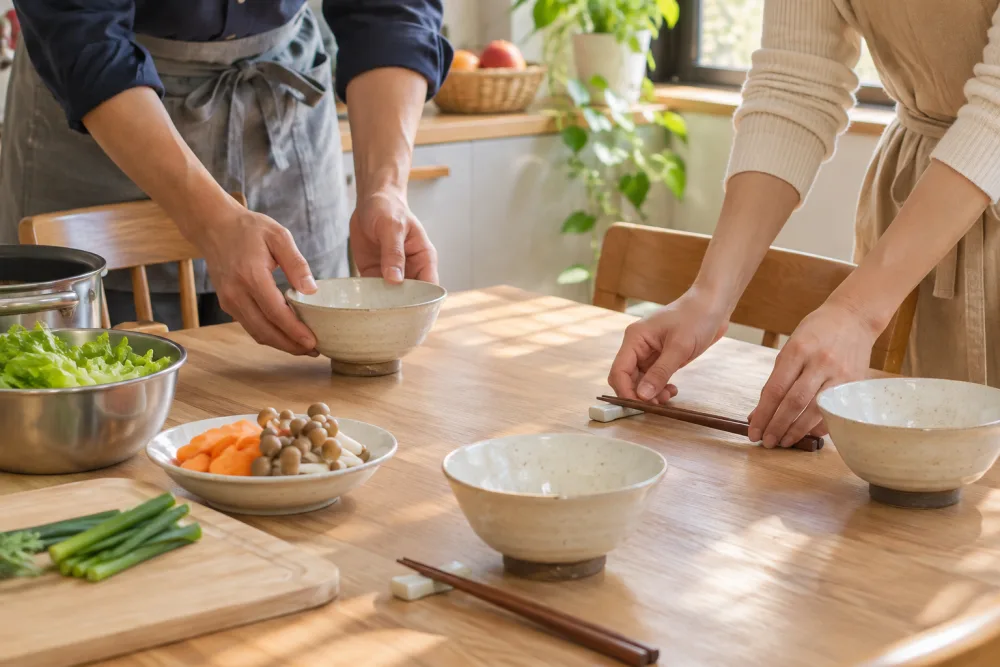
You're setting bowls on the table. Nobody has counted them yet. 足りなかったら、棚から出してください (たりなかったら、たなからだしてください) can mean “If there aren't enough, please take some out of the cupboard.” Start from 足りる (たりる), “be enough.” The plain negative is 足りない (たりない). Its past form is 足りなかった (たりなかった), and the conditional is 足りなかったら. The sentence leaves the count open. It gives someone a plan to follow if there is a shortage.
Compare 足りなかった, “There weren't enough,” with 足りなかったら, “If there aren't enough.” The difference is a small sound at the end of the first clause. In a noisy room, that distinction has an effect: the first could report a shortage that someone already found, while the second tells the listener what to do if one turns up. Put two sample cards on a table. One says “We counted six bowls and need eight.” The other says “We haven't counted yet.” In which scene would a report fit? In which would a conditional instruction help?
Switch the type of response without changing the condition. 足りなかったら、教えてください (たりなかったら、おしえてください) asks the person to let you know if there are too few. That's different from asking them to fetch more. This exercise trains you to retain the first clause accurately while listening for the intended follow-up. In a real kitchen, a correct interpretation of the shortage won't help much if you carry out the wrong instruction.
Review the forms separately with KanaWay
If you meet a relevant verb in a KanaWay review session on Android, pause and say its ta-form aloud before resuming the review. Add ら yourself. You can do the same with a verb on paper if the one you want doesn't come up in your session. Use different verbs: 終わる → 終わったら (おわる → おわったら), “when it ends”; 届く → 届いたら (とどく → とどいたら), “when it arrives”; 足りない → 足りなかったら, “if there isn't enough.” Notice which step causes trouble. You may know the dictionary form but hesitate when the sound changes.
Then put the device away and choose two of those conditions. For each one, invent two different follow-up clauses. In one version, ask someone to tell you. In the other, say what you will do yourself. A session that helps you recall a word does not establish that your instruction makes sense in this particular room or that the other person understood who is supposed to act. Ask a partner to say the trigger and the next action back to you separately. Learn Japanese Hub and KanaWay share a publisher. The two-clause exercise is an activity alongside the app.
The Japanese practice guide offers more ways to rehearse a request out loud.
Say what you would do next
**1. A call from the kitchen.** The rice is cooking. You want the cook to tell you when it's done. Build the first clause using 炊ける. The correct trigger is ご飯が炊けたら. Follow it with 呼んでください. If you said ご飯が炊けた as a separate sentence, you would be reporting that the rice was done. If you left out the first clause, the request would no longer specify what the cook should wait for.
**2. A bowl count that isn't settled.** You need eight bowls and you're about to check the table. Ask someone to fetch more from the cupboard if there aren't enough. 足りなかったら、棚から出してください fits the request. Ask your partner to play two outcomes. In one, the count is seven. In the other, it's eight. The instruction applies in the first outcome. You don't need to fetch a ninth bowl in the second simply because the speaker mentioned the cupboard.
**3. Time for tea.** Some people have to leave soon. Suggest tea only if there is time. 時間があったら、お茶をいれましょう works. If the group is already late, they'll probably skip it. If they finish early, the suggestion becomes practical. Say both follow-up outcomes out loud in English. Then repeat the Japanese sentence and check that it leaves room for each one.
Take the pattern outside the kitchen
A package is expected later. You are going out and want a message when it arrives. 荷物が届いたら、連絡してください (にもつがとどいたら、れんらくしてください) asks the other person to contact you at that point. Now change the delivery from expected to doubtful. You might translate the same conditional as “if it arrives.” You can keep the original request, adjust the English interpretation, and add a separate sentence to explain the uncertainty. A good reading tells you what action depends on what event before it tries to choose the best English conjunction.
Questions about the method
Does たら always mean “after”?
“After” can fit a sequence like the rice example. It can sound too certain if the speaker is describing something that might never happen. Work out how the speaker treats the first event.
Is the verb before ら a report about the past?
The form resembles an ordinary past form. In these instructions, the whole conditional clause identifies a future trigger.
Does the same person have to act in both clauses?
No. The rice becoming ready and the cook calling you show that the subject of the first event and the person acting next can differ. Identify both from the scene.