
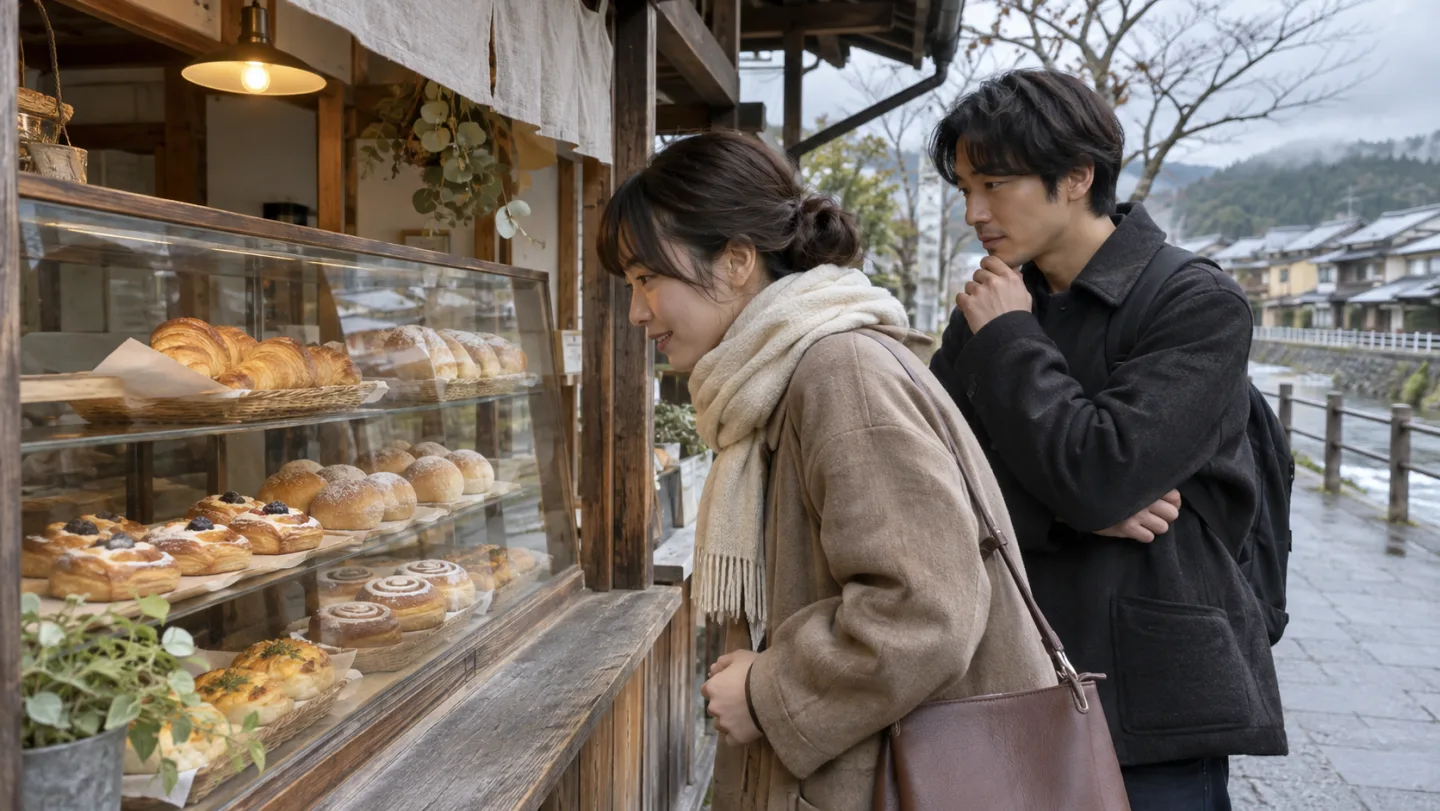
A pastry looks good through the glass. You can say おいしそうです (おいしそうです), “It looks delicious.” Later, you can pass on what a friend told you by saying おいしいそうです (おいしいそうです), “I hear it's delicious.” That little い changes the structure. The first sentence presents your impression. The second passes on an assessment. Listen for what comes before **sou desu**, then check the conversation for where the information came from.
Sou desu with an impression from the counter
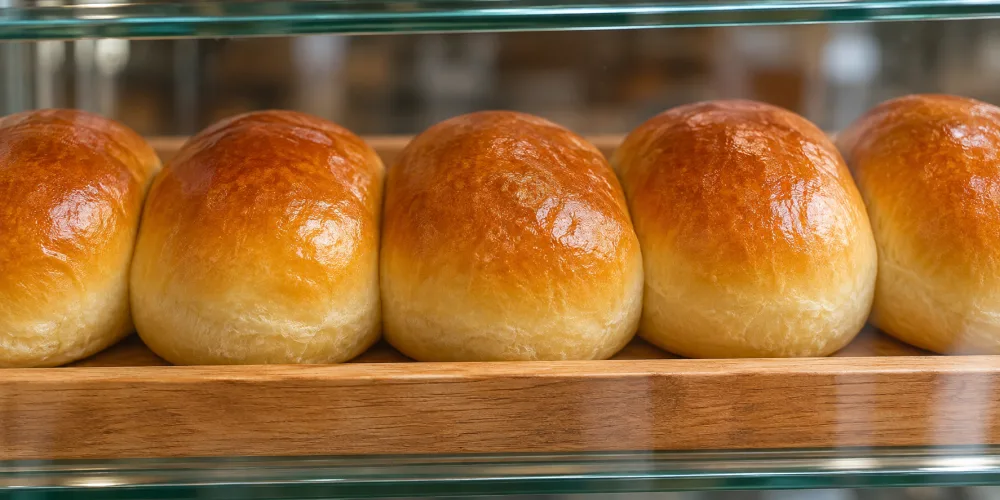
You have not tasted the bun. You can see that its surface is golden and that it has just been set on a tray. おいしそうです is an impression you are willing to share on that evidence. It doesn't make your taste buds the source of the statement. Put おいしい (delicious) next to おいしそう (looks delicious) on your page. The final い drops before the appearance ending. Say the pair in both orders and listen for what changes. Then look back at the scene. If the person hasn't tasted it, “It is delicious” reports more than they have actually said.
Suppose your friend says the pastry looks sweet. They may be reacting to its appearance even though the filling is hidden. You don't need to agree with that assessment. Ask which detail gave them that impression. For a reading exercise, underline the feature the speaker noticed, then put a circle around their impression. If the dialogue never gives the feature, leave it blank. It is enough to recognize that the speaker presents a judgment and does not identify someone else's statement as its source.
Keep the adjective whole when you relay what someone said
Now change only the source of the information. Your friend bought the same kind of pastry earlier. They told you it was delicious, and you are passing on their verdict to someone else. おいしいそうです keeps おいしい whole before the report ending. The assessment is presented as coming from elsewhere. You can make the source explicit with 友だちの話では (ともだちのはなしでは), “according to my friend.” This helps particularly when the other person has no way to tell whether you have tasted the pastry yourself.
Imagine that your friend likes sweet fillings and you prefer something less sweet. You can accurately relay their opinion even if you suspect you will disagree. The report doesn't require you to adopt their taste. To practise, write one line in your notes for what your friend said and another for what you can independently confirm. A paraphrase like “My friend enjoyed it” can be faithful to the context. “I tasted it and loved it” is a different claim.
The Irodori lesson on impressions illustrates the appearance pattern with food. Use the Japanese grammar guide to review the forms used before each ending.

Listen for the difference before a verb, too
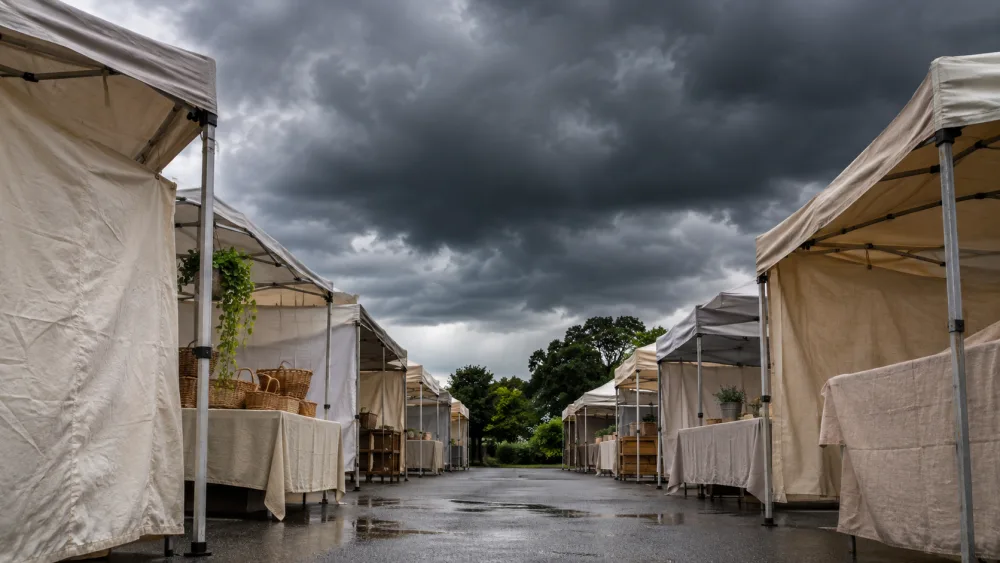
Look outside the market canopy. Dark clouds are gathering. 雨が降りそうです (あめがふりそうです) means “It looks like it's going to rain.” The part before そう is 降り, the form you see before ます in 降ります. You are making a judgment based on the conditions around you. In a different conversation, you may be passing on the forecast. 雨が降るそうです (あめがふるそうです) means “I hear it's going to rain.” This time the report ending follows the plain form 降る.
Check both the form and the context. If a person sees the clouds and says 降りそう, the sky makes their reaction understandable. If the person just heard a forecast and says 降るそう, they are relaying the forecast. The presence of clouds does not prevent someone from quoting a forecast, and a forecast does not prevent you from also looking at the sky. When both sources are available, listen to which one the speaker invokes. To write a clear exercise, give the listener enough context to decide.
The Irodori reporting lesson explains the plain-form connection.
Try the Japanese listening guide for practice identifying a form before interpreting the whole sentence.
Ask which person has which piece of evidence
Picture three people at the stall. One is looking at the tray, one tasted a bun yesterday, and one is passing on a message from the person who tasted it. Give each person a separate card. Only the taster can say, on the strength of their own experience, that yesterday's bun tasted good. The person looking at the tray can share an impression. The messenger can relay the taster's assessment. In a real conversation, any of these people may also have other information. In this exercise, keep their evidence separate so the reason for choosing each form is clear.
Try making your own pair of cards. On the first, write “I see the food but haven't eaten it.” On the second, write “My friend told me it tastes good.” Read a card and say the Japanese sentence that fits. Then hand the cards to someone else and have them listen to your two sentences. Ask which card matches each one. If they can match the cards only after you translate the sentences, slow down and repeat the adjective up to the そう ending. Pay attention to the extra vowel in おいしいそう.
The Irodori grammar notes from the Japan Foundation teach appearance and reporting in separate lessons. The food lesson uses appearance to comment before tasting. The reporting lesson explains how a plain clause can pass on something learned through hearing or reading. Treat the two lessons as a pair for this drill. You can understand the reporting form without memorizing every possible noun or adjective connection. Our examples deliberately use an adjective ending in い and a verb so you can hear what changes in each pair.
Work through three exchanges
**1. The tray has just arrived.** You see fresh buns through the glass. You haven't tried one and nobody has told you how they taste. Say that they look delicious. おいしそうです fits. If you say おいしいそうです, a listener may wonder who told you. Point to the visible tray as you repeat the sentence. Then explain why looking at it is enough to support an impression, even though it isn't enough to confirm the taste.
**2. A friend's message.** Someone sends you a message saying the buns are delicious. You haven't seen the tray yet. Pass on the assessment. おいしいそうです keeps the full adjective. If the listener asks whether you have tried one, answer separately. Don't let your English paraphrase slip from “I heard” into “I know from experience.” Now invent an assessment you don't share, and practise reporting it without changing it to your own opinion.
**3. A change in the weather.** You are standing under the canopy and looking at dark clouds. In a second scene, you are indoors and passing on what the forecast says. Make a sentence about rain for each scene. 雨が降りそうです fits the first. 雨が降るそうです fits the second. The weather outcome may be the same. What differs is the basis on which the speaker says it. To check, add a question after each line that a listener could reasonably ask. In the second exchange, “Where did you hear that?” is an obvious follow-up.
Use the contrast beyond the market
You and a friend are waiting for a package. They read a message saying it will arrive by noon. 正午までに届くそうです (しょうごまでにとどくそうです), “I hear it will arrive by noon,” can relay the message. In a separate scene, you watch someone carrying a parcel toward your door. 届きそうです (とどきそうです), “It looks like it's about to arrive,” can express an impression. You don't know from the carrier's direction alone whether the parcel is yours. If you need to distinguish an observation from a prediction, add the detail you can see before giving your assessment.
For a final exercise, ask a partner to make up a scene and choose the source privately. They say one of the two Japanese forms, and you name the kind of evidence the form presents. Then ask for the specific evidence. Your first answer can be as short as “an impression” or “a report.” The follow-up distinguishes the type of information from its details. Even if you identified “a report” correctly, you still need to hear who said it or where it was written.
Questions about the method
Is the report necessarily true?
The construction presents information as coming from elsewhere. Its accuracy depends on the source. The listener may still ask how reliable it is.
Does an impression have to come from looking?
These examples use sight because it makes the contrast easy to stage. The speaker may also judge from other available signs. In a controlled example, identify the evidence named in the scene before generalizing.
Why isn't そうです by itself enough to decide?
Both constructions can have that sequence at the end. Listen to the preceding form and consider what the speaker is doing in the exchange. An isolated そうです can also mean “That's right” in a different context.