
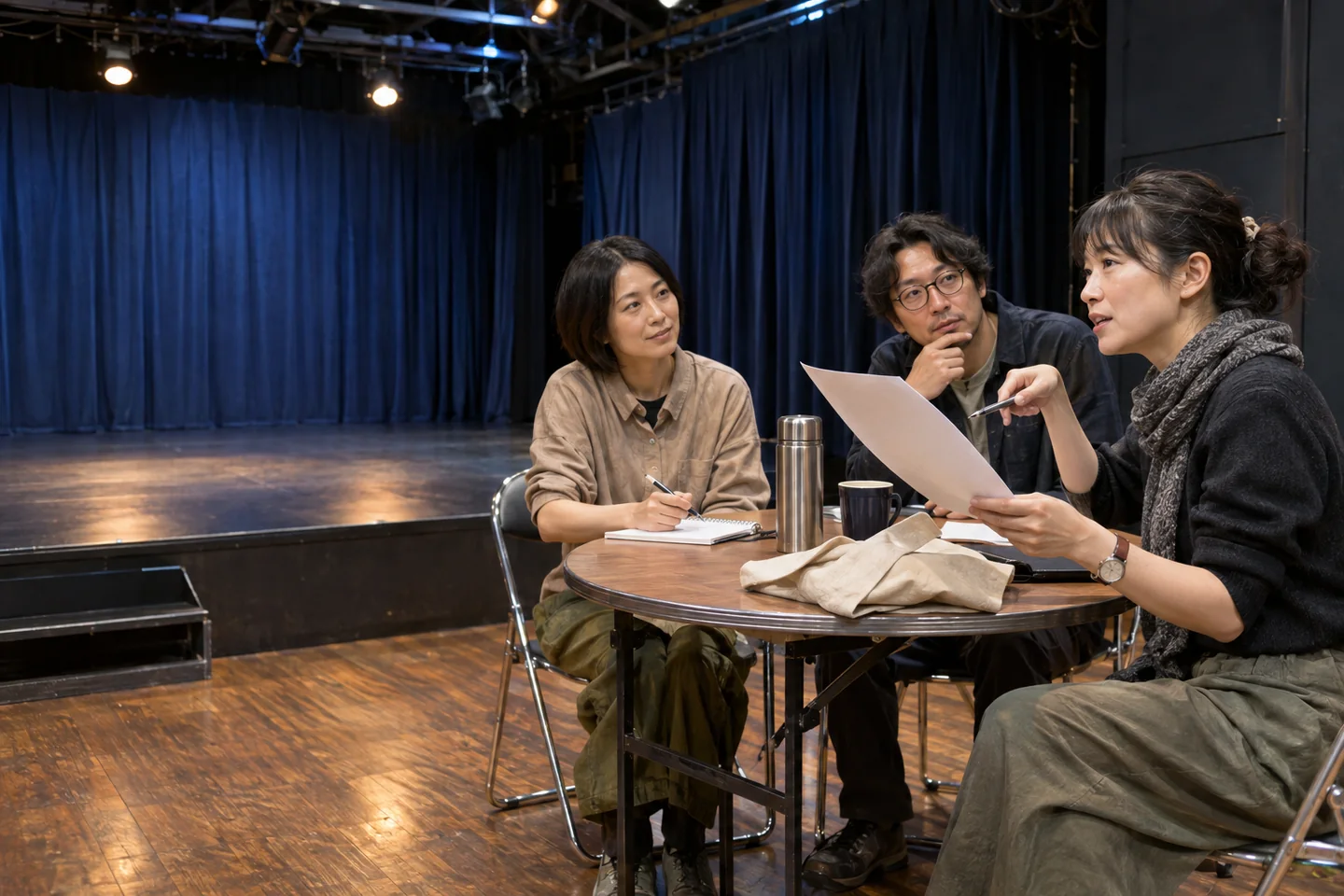
Koto ni suru tells a listener that somebody has settled on a course of action. Imagine the volunteers at a small theatre deciding how to rehearse. One person chooses to sit in the front row to listen. Later she tells her friend that rehearsals will start thirty minutes earlier. There is a decision in both scenes, but the second line reports the arrangement she is now working with. Japanese offers a choice about which part of the story to put forward.
This guide uses the same action in both constructions so you can hear the change in perspective. You will practise ことにする and ことになる with decisions, agreed arrangements and negative choices. A familiar word from a regular KanaWay review can give you a new action to try. You can do the same exercise using the examples on this page.
Koto ni suru puts the choice in view
私は前の席に座ることにしました(わたしはまえのせきにすわることにしました, watashi wa mae no seki ni suwaru koto ni shimashita)means “I decided to sit in a seat near the front.” Perhaps you tried the sound from several places and settled on a seat. The sentence tells us the result of that choice, but it does not tell us what you are doing at the moment. You can say it while still standing with the other volunteers.
For a shared decision, you could say 練習は六時に始めることにしました(れんしゅうはろくじにはじめることにしました, renshū wa roku-ji ni hajimeru koto ni shimashita), “We’ve decided to start rehearsal at six.” The subject is readily omitted when the group is obvious. If you are talking about a decision another person made, it also works to name that person. この劇団は金曜日に集まることにしました describes what this theatre group decided. The construction works well for a choice by another person or a group. The distinction is about how the choice is presented.
With a friend you can say 前の席に座ることにした. The past ending した tells us the decision has been made. A first-person ことにする can be used as you settle on an action: じゃあ、前の席に座ることにする, “Okay then, I’ll sit near the front.” In conversation, the time when you speak and the time of the action may be quite different. The guide to expressing an intention with tsumori covers another way to talk about a future action.

Koto ni naru reports what has been arranged
When the group has been assigned a different slot, a volunteer can say 練習は六時に始めることになりました(れんしゅうはろくじにはじめることになりました, renshū wa roku-ji ni hajimeru koto ni narimashita). In conversation this might come out as “Rehearsal is going to start at six” or “It’s been arranged for us to start at six.” The person could have taken part in the discussion. The wording now lets them pass on what is settled so the listener can plan.
To see the difference without changing the facts, imagine one committee meeting. Inside the room, a volunteer reporting the committee’s choice to a colleague says 六時に始めることにしました. Outside the room, while informing someone about their new timetable, the same volunteer says 六時に始めることになりました. Neither wording identifies the person who proposed six o’clock, and the second does not require anybody to have imposed the schedule. If the detail matters, add it in a separate line.
The default reading becomes easier if you picture the response. A listener who hears about the group’s choice might ask どうして六時にしたんですか, “Why did you choose six?” Somebody who hears the arrangement might instead say 六時ですね, “Six, got it.” Learners often wonder which English verb to attach to ことになる. Work from the news being shared before you select a translation. The Heidelberg University grammar notes detail how the two expressions enter decisions and arrangements.
Keep the action in its plain nonpast form
Take an action such as 持っていく(もっていく, motte iku, take along)and keep it before こと. 台本を持っていくことにしました(だいほんをもっていくことにしました, daihon o motte iku koto ni shimashita)means “I decided to take the script.” Even if you made the choice yesterday, you still use 持っていく for the action you decided on. The ending しました marks the past decision. Holding these jobs apart makes it easier to handle a sentence with two separate times.
To say you decided against doing something, use the plain negative before こと. 今日はマイクを使わないことにしました(きょうはマイクをつかわないことにしました, kyō wa maiku o tsukawanai koto ni shimashita)means “We decided not to use a microphone today.” Here 使わない is what the group chose. A line with the negation at the end would have a different job. It could deny that a decision was made at all, depending on the wider sentence.
Now change only the last part: 今日はマイクを使わないことになりました. This tells a listener that the plan for today is to work without a microphone. Try saying that as a rehearsal announcement. Another person can reply じゃあ、もう少し大きい声で話します, “Then I’ll speak a little louder.” If you already have a basic handle on the verb なる, the guide to describing changes with naru gives you a way to compare this construction with simpler sentences about change.

Say when a decision happened and when it applies
Consider 昨日、来週から七時に集まることにしました(きのう、らいしゅうからしちじにあつまることにしました, kinō, raishū kara shichi-ji ni atsumaru koto ni shimashita). The group made the decision yesterday. Starting next week, they will meet at seven. The new schedule is in the future, so the sentence still says 集まる before こと. Look for the two time expressions and decide which event each one qualifies.
Try the same message without 昨日. It still naturally means the decision has been made, but the listener cannot tell when. Put 昨日 back, then remove 来週から. Now you know when the decision was made but need context to know when the schedule begins. Neither construction keeps track of these two times by itself. Add enough detail to help the person who has to show up.
A third possibility is provisional: maybe the volunteers are considering seven o’clock and have still to confirm with the venue. ことにしました is a poor fit if you are describing that as an undecided option. Practice answering an ordinary question such as “Have you decided?” in three ways: yes with the chosen time, yes with an arrangement reported, and no with the timing still open. Listening for which of those happened is more useful than treating every future statement as a decision.
Take one action from your usual KanaWay review
Open KanaWay’s vocabulary review and work through the items that are available to you. The site describes spaced review of earlier material. If a familiar verb suggests an action you could either choose or hear announced, use that verb away from the app. A correct vocabulary answer just confirms the item you practised. Establish which ending fits the decision and check the whole sentence with the examples here or a partner.
For example, take 待つ(まつ, matsu, wait)from this page if no suitable review item appears. You decide to wait at the entrance because you will be meeting a friend: 入口で待つことにしました(いりぐちでまつことにしました, iriguchi de matsu koto ni shimashita). Next imagine that your group has agreed where to wait, and you tell an absent friend: 入口で待つことになりました. In both lines the verb remains 待つ. Give each line one extra sentence that makes its perspective plausible.
Rotate the roles. Your partner makes a choice in the first line. You give the announcement in the second. Then pick a negative choice and check that ない appears before こと rather than after it. You can do the whole round with 待つ, 座る and 使う. If the next review session supplies a different familiar verb, use it to try the same contrast in a different setting.
Test how much the listener can recover
Tell someone the group has arranged to rehearse on Friday. Ask them for a paraphrase. If they think that you alone picked Friday, add who agreed to it or give a little more context. Then have them tell someone that they themselves decided to bring an extra copy of the script. Here the choice is the news. When the same person tells a third volunteer that everyone should bring a copy under the new arrangement, the emphasis moves to what has been settled.
You can also try a line from life outside the theatre. Think of a meal, visit or lesson on your calendar. Say when it was decided, what was decided and who needs to know. Make two versions with the same action. Read one of them out without explaining the backstory. If a partner cannot tell who had the final say, ask whether they actually needed that information. Add it only if it would change what they do.

Questions about the method
Can I use koto ni naru for a choice I helped make?
Yes. You might describe a shared decision as an arrangement that others can now act on. ことになりました can leave open who proposed it, who approved it and whether you personally wanted it.
Which part do I change for a negative choice?
Put the plain negative before こと, as in 使わないことにしました, “we decided not to use it.” The last part still tells the listener that a choice has been made.
Is koto ni suru the same as having an intention?
In this use, ことにする presents a choice as settled or being made. An expression of intention may simply tell someone what you plan to do. In some situations the same action could be described either way, depending on what you want to put in view.