
Naru in Japanese is useful when you notice a change but accidentally describe only the final situation. “The workshop is quiet” and “the workshop has become quiet” are both useful, but they answer different questions. The first describes a condition. The second tells your listener that something was different before. Learning the ending without choosing the intended message makes these sentences easy to confuse.
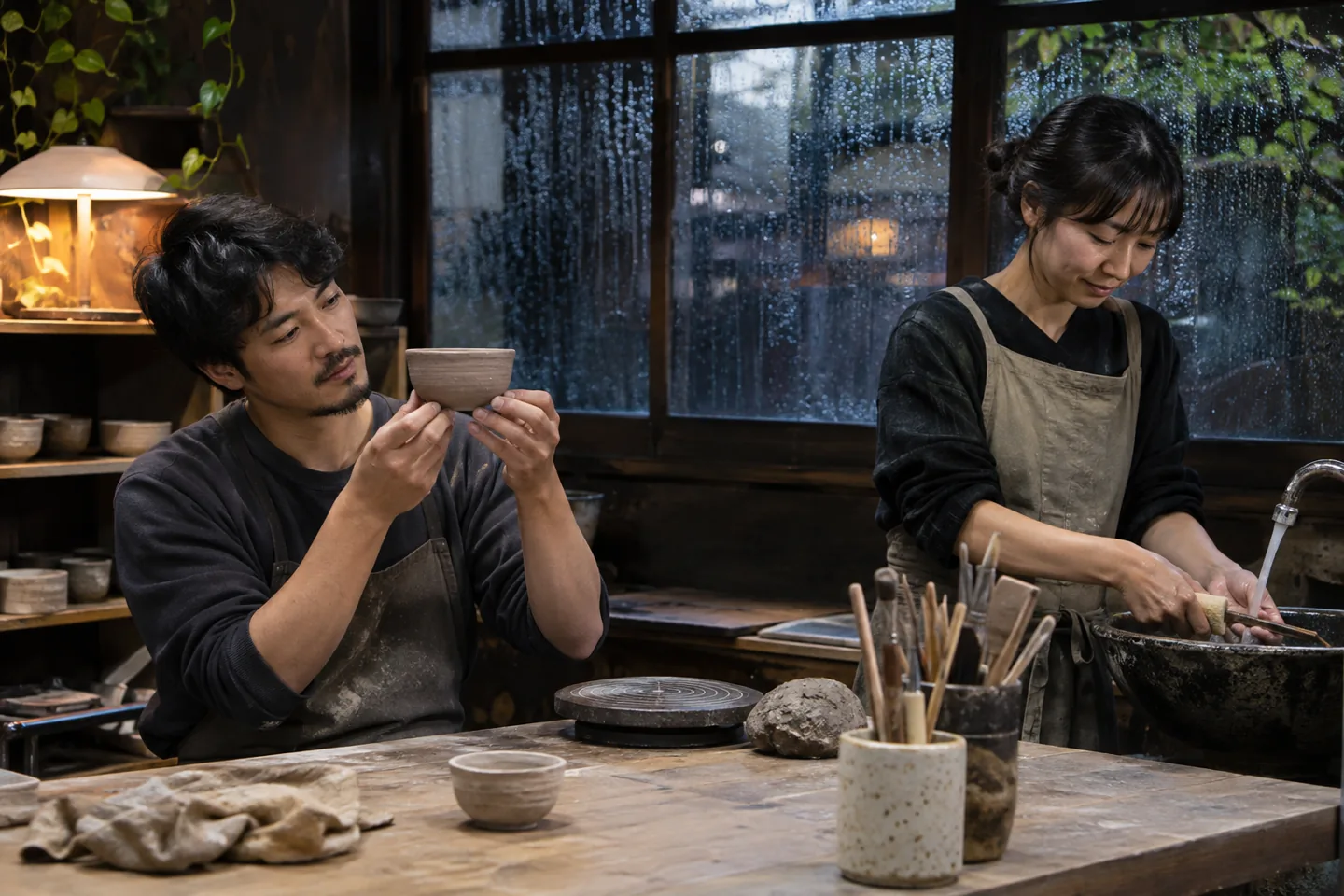
Imagine an evening pottery class. The water gets cold, the room becomes quiet and a learner's second attempt feels easier. This fictional setting gives you observable changes instead of vague promises about improvement. You will build sentences from the resulting state, check the connection before なる, and use a short exercise alongside KanaWay vocabulary review. You can also do the entire sentence task on paper. The aim is a clear account of a change, not a score, a fixed learning deadline or a claim that an application understands your handmade examples.
Naru in Japanese starts with the resulting state
Start with two questions: what are we talking about, and what is it like now? For the studio water, the resulting state is cold: 冷たい(つめたい, tsumetai). 水が冷たいです(みずがつめたいです, mizu ga tsumetai desu)means “The water is cold.” That statement does not by itself say whether it was warm earlier. You can say it when you first arrive and have no information about the previous temperature.
Now imagine you checked the same water at the beginning and again later. 水が冷たくなりました(みずがつめたくなりました, mizu ga tsumetaku narimashita)means “The water became cold” or, naturally in this situation, “The water has got cold.” The ending introduces a change. You are reporting the water's resulting condition without needing to identify the exact physical cause. The English tense choice depends on the surrounding conversation; it is not a separate Japanese conjugation rule.
Keep the earlier situation in your practice notes, even when you do not say it aloud. Write “same water, earlier not cold, now cold” before making the sentence. If you only know “now cold,” choose the simple description unless the context supports a change. This small evidence check stops you using なる merely to make a sentence longer. It also makes partner practice easier: your listener can ask what changed rather than guessing what you intended.

Build the connection before you conjugate
With an i-adjective, replace the final い with く before adding なる. 冷たい becomes 冷たくなる, “become cold.” 難しい(むずかしい, muzukashii)becomes 難しくなる, “become difficult.” The connecting form stays the same when you choose a polite past ending: 難しくなりました. Do not put the adjective's polite です before the verb. You are building one predicate, not attaching another verb to an already finished sentence.
With a na-adjective, use に: 静かになる(しずかになる, shizuka ni naru), “become quiet.” 静かな is the shape used before a noun, as in 静かな部屋, a quiet room. It is not the connection you need before なる. For a noun, に also marks the resulting category or role: 来年、先生になります(らいねん、せんせいになります, rainen, sensei ni narimasu), “I will become a teacher next year.” That is a future role in a fictional example, not a claim about your own plans.
Notice two common traps. きれい is a na-adjective despite its final sound, so the useful pattern is きれいになる. The adjective いい uses よく in this construction: よくなる, “become better.” Classify the word before changing its ending; the last written character alone is not a reliable classifier. The St. Olaf Japanese teaching note provides a compact reference. Use our grammar guide when you need to reconnect the pattern with adjective types.
Follow one change through the pottery class
At the start of the fictional lesson, people are talking while they prepare their tools. Later, everyone concentrates on a bowl. 教室が静かになりました(きょうしつがしずかになりました, kyōshitsu ga shizuka ni narimashita)reports “The classroom became quiet.” It describes a changed atmosphere. 教室は静かです simply says that the classroom is quiet. Neither is more advanced or inherently better; the appropriate choice depends on which information your listener needs.
For another example, imagine the workbench was crowded and is now tidy. 作業台がきれいになりました(さぎょうだいがきれいになりました, sagyōdai ga kirei ni narimashita)means “The workbench became clean/tidy.” In this setting, explain which sense of きれい you intend. The word can also describe beauty. A translation should follow the situation rather than mechanically choosing the first dictionary equivalent. You are comparing conditions, not praising a person or evaluating artistic quality.
Make three brief notes: subject, earlier condition, resulting condition. Then cover the last note and ask a partner what happened. They can answer “water became cold,” “room became quiet,” or “bench became tidy.” Reject a beautifully pronounced answer if it names the wrong subject or state. Conversely, keep a semantically correct answer and repair its ending separately. Meaning and form are two useful checks; combining them into one vague judgment makes the next attempt harder to improve.
Report a change without claiming its cause
なる focuses on reaching a state. It does not automatically mean that no person helped the change happen. Someone may have cleaned the bench, but 作業台がきれいになりました still reports the resulting change. If your message is about a person's deliberate action, a different construction can put that action in focus: 作業台をきれいにしました(さぎょうだいをきれいにしました), “I/someone made the workbench clean.” The omitted person must be supplied by context; Japanese has not secretly specified “I.”
This contrast matters more than translating なる as “naturally” every time. In the first sentence, the bench is what becomes tidy. In the second, someone acts on the bench. Notice the corresponding が and を in these examples. Do not swap the verb while leaving the rest of the sentence unchecked. The intended viewpoint helps you decide what should be the subject and whether an object is involved.
Keep the practice limited to adjectives and nouns for now. An ordinary verb cannot simply be inserted into the same adjective slot. Expressions about becoming able to do something require their own structure, and なくなる has uses that deserve separate attention. Recognizing a boundary is progress: write the unfamiliar example down for later rather than manufacturing a form from a rule designed for another word class. This lesson does not promise to cover every expression containing なる.
Use a review word as a starting point
If a familiar adjective appears while you review vocabulary in KanaWay on Android, pause and make a state card for it. Suppose the word is 静か. Write “quiet now” on one side and “became quiet after the class settled down” on the other. Say the appropriate Japanese sentence for the side a partner chooses. If no suitable word appears, take 冷たい or きれい from this article and continue on paper. No particular review item or lesson sequence is required.
This is a learner-directed activity beside the app. It does not mean KanaWay automatically supplies these cards, generates the pottery dialogue or grades the difference between a state and a change. Learn Japanese Hub and KanaWay share a publisher. Vocabulary recognition is a useful starting point, but it does not establish whether your new sentence communicates the change you intended. Your written context and your partner's interpretation provide the separate check.
After a review, choose only one word to carry into a conversation. Ask the listener to explain whether they heard a current condition, a completed change or a future change. Then reveal the card. If the interpretation differs, first inspect your context and ending. For additional sentence-building ideas, use the practice guide. Keep your own examples small enough to check; adding several unfamiliar verbs does not make the exercise more informative.

Test the message, then repair the form
Try three prompts before reading the answers. First: the same studio water was warmer earlier, and is cold now; report the change politely. Second: you have just entered a quiet room and know nothing about its earlier noise; describe what you observe. Third: the bench was messy and is tidy after cleanup; report its changed state without naming the cleaner. Say each answer before writing it so that the connection is not hidden inside a copied model.
Suitable answers are 水が冷たくなりました, 部屋は静かです, and 作業台がきれいになりました. In the second answer, なる would introduce a change that the prompt did not establish. In the third, きれくなりました is not the pattern for きれい. Compare your intended message first, the adjective class second and the ending third. A different sensible topic marker may be possible in a fuller conversation; these short prompts deliberately keep the surrounding context narrow.
Finish with one transfer task: choose a real change you can reasonably observe, such as water cooling or a room becoming quieter. Write the earlier and later conditions privately, make a sentence, and ask someone to identify the change. If you cannot establish an earlier condition, describe the present state instead. Keep the resulting example for your next review and change the subject, not every part of the grammar, on the following attempt.
Questions about the method
Does naru always mean a natural change?
No. It presents a change in state without necessarily putting an agent in focus. Human action may have contributed. In the bench example, someone can clean it and you can still report that it became tidy. Choose a construction with する when your intended message emphasizes making something a certain way. This is a difference of viewpoint, not a guarantee about the absence or presence of human involvement.
Why is kirei ni naru correct?
きれい behaves as a na-adjective in this construction. Its final い does not make it an i-adjective. Use きれいになる, with に before the verb. Learn the word together with an ordinary example such as きれいな部屋, then contrast that noun phrase with the change predicate. The contrast lets you check the connection without treating every word ending in the same sound as the same grammatical class.
Can I practice without the app?
Yes. The essential materials are a word, two clearly described conditions and a way to check the sentence's meaning. Paper cards and a partner are enough. KanaWay review can provide a familiar word when an appropriate item appears, but the exercise does not depend on a dedicated app feature. Neither a correct card answer nor a single successful conversation establishes lasting mastery; return to the same distinction in a different situation.