
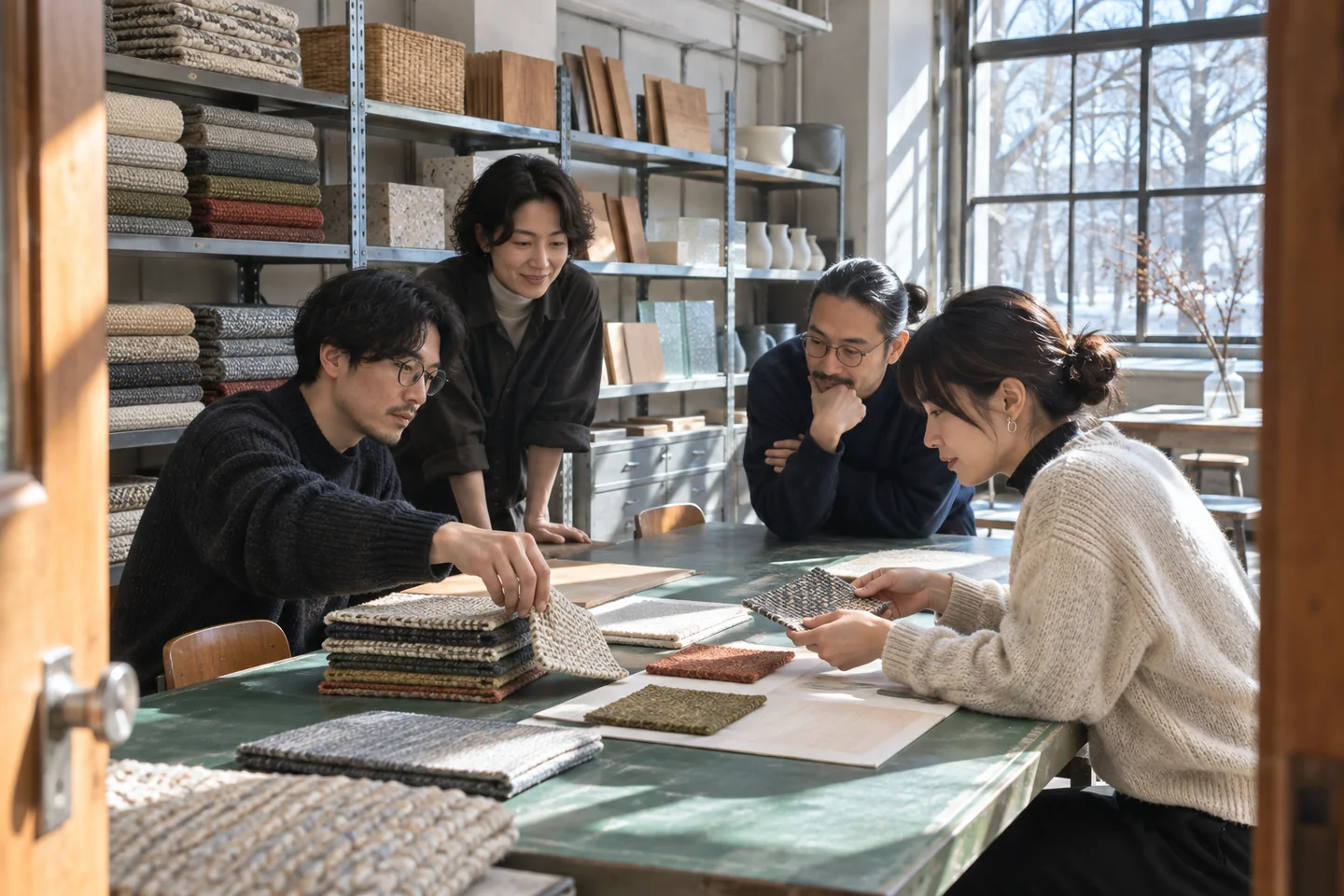
Zutsu in Japanese attaches to a quantity and tells you how that quantity is distributed or repeated. Imagine a textile workshop with three people and a stack of samples. If the organizer says 二枚ずつ(にまいずつ, ni-mai zutsu), each person might get two samples, or one person might work through the stack two samples at a time. The context tells you which division the speaker has in mind.
This lesson follows the samples from the worktable to the lending shelf. You can work through it with paper scraps or just draw the piles. By the end, you should be able to say what is being counted, what gets the same amount, and whether the sentence describes an actual total.
Zutsu in Japanese starts with a quantity
Put ずつ directly after a quantity such as 一枚(いちまい, ichi-mai, one flat item)or 二つ(ふたつ, futatsu, two things). In 見本を二枚ずつ配ります(みほんをにまいずつくばります, mihon o ni-mai zutsu kubarimasu), the thing being handed out is 見本, a sample, and the quantity is two flat items. 配ります means “hand out.” The ending ずつ signals that two is the amount for each recipient or group. If everyone can see the people waiting, the organizer can leave the recipients unspoken.
To make the recipients explicit, say 参加者に見本を二枚ずつ配ります(さんかしゃにみほんをにまいずつくばります, sankasha ni mihon o ni-mai zutsu kubarimasu), “I’ll give the participants two samples each.” In a situation where you need to rule out one shared pair for an entire group, you can make the unit explicit with 一人に二枚ずつ(ひとりににまいずつ, hitori ni ni-mai zutsu), “two per person.” This comes in handy when several people arrive together and are about to divide the materials themselves.
Draw three circles for participants. Put two short marks inside each circle. Which part of the drawing comes from 二枚ずつ? The two marks within one circle do. The number of circles comes from the situation or a separate phrase. Finally count all the marks. You can infer six from the picture, but you could not get that number from 二枚ずつ on its own. The University of Duisburg-Essen grammar notes also illustrate this use of ずつ with equal groups.
Choose the counter for what you hand out
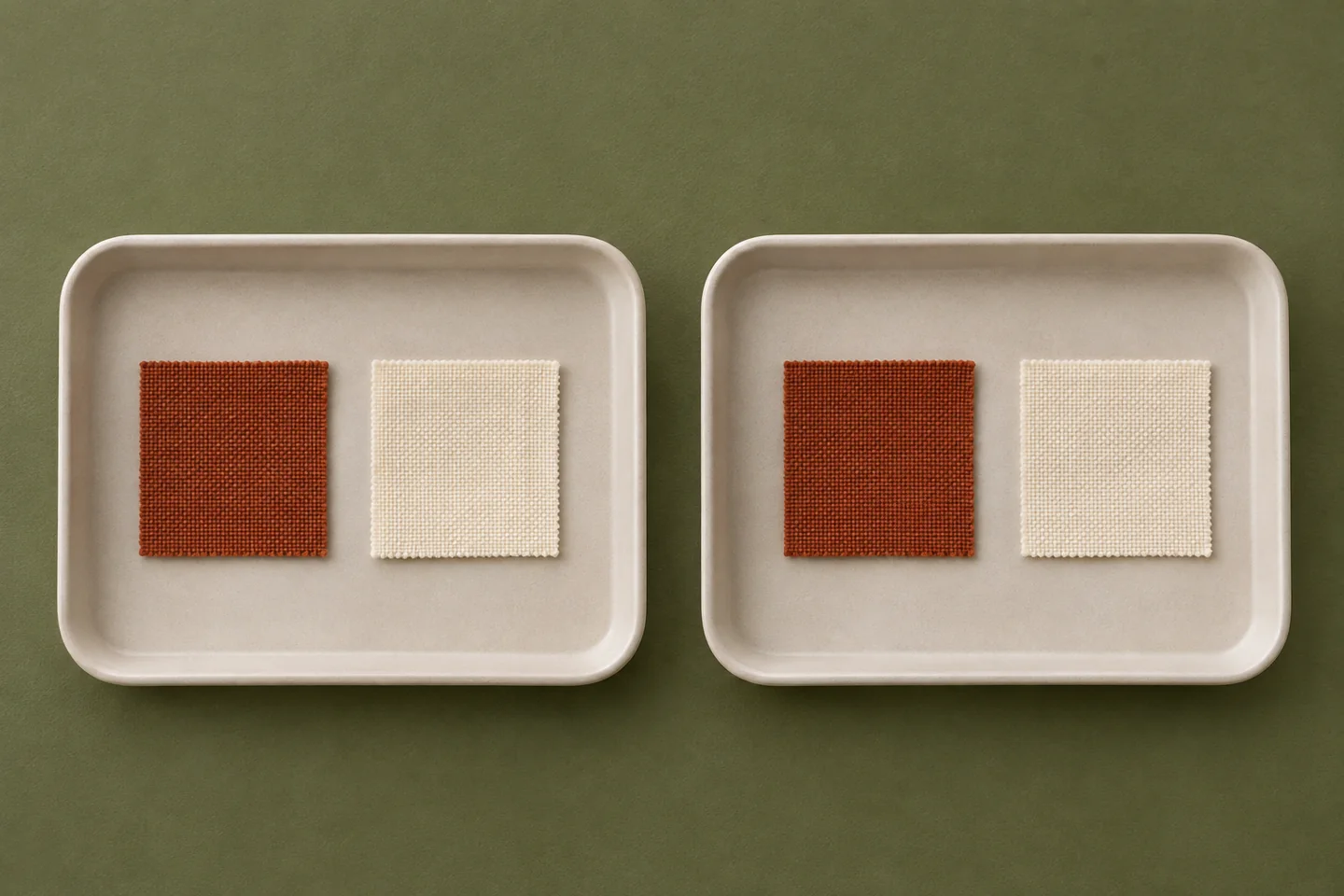
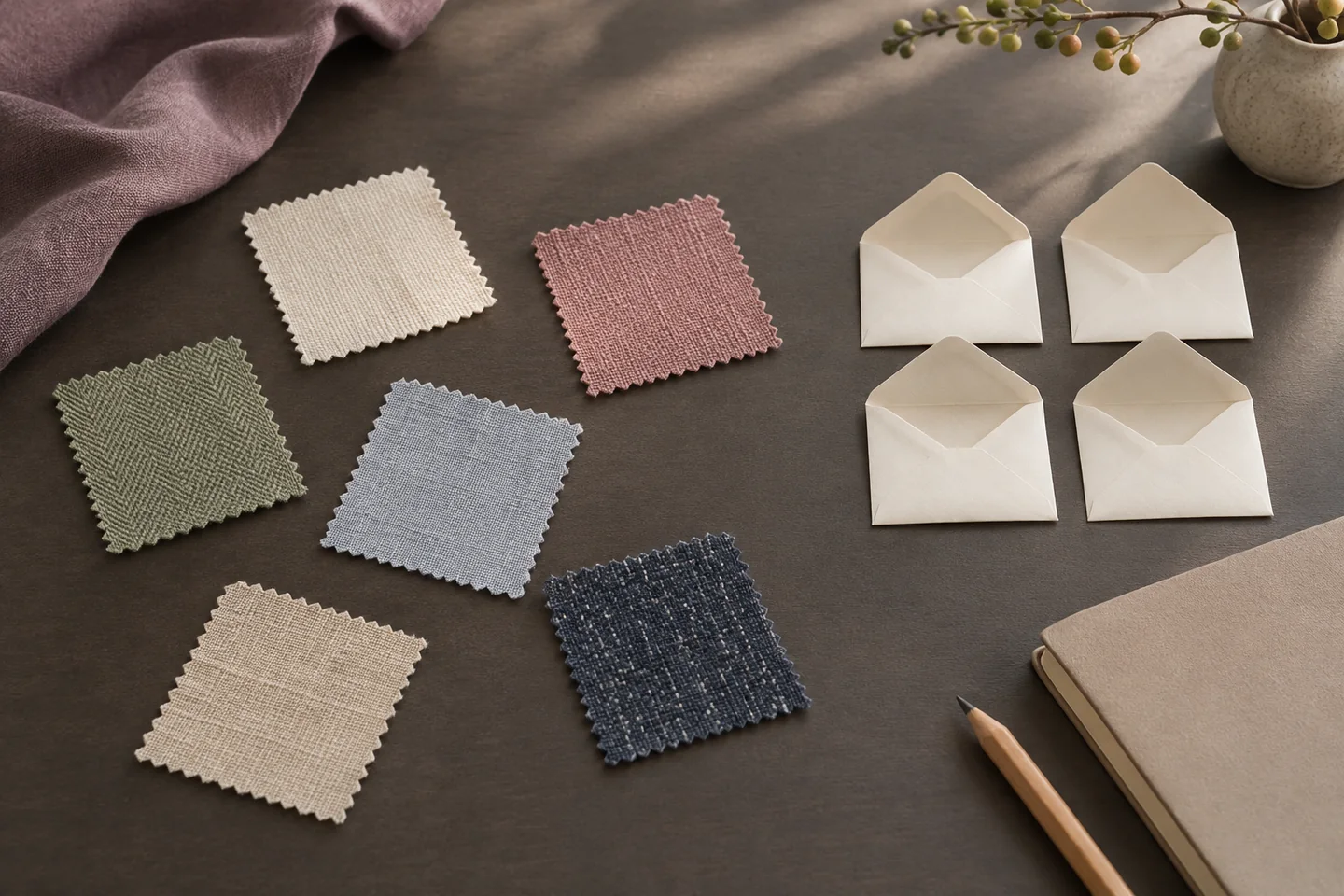
Keep the object and quantity together when you first practise. For thin cards or flat textile swatches, use 見本を二枚ずつ, “two flat samples each.” For labeled sample jars, you might use 容器を二個ずつ(ようきをにこずつ, yōki o ni-ko zutsu), “two containers each.” If you are talking about various things and the general count is natural, 二つずつ can work. The stuff being counted determines the counter, and ずつ follows that counter as a separate piece of meaning. The guide to counting flat objects with mai has more practice choosing that counter.
Watch out for 一人ずつ(ひとりずつ, hitori zutsu). In 一人ずつ入ってください(ひとりずつはいってください, hitori zutsu haitte kudasai), “Please come in one at a time,” the people themselves are being counted. In 一人に二枚ずつ, the person is the recipient and the items being counted are the samples. Locate the に, then read the second quantity. That gives you a quick way to tell the lines apart without memorizing two unrelated translations.
If a class is preparing materials for pairs, use グループに見本を二枚ずつ配ります to give two to each group. In a room where the groups and members might both be salient, you can go a step further with 一組に二枚ずつ(ひとくみににまいずつ, hitokumi ni ni-mai zutsu), “two per group.” Once the instructions are clear, later announcements can be shorter. Start practice with enough information to let a listener act on the instruction.
Look at the action to spot repeated batches
The same two samples might be packed together without being assigned to anybody. 見本を二枚ずつ袋に入れます(みほんをにまいずつふくろにいれます, mihon o ni-mai zutsu fukuro ni iremasu)can mean “I’ll put the samples into bags two at a time.” If you have just explained that each bag holds one set, “two per bag” is a natural rendering. The physical setup supplies information the Japanese wording can leave implicit, especially whether you take a fresh bag after each pair.
Now take two samples, compare them, and put them back before taking the next pair. 見本を二枚ずつ比べます(みほんをにまいずつくらべます, mihon o ni-mai zutsu kurabemasu)describes comparing the samples two at a time. The repeated action defines the groups. You do not need anyone to receive them or any containers to remain full afterward. To see the difference, say both lines while miming the actions. Your hands work with two items in either case, but only the packing line puts them in bags.
Sometimes speed or capacity is the reason for a fixed batch, but ずつ leaves that motivation open. You could compare pairs because you have space for only two pieces on the light table, or because you want to compare one dark sample with one light one. If that distinction matters, state it separately. Likewise, a shelf with many trays does not tell the listener how many you will finish today. Give a total or a time limit explicitly when you are coordinating work.
Recognize gradual progress with 少しずつ
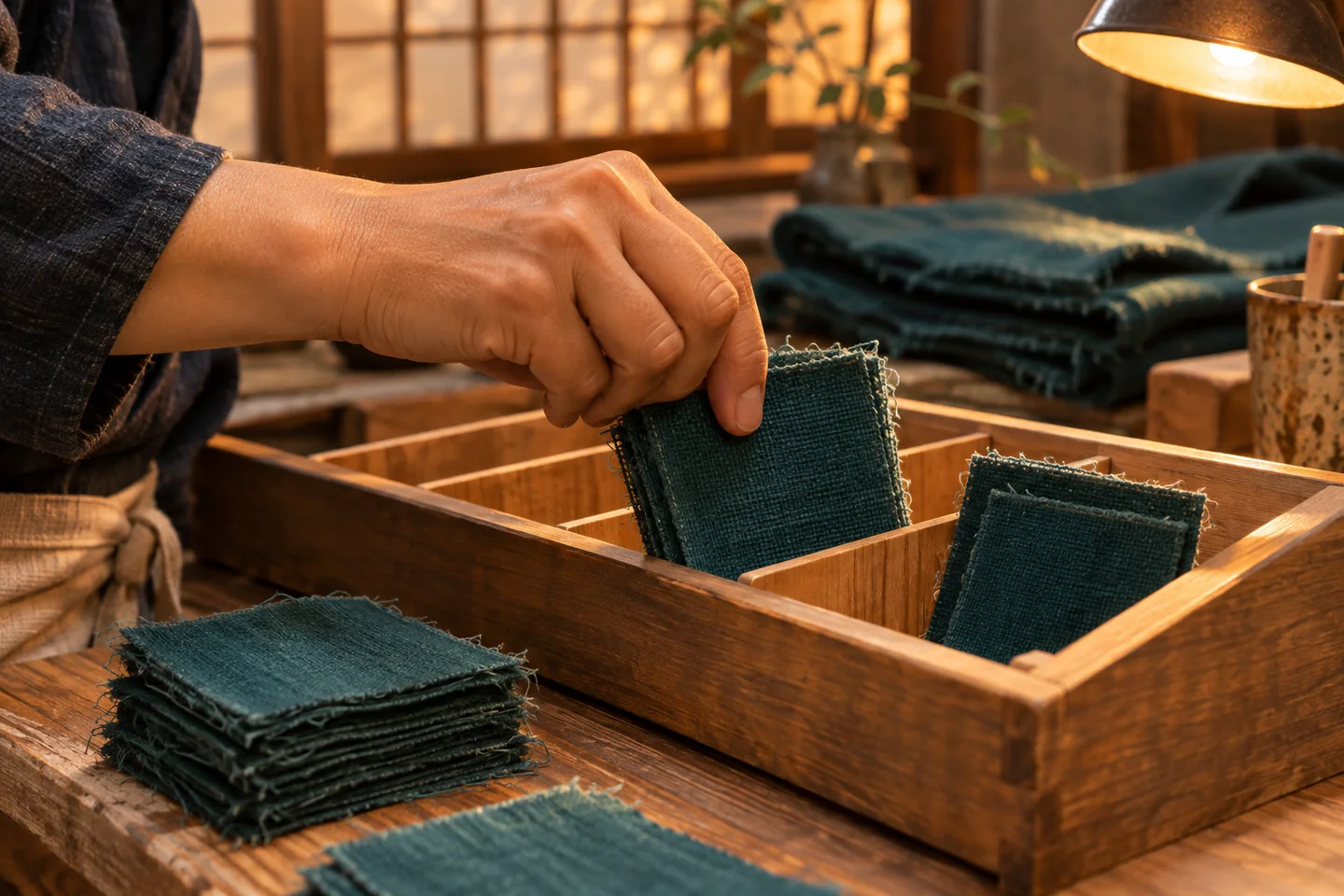
少しずつ(すこしずつ, sukoshi zutsu)means “little by little.” The chunk 少し gives a small amount without specifying a count. Imagine the samples are difficult to tell apart at first. 少しずつ布の違いが分かってきました(すこしずつぬののちがいがわかってきました, sukoshi zutsu nuno no chigai ga wakatte kimashita)can mean “Little by little, I’ve started noticing the differences between the fabrics.” Each time you work with the material, you pick up more details. There is no promise of a measurable or identical improvement after each session.
Compare 少し勉強します, “I’ll study a little,” with 少しずつ勉強します, “I’ll study a bit at a time.” The first could describe what you will do for a short while today. The second presents the activity as something you take in small portions. Compare both with 毎日五分ずつ勉強します(まいにちごふんずつべんきょうします, mainichi go-fun zutsu benkyō shimasu), “I’ll study five minutes each day.” Here 毎日 gives the repetition, 五分 specifies the amount of time and ずつ connects that amount to each occurrence. If the counters in minutes are unfamiliar, use the Japanese minutes guide before trying to vary the schedule.
When describing progress in your own study, decide whether you mean a practice schedule or a gradual change in ability. The five-minute line describes the plan. 少しずつ読めるようになりました(すこしずつよめるようになりました, sukoshi zutsu yomeru yō ni narimashita)describes gradually becoming able to read. You can put the two in the same conversation, but neither claim entails the other. A sentence about gradual progress can be true even if some days went by without practice.
Quick check before you leave the workshop
Cover the worked examples and look at any small objects on your table. Say a sentence with two items total, then make the same sentence describe two each. Add the number of people and work out the new total. Finally, keep the same number and change the action so you are examining them two at a time. Tell a listener where the items end up and check that both of you imagined the same process.
When you listen, you can hold the quantity in mind and wait for the verb. A line mentioning a number and ずつ won’t always tell you who gets what until a little later. Check who or what the sentence already mentioned, and ask a short question if the distribution is still unclear. In a real workshop, getting the right number of samples to each table matters more than finding the same English expression every time.
Questions about the method
Can zutsu come before the number?
In the pattern practised here, the amount precedes ずつ. Say 二枚ずつ or 少しずつ. If you want to start with the recipients, put them first and keep the amount together with ずつ, as in 参加者に二枚ずつ配ります.
Does 二枚ずつ tell me the total?
It tells you two per unit. You'll need to know how many units there are to work out a total. The unit might be a participant, a bag or one round of checking, depending on what the conversation is about.
Can 少しずつ describe a change without a person doing anything?
Yes. 少しずつ暗くなってきました(すこしずつくらくなってきました, sukoshi zutsu kuraku natte kimashita)can describe it gradually getting dark. A gradual result can be something you observe as well as something you deliberately work toward.