

The Japanese counter mai is useful when you count individual sheets, cards or tickets, but first you need to decide what counts as one item. Three loose sheets and a single notebook are not the same counting task. A stack can hide its contents; a packet can contain an unknown number. The first decision is the unit, not the pronunciation of the numeral.
This guide gives you a small paper-and-card task that works without an app. You will read quantities from one to ten, build two short grammatical patterns and solve six original exercises. We keep the objects familiar so that you can tell a counting mistake from a reading mistake. The photographs show specific arrangements for practice; they are not instructions to infer unseen quantities from a real packet.
Choose the unit for the Japanese counter mai
枚 is read まい, mai, when used as this counter. It commonly counts individual thin, flat items, including sheets of paper and tickets. Treat the sheet or ticket as the unit. Two sheets next to each other remain two items; moving them into a stack does not automatically turn them into one counted sheet.
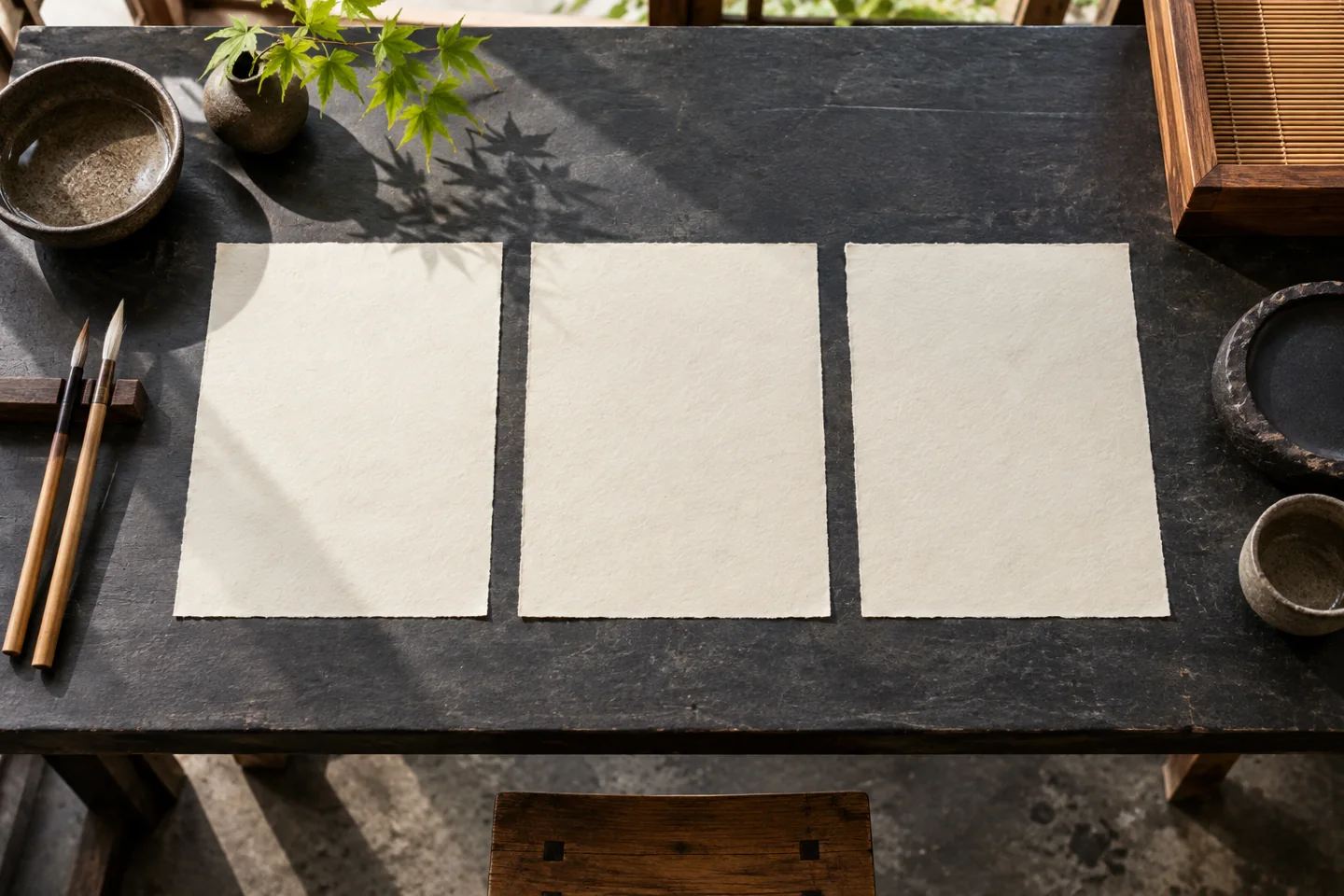
For our first task, spread three loose paper sheets without overlap. Point to each sheet once. The number tells you how many units you identified, while mai supplies the counting category. If you count a shadow or a corner twice, the counter can be correct even though your quantity is not. Check the physical arrangement before translating it.
A bound notebook is a useful contrast. Its pages may be thin, but the notebook as a whole is a bound volume. Do not classify the whole object solely from the shape of its cover. Counting pages inside it is another task with another chosen unit. We will not estimate that internal quantity from an exterior photograph.
The general guide to numbers and counters explains why the category matters. Today we narrow the problem to individual flat items, rather than memorising a catalogue. Keep the object, unit and quantity as three separate notes. That makes a later correction more precise than simply writing “wrong Japanese number”.
Read one to ten without borrowing another counter’s changes
Use this checked sequence: 一枚, いちまい, ichimai; 二枚, にまい, nimai; 三枚, さんまい, sanmai; 四枚, よんまい, yonmai; 五枚, ごまい, gomai. Continue with 六枚, ろくまい, rokumai; 七枚, ななまい, nanamai; 八枚, はちまい, hachimai; 九枚, きゅうまい, kyūmai; and 十枚, じゅうまい, jūmai.
The University of Texas JOSHU counter table verifies these readings and also lists shichimai for seven. We practise nanamai consistently, without claiming it is the only valid variant. The long vowels in kyūmai and jūmai belong to the number. The counter remains mai in these combinations.
Do not import a sound change from a different counter. If you previously studied cups or minutes, a familiar numeral may tempt you to reuse that other ending. For this set, read the complete mai expression. Three sheets is sanmai, not a form created by attaching mai to the changed pronunciation of three cups.
Cover the romanisation and read the kana in your notes. Then recover three quantities in mixed order: eight, two, four. Record the exact number that caused hesitation.
Make a noun phrase with quantity, no and the object
三枚の紙, sanmai no kami, means “three sheets of paper”. The quantity expression comes before の, no, followed by the object word 紙, かみ, kami. This is a noun phrase, not yet a complete statement about what exists or what somebody bought. Keep that grammatical job clear before adding a verb.
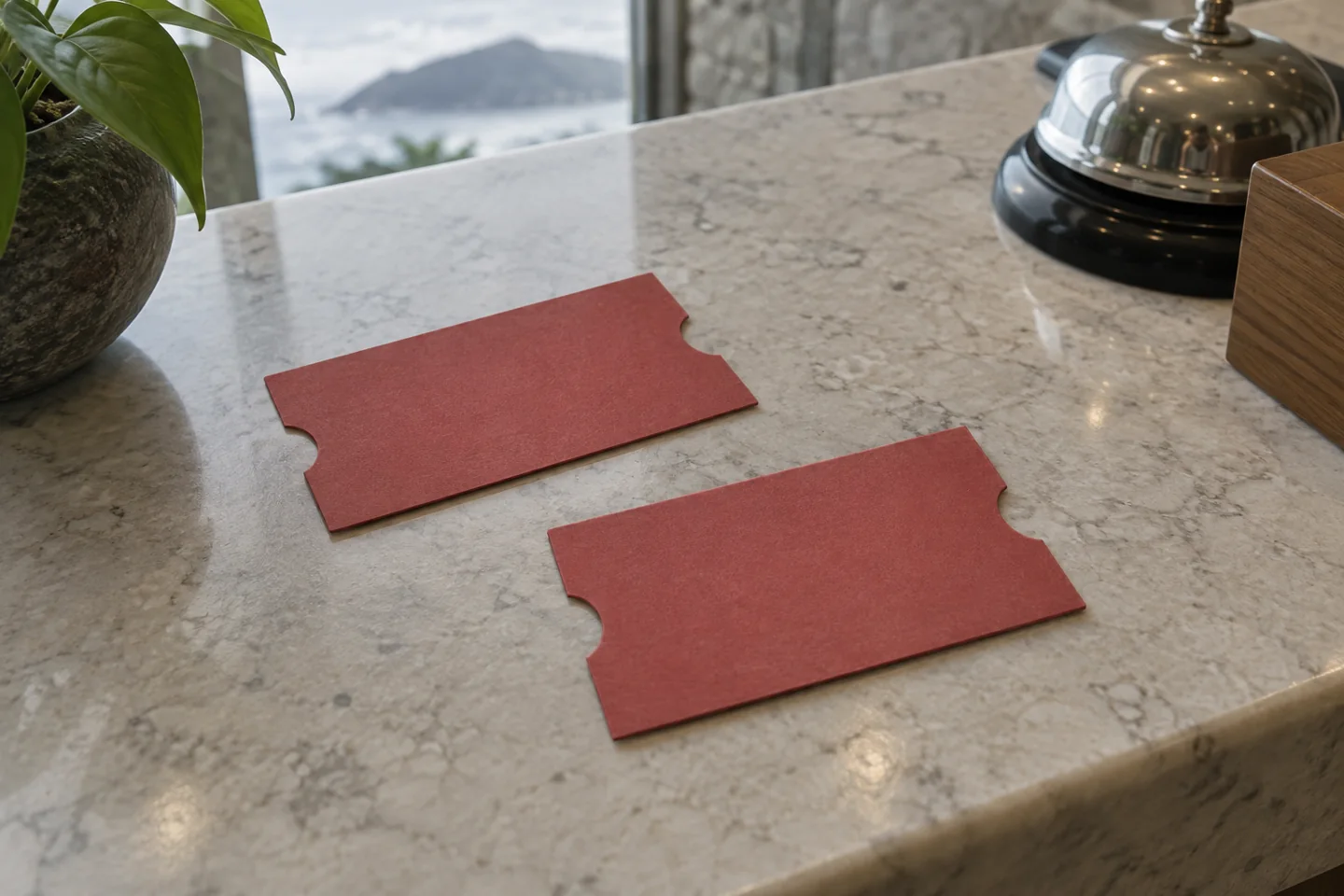
二枚のカード, nimai no kādo, means “two cards”. カード, kādo, has a long vowel, represented by the line over a in this romanisation and by ー in katakana. Our two blank red pieces are fictional practice tokens shaped like cards. They do not stand for a real admission ticket, valid document or purchase.
Choose one model and change only the quantity. Sanmai no kami becomes yonmai no kami when you count four sheets instead of three. Changing the number does not require another no or a different object word. If you also switch the object and sentence pattern, you make the cause of a mistake harder to identify.
You can use the Japanese vocabulary guide to prepare the object words before the counting task. For this lesson, kami and kādo are enough. A longer object list is not necessary to show you understand the noun phrase. New objects should be checked individually rather than assigned mai solely because they look somewhat flat.
State a quantity, then ask how many
紙が三枚あります。Kami ga sanmai arimasu means “There are three sheets of paper.” This controlled statement names paper, marks it with が, ga, gives the quantity and ends with あります, arimasu. It is different from the noun phrase sanmai no kami. Do not paste the two models together without checking the resulting grammar.
カードが二枚あります。Kādo ga nimai arimasu means “There are two cards.” Here the object changes while the pattern stays the same. Use it for the given arrangement, not as a claim about an unseen pack. Our practice objects are inanimate everyday items, so this lesson does not attempt to explain every existence construction.
何枚 is read なんまい, nanmai, “how many” with this counting category. 紙は何枚ありますか。Kami wa nanmai arimasu ka asks “How many sheets of paper are there?” The paper is already identified in our scene. A short answer such as sanmai desu can then state the relevant quantity without repeating every element.
Nanmai and nanamai are different. Nanmai asks for a quantity; nanamai means seven items. Write them beside their meanings before reading aloud. The extra na in nanamai belongs to the numeral nana. Do not assume a question contains seven merely because the beginning sounds similar, or use a question word where an answer number is required.
A packet is not a transparent count
Suppose a packet contains four loose sheets and you are explicitly told that contents count. You can describe those four individual sheets with yonmai. If you see only a closed packet and nobody supplies its contents, you cannot determine the sheet count from the exterior alone. A plausible guess is still a guess, not a verified quantity.
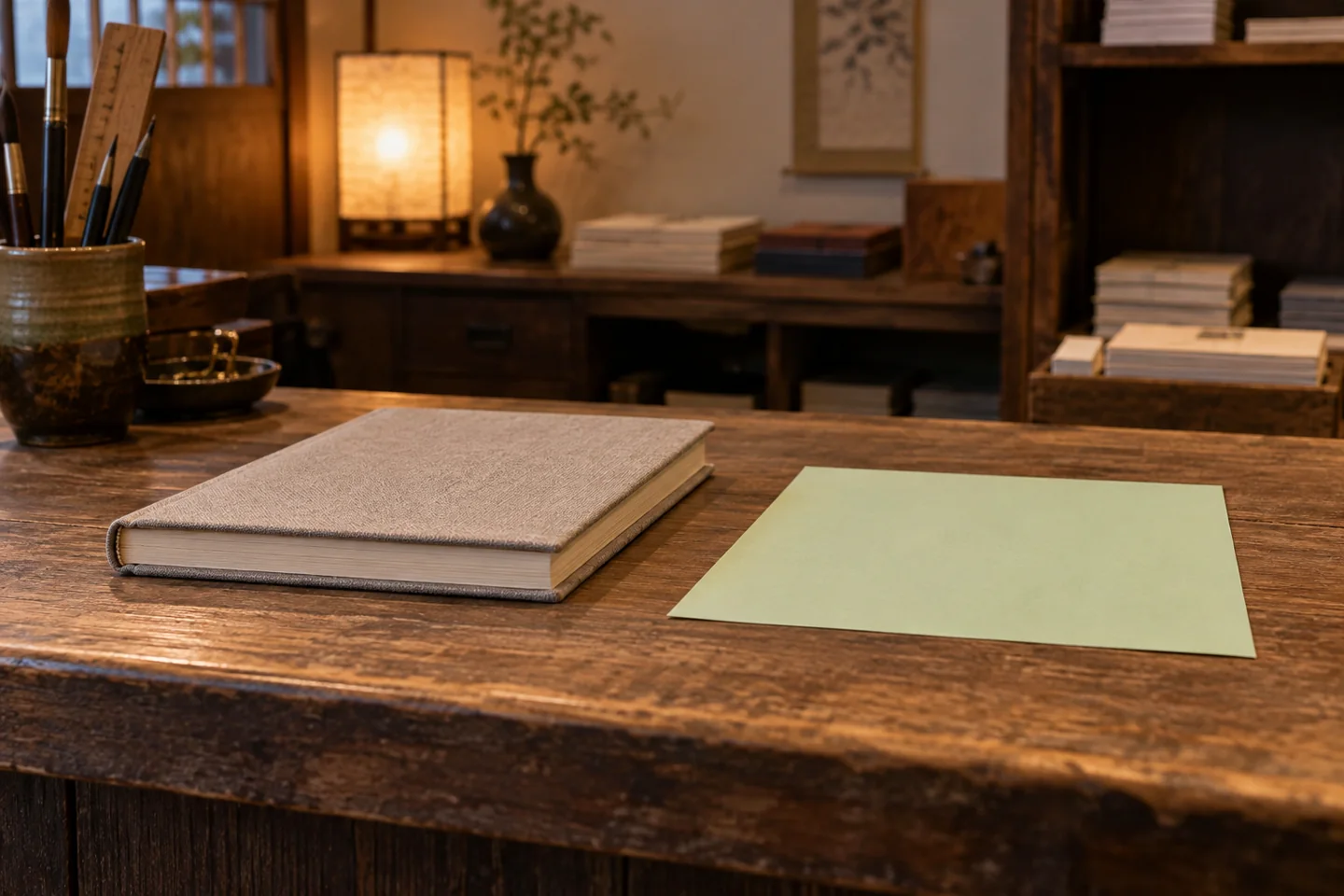
The image with a bound notebook and one loose sheet shows the distinction. If the task asks for loose sheets, only the separate sheet belongs to that set. The notebook is present as a distractor, not as a reason to invent a page total. Its bound-volume category can be studied separately; its unknown number of pages stays unknown.
Try explaining the unit in plain language before answering Japanese. If a partner cannot tell whether you counted sheets, pages or containers, repair your task description. This is a practical check of clarity. It is more useful than arguing about the reading of a numeral while the people in the conversation are counting different things.
Six checks with a specified unit
Cover the next section. For each prompt, first say what the unit is, then choose a reading or sentence. Some tasks test a known quantity; one tests whether the information is sufficient. You may consult the short reading sequence, but do not change the unit to make a memorised phrase fit.
A: Three separate loose sheets lie on a table. Give the quantity with mai. B: Two practice cards lie beside one another. Build the noun phrase “two cards”. C: Four loose sheets are visible. State “There are four sheets of paper.” D: You hear nanmai in a question about the known paper set. Is it asking how many or stating seven?
E: One loose sheet lies beside a closed bound notebook. The question asks only for the number of loose sheets. Answer that question without counting the notebook. F: A closed packet is shown, but its contents are not visible and no quantity is supplied. Can you state the number of sheets inside it? Explain your decision before attempting Japanese.
As a final transfer check, take C and change only the quantity from four to eight. Keep the same object and statement pattern. This reveals whether you can replace a quantity inside a sentence, rather than recognise a whole answer you have just seen. If the number was right but the unit changed, identify that as a separate error.
Answers with the reason for each choice
A is 三枚, さんまい, sanmai: three individual sheets. B is 二枚のカード, nimai no kādo: two cards, a noun phrase with no joining the quantity to the object. The cards are the units; no claim about their validity or purpose is needed for this physical counting task.
C is 紙が四枚あります。Kami ga yonmai arimasu: “There are four sheets of paper.” The numeral is four, and each separate sheet is one unit. D asks how many: 何枚, nanmai. Seven would be 七枚, nanamai in our selected reading. The similarity of the beginning is not enough to identify the meaning.
E is 一枚, ichimai, for the single loose sheet. The notebook does not belong to the specified loose-sheet set. F cannot be answered with a known sheet quantity because the necessary information is absent. You may know which counter to use for sheets while still not knowing their number. Those are separate kinds of knowledge.
The changed version of C is 紙が八枚あります。Kami ga hachimai arimasu: “There are eight sheets of paper.” Check unit, numeral, reading and grammatical pattern in that order. An error note such as “counted the notebook” suggests a different next practice from “forgot hachimai” or “used the noun-phrase model for a complete statement”.
Build a small counting routine you can verify
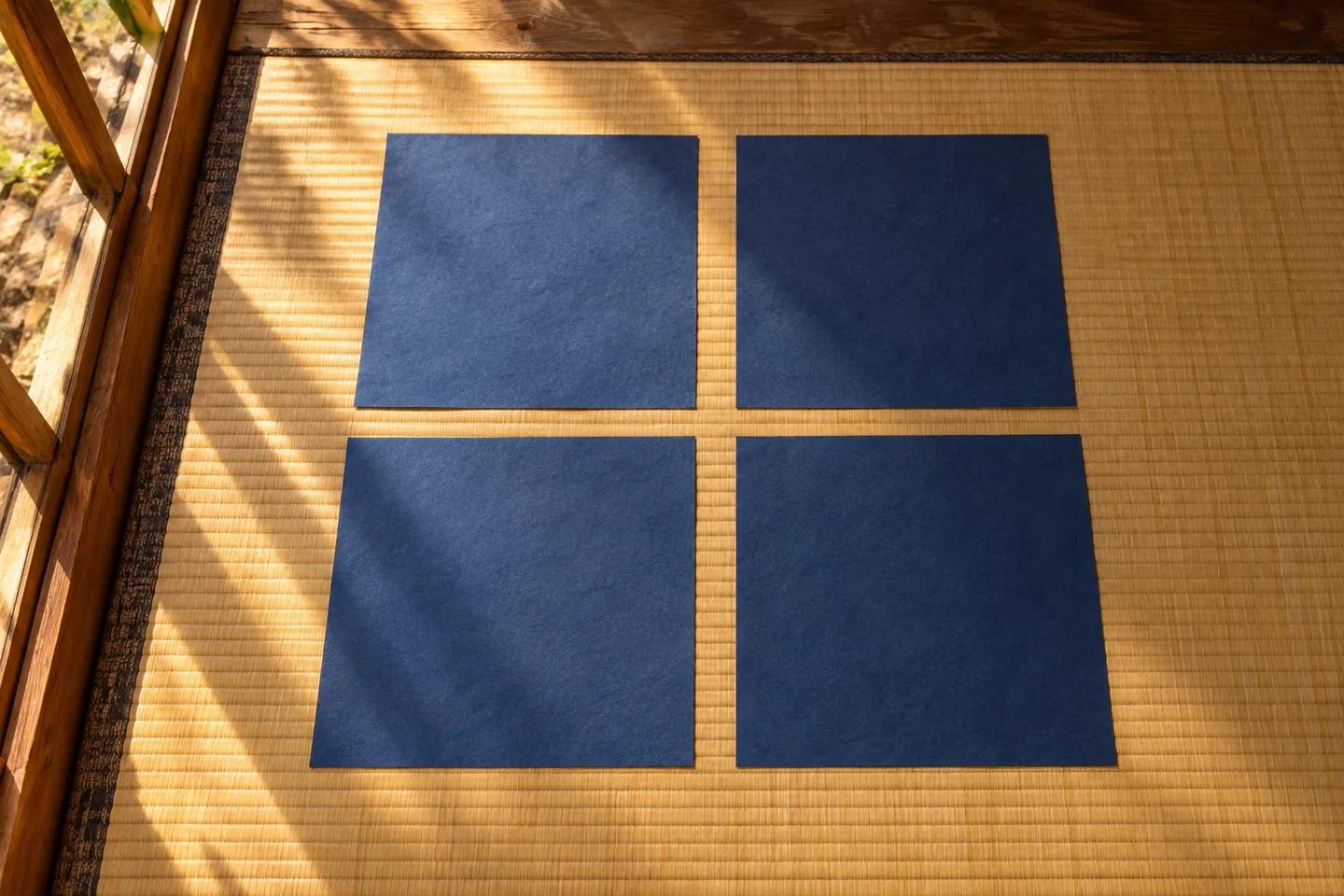
Arrange a few safe paper pieces, count each once and describe the set. Move them without adding or removing anything, then confirm that the quantity has stayed the same. Next change the quantity by one, recount and form a fresh expression. This tests the connection between physical units and words, not just your memory of a row of numerals.
At another session, use a short written prompt instead of the original arrangement. Make the unit and quantity explicit, and include an unknown quantity occasionally. The correct response to missing information should remain “not enough information”, rather than a fluent invented count. A partner can check the stated set against your answer.
The Japanese practice guide helps you keep a task small and inspect its result. Today’s criteria are concrete: choose individual flat items, read the selected quantity, distinguish nanmai from nanamai and use one checked grammatical pattern. Add a new counter when your actual learning situation requires it; this lesson does not promise mastery of every Japanese counting category.
Questions about the method
Does mai count every object made from paper?
No. These examples count individual sheets, cards and tickets. A bound volume or a packet is a different selected unit. Check the object and intended category rather than assuming material determines its counter.
Is nanamai the only reading for seven sheets?
No. The verified university table also lists shichimai. This guide uses nanamai consistently for a controlled first practice, while recognising the alternative. Nanmai without the extra na is the question quantity.
Can I count a hidden stack from its photograph?
Not reliably if the image does not reveal all items and no count is provided. Knowing mai tells you the category, not an unseen quantity. Use an explicit contents count or leave the answer undetermined.