
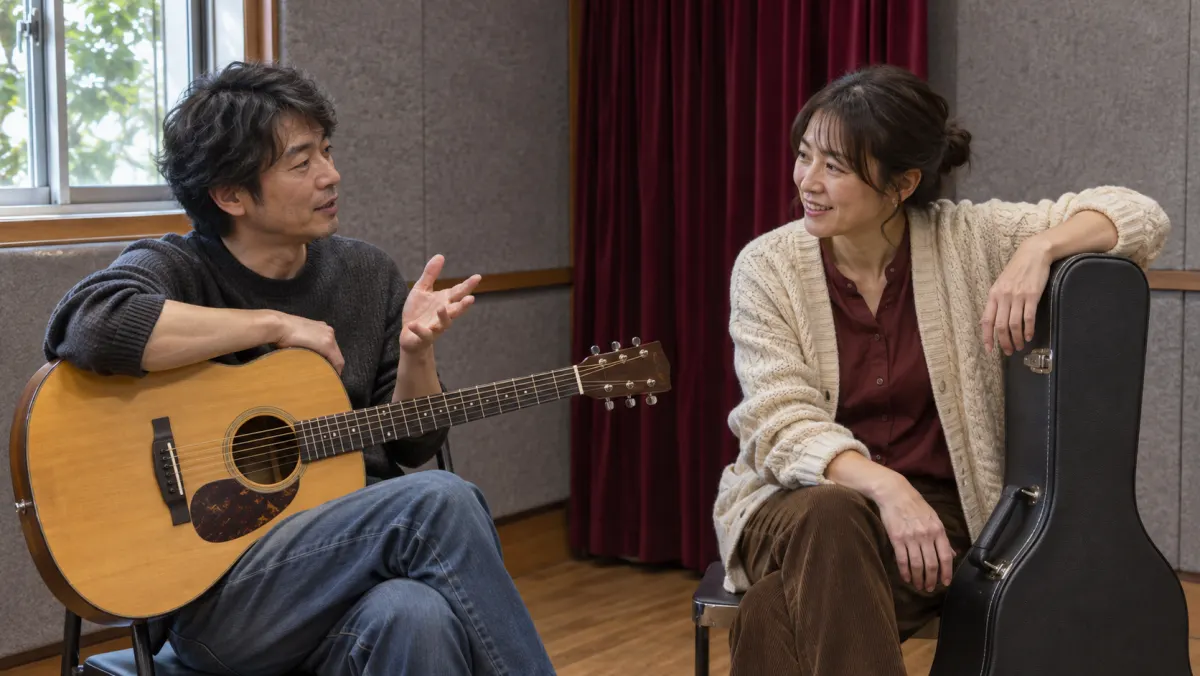
An instrument can be easy to play while its case is awkward to carry. A tune can be easy to remember even when performing it still takes practice. Yasui and nikui help you describe the ease or difficulty of a particular action. The important first step is naming that action. A general “easy” attached to the wrong task will not communicate the musician's actual experience.
We will follow a fictional rehearsal conversation between adult amateur musicians. The exercise notes supply their assessments; these are original language examples, not instrument reviews or findings from real product tests. No app is needed. You can work through the conversation, build three forms and check a new exchange with a few paper notes and a reliable verb reference.
Yasui and nikui describe doing something
このギターは弾きやすいです。Kono gitā wa hikiyasui desu. “This guitar is easy to play.” 弾く, hiku, is the verb for playing a stringed instrument in this setting. 弾きやすい, hikiyasui, describes ease of playing. The sentence does not tell us the guitar's price, its maker or how long the musician has studied.
The St. Olaf College explanation of yasui and nikui identifies their easy-to-do and hard-to-do meanings. Here the action is part of the description. Keep it visible when translating: “easy to play” gives more information than “easy.” The context tells us which instrument and whose supplied assessment we are practising.
Write a two-part meaning note: object “this guitar,” activity “play.” Add the exercise's assessment “easy.” Only then produce the Japanese. This order prevents a familiar ending from selecting the meaning for you. If the task changes from playing to carrying, you must reconsider the verb even if the same musician and the same instrument remain in the room.
Build the connection from the masu stem
Start from 弾きます, hikimasu. Remove ます to obtain 弾き, hiki, then attach やすい: 弾きやすい, hikiyasui. This is not the dictionary form hiku followed directly by yasui, and it is not the whole polite hikimasu followed by yasui. The part before masu supplies the connection in the pattern we are studying.
For a different verb, take 運びます, hakobimasu, “carry,” remove masu to get 運び, hakobi, and add にくい: 運びにくい, hakobinikui, “hard to carry.” Do not remove random letters from a romanised dictionary form. Establish the verb and its correct polite form first. Our verb conjugation guide offers a broader reference for those starting forms.
The University of Texas JOSHU reference explicitly connects these endings to the pre-masu form. Use the connection to inspect your own result, rather than treating each full word as an unrelated exception. A short chain from meaning to polite verb to stem is enough for today's three examples; you do not need to build every possible compound at once.

Change the action when the assessment changes
このケースは運びにくいです。Kono kēsu wa hakobinikui desu. “This case is hard to carry.” ケース, kēsu, names the case. The difficulty concerns carrying it. A photograph of a case cannot establish that assessment by itself: the exercise gives a musician's statement. We are practising how to express that statement, not diagnosing a design flaw from the picture.
Compare the guitar and case descriptions. A guitar that is easy to play does not automatically have a case that is easy to carry. Those are different activities involving different objects. Keep the verb next to the assessment in your notes. This helps when a conversation contains several positive and negative evaluations and a question asks which activity was actually difficult.
For a controlled reversal, the prompt now says the case is easy to carry. Retain hakobi and replace nikui with yasui: 運びやすい, hakobiyasui. The meaning changes from difficulty to ease. You have not changed the noun to guitar or the activity to playing. Check all three pieces after making the local change so that your answer preserves the new supplied message.
An easy tune is not a claim of complete mastery
この曲は覚えやすいです。Kono kyoku wa oboeyasui desu. “This tune is easy to remember.” 曲, kyoku, refers to the piece or tune in our rehearsal. Start from 覚えます, oboemasu, remove masu and add yasui. The stem is oboe, giving oboeyasui. Notice the entire connection rather than forcing every verb to end in the same stem sound.
Remembering a tune and playing it accurately are different tasks. The musician may find the tune memorable while still working on a difficult passage. The sentence supplies no performance score, practice duration or claim that every aspect is easy. When checking a paraphrase, preserve the particular activity instead of expanding “easy to remember” into “I can already perform the whole piece perfectly.”
This distinction is useful outside music as well. An instruction can be easy to understand without being easy to carry out. You do not need to translate that extra example today to see the learning point. Write the action in your meaning note and ask what evidence the sentence actually supplies. Our sentence structure guide helps keep the described object and final predicate connected.

A past assessment changes the adjective ending
Suppose the exercise now reports yesterday's trial of the guitar. このギターは弾きやすかったです。Kono gitā wa hikiyasukatta desu. “This guitar was easy to play.” The easy-to-play description takes a past adjective ending. The underlying playing verb does not become hikimashita immediately before yasui in this construction.
Compare hikiyasui desu and hikiyasukatta desu. The first supplies the present assessment in our initial dialogue; the second reports the past assessment in the new prompt. Keep the action “play” stable while changing when that assessment applies. This is a grammar exercise about a fictional speaker, not a product test conducted by Learn Japanese Hub.
Our adjectives guide provides the broader i-adjective pattern. For this lesson, one past affirmative example is enough. Do not add several unfamiliar negative and past-negative forms just to make the note look complete. A useful check is whether you can explain the difference between the two supplied messages before changing the ending in writing.
Read the rehearsal exchange before answering
The first musician's note says: this guitar is easy to play; this case is hard to carry; this tune is easy to remember. Another note says that yesterday's guitar trial was easy to play. Treat those as the complete facts for the following tasks. The photographs provide a setting, not extra spoken statements or hidden information about ability.
First, make the polite description of the guitar's ease of playing. Second, describe the case's difficulty of carrying. Third, build the memorable-tune sentence and show the stem you used. Fourth, the case assessment changes to easy to carry; change only the relevant ending. Fifth, place the guitar's easy-to-play assessment in the past, as supplied by the second note.
Sixth, evaluate a learner's summary: “The tune is easy to remember, so the musician can perform it perfectly.” Which part goes beyond the given information? Answer in your own language before trying to produce more Japanese. That final task tests the boundary of the message, rather than whether you can repeat an ending that has just appeared five times.
Repair the specific form or interpretation
The first answer is このギターは弾きやすいです。Kono gitā wa hikiyasui desu. The second is このケースは運びにくいです。Kono kēsu wa hakobinikui desu. Compare hiki and hakobi: both come from their own polite verb forms. If you produced hiku-yasui or hakobimasu-nikui, return to the connection step and rebuild only the part that went wrong.
The third is この曲は覚えやすいです。Kono kyoku wa oboeyasui desu, using oboe from oboemasu. The fourth uses hakobiyasui instead of hakobinikui. The fifth is このギターは弾きやすかったです。Kono gitā wa hikiyasukatta desu. Check the action, assessment and time setting separately, then read the complete answer naturally.
For the sixth, perfect performance is not stated. Ease of remembering does not prove complete mastery. Finish with a new mixed prompt drawn from the three activities, hiding the answer until you have tried. Record whether you forgot a word, attached the ending to the wrong form or changed the claim. Your next practice should address that particular gap, rather than repeat every sentence regardless of the error.
Questions about the method
Does yasui always describe a low price?
No. In the verb-plus-yasui pattern here, it describes ease of doing the named activity. Our guitar sentence is about playing it, not buying it cheaply. Read the whole predicate rather than translating a familiar sound in isolation.
Does nikui mean that an action is impossible?
No. “Hard to carry” describes difficulty in the supplied assessment. It does not by itself say that carrying cannot happen. Keep difficulty, ability and permission separate unless the surrounding text gives additional information.
Can I decide the assessment from the photograph?
Not reliably. The exercises provide the musician's stated assessment in writing. A visible case or guitar does not tell you how easy a particular person finds an activity. Use the image for context and the supplied statement for the answer.