
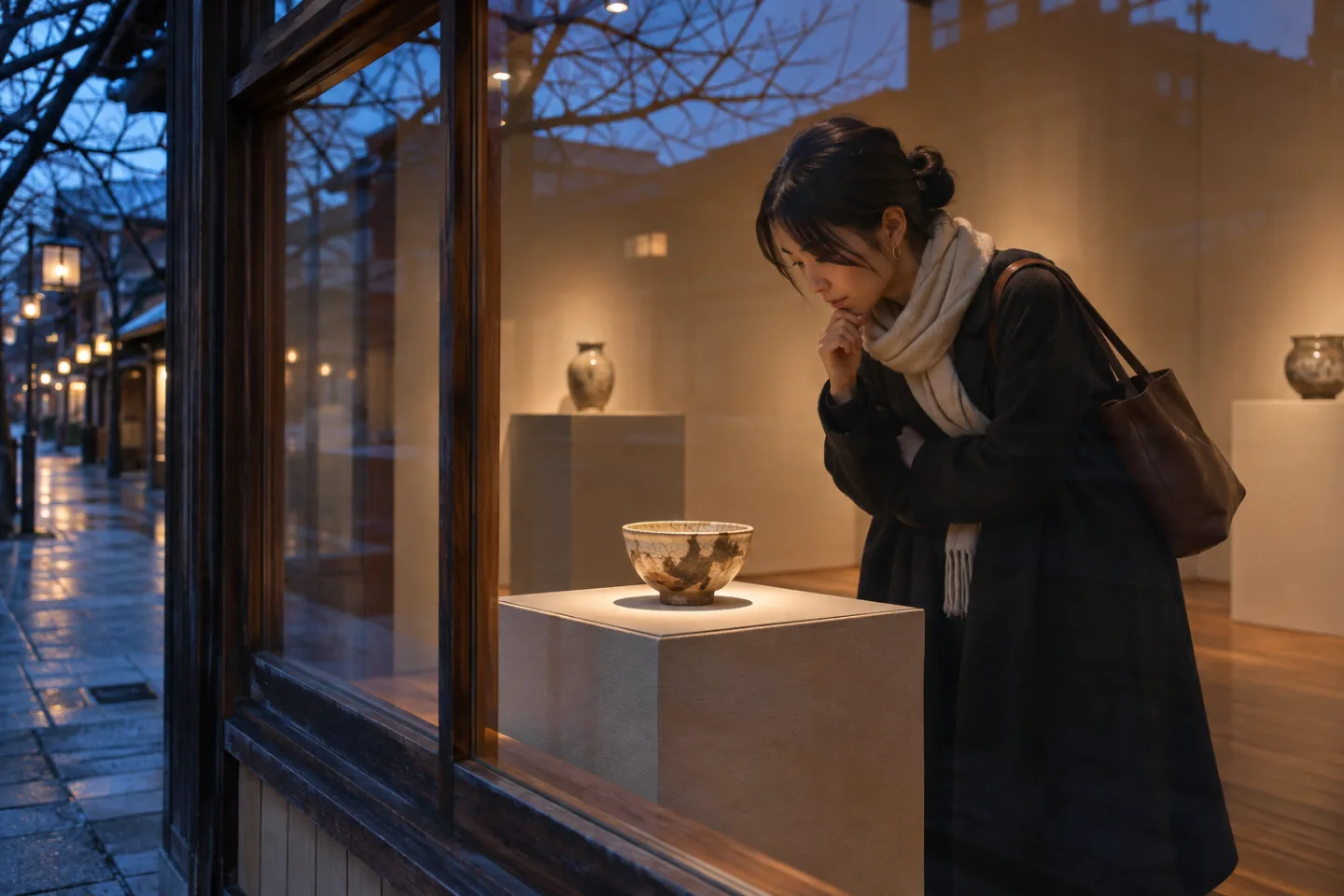
You leave a ceramics exhibition without buying a cup. A friend takes that as a sign that you disliked the work. You can correct that impression without pretending you loved every object. 好きじゃなかったわけではない (すきじゃなかったわけではない) can mean “It's not that I didn't like it.” You might then explain that you already have plenty of cups at home. **Wake dewa nai** helps separate what your friend saw from the conclusion they drew.
Wake dewa nai tells you which idea to cross out
Suppose your friend says “You didn't buy anything. I guess you didn't like the exhibition.” There are two separate ideas in that remark. The first is an observation about what you did. The second is a guess about how you felt. When you reply 好きじゃなかったわけではない, the part before わけではない is the guess that you did not like it. That's the idea you are taking issue with. The observation that you left empty-handed can stay on the table.
Say the reply again and continue with うちにカップがたくさんあるから (うちにカップがたくさんあるから), “because I have plenty of cups at home.” Now the friend knows why the observation and the guess should be separated. The new reason gives a plausible account of your decision. It still leaves open which piece you liked most or whether you would return for another visit. The grammar doesn't fill in those details. If they matter, state them separately.
Here is a way to mark up the exchange as you read. Write “no purchase” on one line and “didn't like the exhibition” on another. Circle the observation and strike through the conclusion. Add the new reason alongside the observation. If your paraphrase says that the person bought a cup after all, you've crossed out the wrong line. If it says the person loved everything, you've added an opinion the speaker did not express.
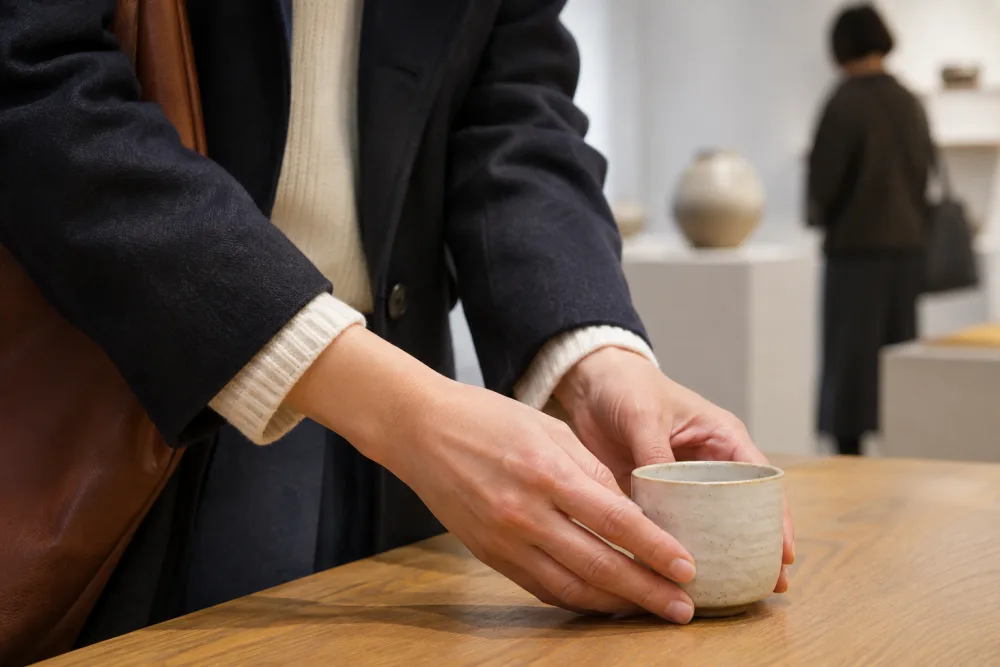
A claim about everything is different from a claim about one thing
Look at 全部見たわけではない (ぜんぶみたわけではない), “I didn't see everything.” The phrase before わけではない is 全部見た, “I saw everything.” The speaker rejects that complete claim. Maybe they saw three displays and missed a fourth. Maybe they only looked at the pieces near the entrance. You cannot count how many they saw from this sentence. Compare 一つも見なかった (ひとつもみなかった), “I didn't see a single one.” That second sentence explicitly rules out even one item.
Try the same check with いつも買うわけではない (いつもかうわけではない). If a friend thinks you always buy something when you visit an exhibition, this reply rejects the word “always” in that conclusion. It does not imply “never.” You might sometimes buy a cup as a gift and usually go home without one. The exact frequency is up to you to explain. If you hear this reply, the safest note is “not every time.” Don't silently turn that note into a precise number of purchases.
In a reading exercise, look for the expression that sets the size of the claim. 全部 covers everything. いつも covers every occasion. In the first example, one missed object is enough to contradict the original claim. In the second, one visit without a purchase is enough to contradict the original claim. These are two uses of the same reading technique. Keep the words that limit or broaden a statement inside your brackets when you work out what the speaker is rejecting.
Read the Japan Foundation grammar notes for the everyday form wake janai. Review Japanese grammar to work on reading plain clauses before combining them.
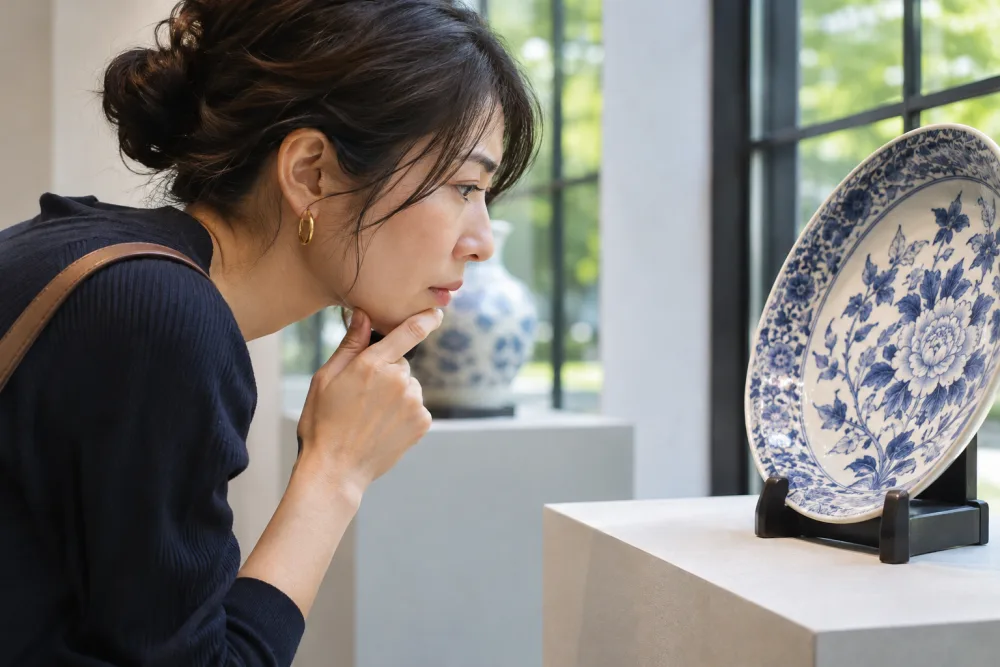
An ordinary negative may sit inside the rejected claim
In our gallery example, 好きじゃなかった is already negative. The outer わけではない tells you the speaker is rejecting that negative description. In English you can keep the distinction visible with “It's not that I didn't like it.” It can sound more hesitant than a direct “I liked it,” especially if you add a reason and leave your opinion otherwise unstated. If you remove both negatives and write “I loved the show,” the result is more enthusiastic than the original.
To practise, underline the inner clause first. Then put a box around わけではない. Give each mark a job. The underlined words identify the idea someone might believe. The box rejects that idea. Read the sentence aloud once with a small pause before the boxed part, then again without the pause. The pause is only an exercise. In conversation, listen for the entire ending even if the speaker says it quickly.
You may also hear わけじゃない in conversation. In the exhibition exchange between friends, 好きじゃなかったわけじゃない is possible. The shorter ending gives a more conversational sound. It still rejects the same claim. When you compare the two versions, keep the inner clause fixed so you can hear what actually changed. Try paraphrasing both versions and notice that you don't need two different explanations of why the friend left without buying anything.
The lesson on kara can help when you add a reason.
Put the reason after the correction
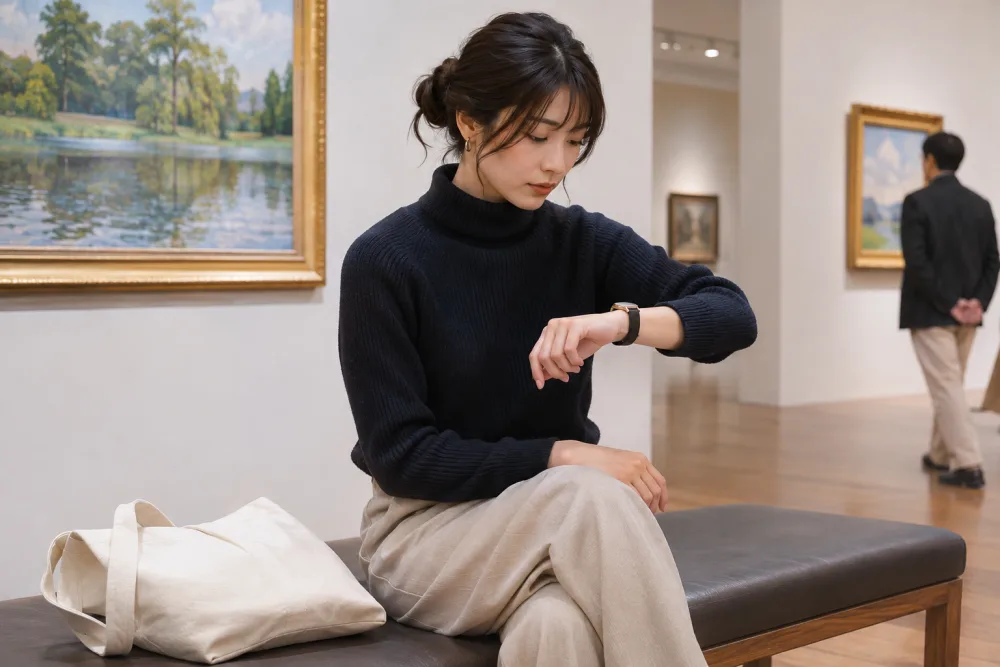
A useful reply has two parts. First identify the assumption you want to set aside. Then give the listener a fact that helps them revise it. Suppose the gallery is closing soon and your friend takes your glance at the clock to mean you are bored. 退屈なわけではないよ (たいくつなわけではないよ), “It's not that I'm bored,” addresses the assumption. 電車の時間が気になって (でんしゃのじかんがきになって) adds that you're thinking about the train time. The second part can be fragmentary in a friendly exchange because the reason for mentioning it is already clear. In a written exercise you can use a full sentence and make the relationship explicit.
Now change the scene. You are the friend who has made the wrong guess. After hearing the correction, ask a question about the actual concern instead of repeating the guess in different words. 電車は何時? (でんしゃはなんじ), “What time is the train?”, is one possible response. You can use this technique to check your own comprehension. If your follow-up question still assumes boredom, revisit which clause was rejected. If it responds to the timetable, you have followed the turn the conversation took.
The Japan Foundation's Marugoto grammar notes explain how the conversational ending わけじゃない can soften the rejection of a statement, including a statement that is already negative. For this exercise, keep the observation, the rejected interpretation and the reason on separate lines. With that separation, you can vary the ending without changing the facts of the scene.
Try the correction in three conversations
**1. The closed notebook.** Your friend sees that you shut your sketchbook after drawing one cup. They assume you dislike drawing. You enjoy sketching, but you have to leave soon. Which idea should you reject, and which observation stays true?
絵を描くのが嫌いなわけじゃない (えをかくのがきらいなわけじゃない) is one way to reject the idea that you dislike drawing. It does not reverse the action of shutting the book. You could follow it with もう帰らないと (もうかえらないと), “I have to head home now.” Check the two parts separately. The first addresses what the friend thinks about your taste. The second explains why the notebook is closed.
**2. The part of the gallery you missed.** A friend asks whether you saw everything. You saw several pieces at the front but ran out of time before the back room. Try a sentence with 全部 and わけではない. Then write a separate sentence telling your friend what you did see.
全部見たわけではない rejects the claim that you saw everything. 入り口の近くの作品は見たよ (いりぐちのちかくのさくひんはみたよ) adds that you did see the works near the entrance. A person who hears only the first sentence cannot infer the location of the pieces you saw. If their next question is “Which pieces?”, they're asking for information you haven't given them yet.
**3. A purchase on a previous visit.** Last week you bought a bowl. This week you only came to look. Someone assumes you buy something every time. Use いつも to quote the scope of that assumption inside your reply. Then try a second reply that simply reports what happened this week.
いつも買うわけではない challenges the generalization. 今日は買わなかった (きょうはかわなかった), “I didn't buy anything today,” reports a specific fact. Both can fit the conversation. If the person merely asks whether you bought anything today, the second is sufficient. If they're describing a habit you don't have, the first addresses that larger claim directly.

Transfer the pattern to a book you haven't finished
A friend lent you a novel. You are halfway through it when they ask whether you stopped because you don't like it. Think of a reason that doesn't require inventing an opinion about the whole book. Maybe you only read during your commute and haven't had much time on the train this week. Try つまらないわけじゃない (つまらないわけじゃない), “It's not that it's boring,” then add your reason in one short sentence. If your friend wants to know whether you'd recommend the novel, say how much you've read before answering. The correction leaves your full assessment open.
Now reverse the roles. Listen to your partner's response and paraphrase it in three short notes: what happened, what inference was rejected, and what new reason was offered. If the third note is blank, the partner may simply have withheld the reason. Ask a follow-up question instead of supplying one from the picture or your own expectations.
Questions about the method
Does わけではない always mean “not necessarily”?
The translation depends on the proposition and the exchange. “Not necessarily” often fits a general claim with words like “always.” “It's not that” can sound more natural when someone rejects a guess about their motives or taste. Read the surrounding lines before choosing.
Does 全部見たわけではない tell me how much the person saw?
No. It rejects complete coverage. You need another statement, such as an explanation of which room they visited, to know more.
Can I always use わけじゃない instead?
It often suits informal speech. Learn to recognize both versions. If you're writing for an audience that expects a more formal register, わけではない may fit better. In either version, first identify the full idea the speaker is rejecting.