
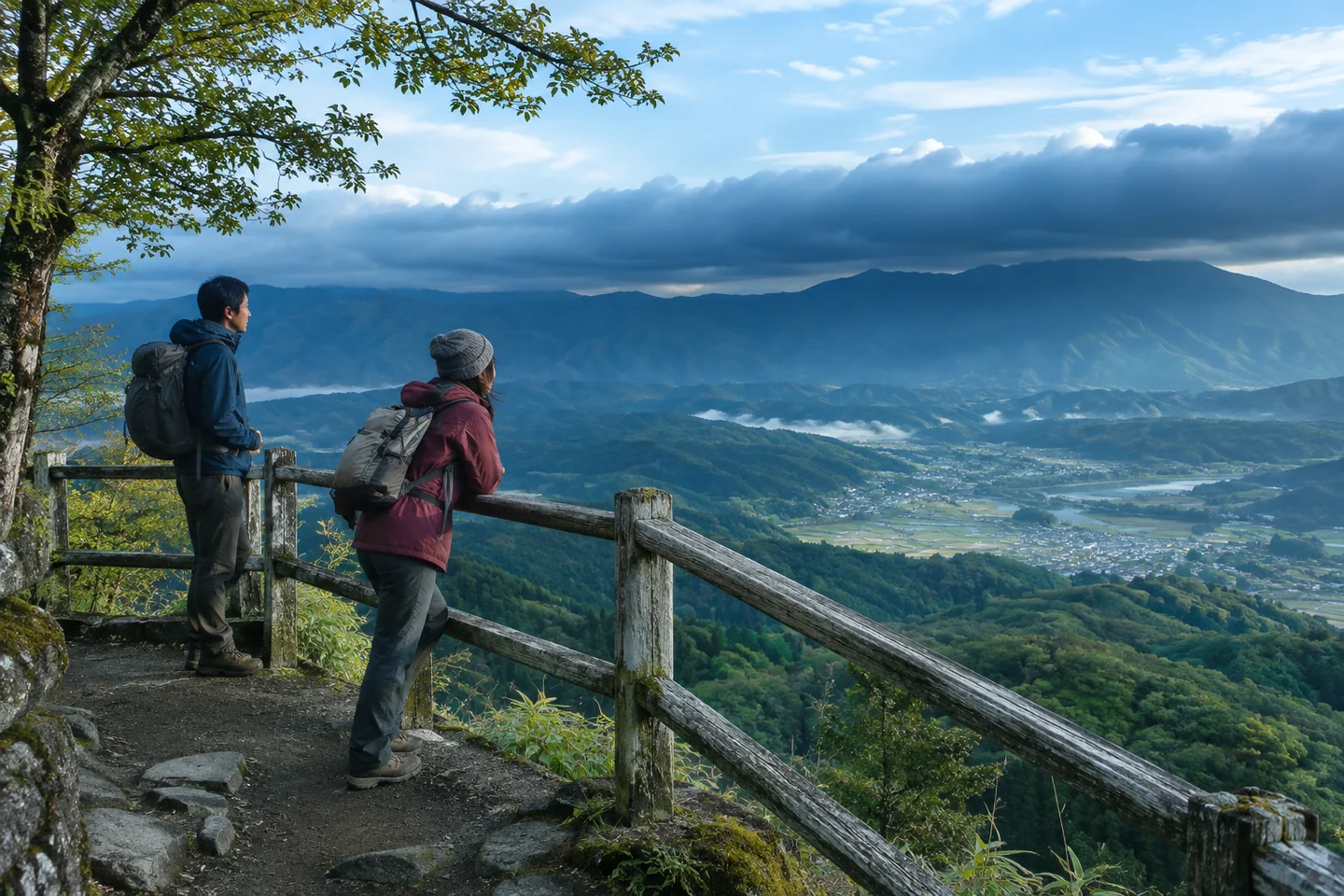
Uchi ni describes what you do while a condition still holds or what happens over the course of an activity. At a mountain lookout, you can take a photo while the valley is still visible. You can head back toward the station before it rains. You can also tell someone that fog appeared while you were looking down at the valley. All three scenes can use うちに, with a difference in how you describe the time around the action.
This lesson follows a short visit to a lookout, starting on the terrace and ending under a roof. At each step, identify the condition that gives the action its timing. Then decide whether you are suggesting a sensible moment to act or reporting a change you noticed. You can do the exercises on paper without needing any special equipment.
Uchi ni gives you a window in which to act
At the rail, a friend says 景色が見えるうちに写真を撮りましょう(けしきがみえるうちにしゃしんをとりましょう, keshiki ga mieru uchi ni shashin o torimashō), “Let’s take a photo while we can still see the view.” 見える says that the view is visible. Taking the photo is the action to fit in while that condition still holds. If the clouds come down, the same camera and viewpoint might no longer help you get the picture you want.
A clear way to build the sentence is to name the present condition first. “The view is visible.” Then name an action that makes sense because of it. “Let's take a photo.” Join the two with うちに. You can describe a fairly long opportunity as well as a short one. The phrase does not tell the listener how many minutes are left. They can infer urgency from the situation, the action proposed or the way you say it.
You can do the same with 明るいうちに(あかるいうちに, akarui uchi ni), “while it’s still light.” A companion might suggest starting back before the light fades. The useful detail is the condition, not an exact time of day. The Meguro Language Center handout gives examples of acting within a continuing condition and noticing a change in the course of another activity.

Choose a phrase for the condition you mean
Before うちに, a plain verb can give the interval. 景色が見える describes a state. 駅で待っている(えきでまっている, eki de matte iru)describes an activity in progress, waiting at the station. Ask which interval matters to the rest of the sentence. One person might use the waiting time to check a map. Another might describe what they noticed while waiting.
An い adjective connects directly, as in 明るいうちに. A な adjective uses な. 静かなうちに(しずかなうちに, shizuka na uchi ni)means “while it is still quiet.” A noun can connect with の, as in 休みのうちに(やすみのうちに, yasumi no uchi ni), “during the break” or “while I’m on holiday,” depending on context. 今のうちに(いまのうちに, ima no uchi ni)is a common choice when the opportunity is now and both listeners already understand what might change.
Practise by building two phrases for the same choice. Say 今のうちに駅へ戻りましょう, “Let’s head back to the station now while we can.” Then give a specific reason: 明るいうちに駅へ戻りましょう, “Let’s head back while it’s still light.” In the first version, the other person needs to know why now is useful. In the second, the phrase about the light supplies that reason. If you need words to locate the station in the reply, use the guide to Japanese location words.
Name a change that has yet to happen
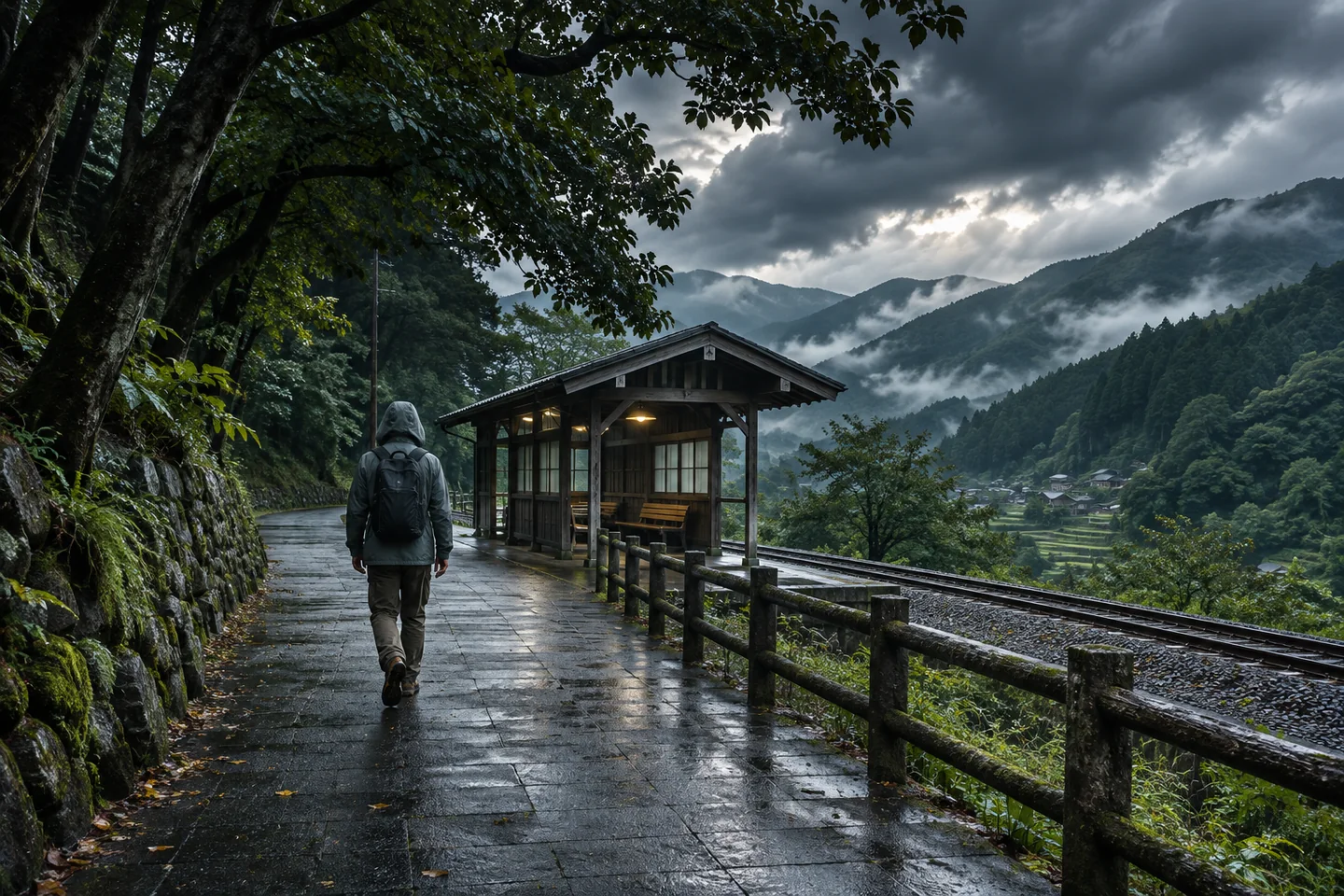
Rain is forecast, but none has fallen on the lookout. 雨が降らないうちに駅へ戻りましょう(あめがふらないうちにえきへもどりましょう, ame ga furanai uchi ni eki e modorimashō)means “Let’s go back to the station before it rains.” The plain negative 降らない gives the interval before the change. 戻りましょう says which action you want to get done during it. The forecast is context for the suggestion.
You can write the sentence in two parts to check the meaning. First, write what has not yet happened. Then write the action you propose. 雨が降らないうちに is about timing the return while it is not raining yet. That choice does not promise that it will rain or tell you how long the rain will last. If the rain has already started, you would need a different description of the situation.
Another natural change is sunset. 日が暮れないうちに戻りましょう(ひがくれないうちにもどりましょう, hi ga kurenai uchi ni modorimashō)means “Let’s get back before dark.” Compare it with 明るいうちに戻りましょう. One names the change you want to get ahead of, and the other names the light you still have. Try saying one of these when you have a minute to explain the situation and the other when the reason is visible to both people.
Report what changed while you were doing something
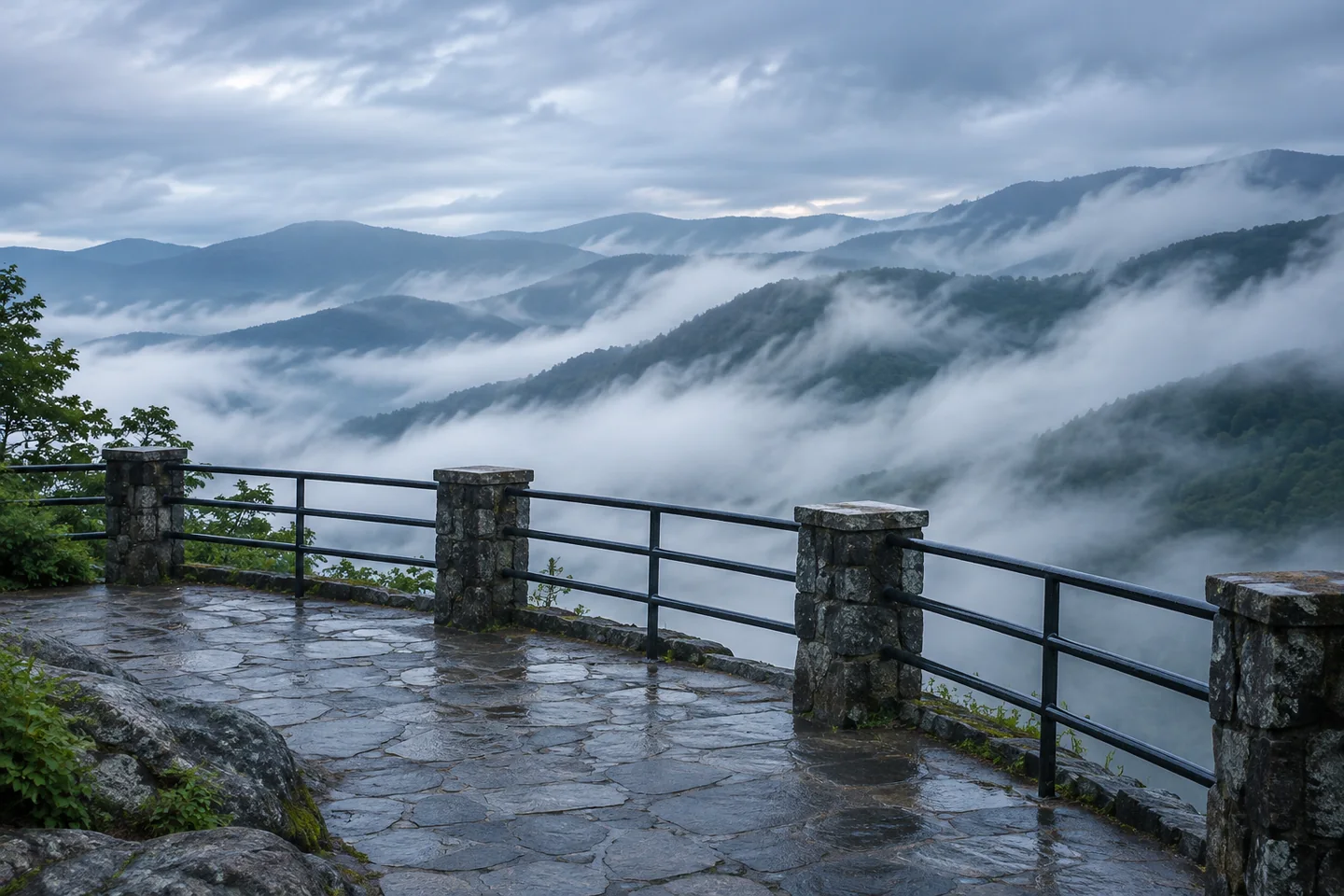
Sometimes the second part of the sentence describes what happened without anyone trying to make it happen. 景色を見ているうちに霧が出てきました(けしきをみているうちにきりがでてきました, keshiki o mite iru uchi ni kiri ga dete kimashita)means “While we were looking at the view, fog started coming in.” The first part gives the course of the activity. The fog arrived during that time. The people looking over the valley did not bring about the change by looking.
Try reading the sentence in two voices. First, read the suggestion about taking the photo and picture someone deciding to move. Then read the sentence about the fog and picture someone recounting the visit afterward. In the second sentence, 出てきました gives a change that has already been observed. Let the final verb and situation guide you. If you always translate うちに as “before it’s too late,” you will miss this ordinary reporting use.
A gradual change also works. 駅で待っているうちに体が冷えてきました(えきでまっているうちにからだがひえてきました, eki de matte iru uchi ni karada ga hiete kimashita)means “I started to get cold while I was waiting at the station.” You can report that after getting on the train. The verb before うちに stays in ている here because it describes the activity underway at the relevant time. The polite past at the end tells what happened.
Decide between a condition and an explicit deadline
A time printed on a schedule can function as a deadline. 五時までに駅に戻ります(ごじまでにえきにもどります, go-ji made ni eki ni modorimasu)means “I’ll get back to the station by five.” Here five o’clock is the limit. If a friend says 明るいうちに戻りましょう, the relevant limit depends on the light. They have not named a time. For more examples of a stated deadline, see the guide to made ni.
Sometimes you have both kinds of information. You need to return by five to meet a friend, but you also want to get back before dark. Make two lines, one for the deadline and one for the condition. Which would you say to somebody who has never seen the train schedule? Which would you say if they can see the sky but have not heard that another person is waiting? The answer depends on what the listener needs to decide.
間に(あいだに, aida ni)can also put something inside an interval. 駅で待っている間に電話が来ました means “A call came while I was waiting at the station.” If you are simply locating the call in time, that is a convenient way to do it. うちに can instead bring out the idea of a condition that remains available or a development noticed over an activity. There are contexts where both forms work. Make the choice based on which part of the story you want to highlight.
Try both readings with a familiar setting
Pick a setting with a condition you can see or check, such as a quiet room, a clear evening or a drink that is still warm. Say what you can do while the condition holds. Then describe something that develops while you are there. In each sentence, underline the phrase before うちに and circle the verb that follows it. If someone hears only the second part, could they still tell whether it describes a suggestion or a report?
Try exchanging the two verbs that follow うちに. See whether the new sentences are plausible and say what would need to change in the context. This helps you practise the timing without treating one English word as the fixed meaning. Check whether you are acting within a condition, acting before a change or noticing what happened during an activity.
Questions about the method
Does uchi ni always mean I should hurry?
No. A suggestion can take advantage of a condition that may end, but the phrase can also introduce an activity during which something happens. The fog example reports an observation. It does not ask somebody to rush.
What does the negative before うちに change?
In 雨が降らないうちに, the interval lasts while rain has not started. A natural English rendering is “before it rains.” The action after うちに can still be positive, such as heading back to the station.
Can I say 今のうちに without describing the reason?
Yes, when the situation already makes the opportunity clear. If it is unclear to your listener why now matters, say the condition out loud or name the change you are trying to get ahead of.