
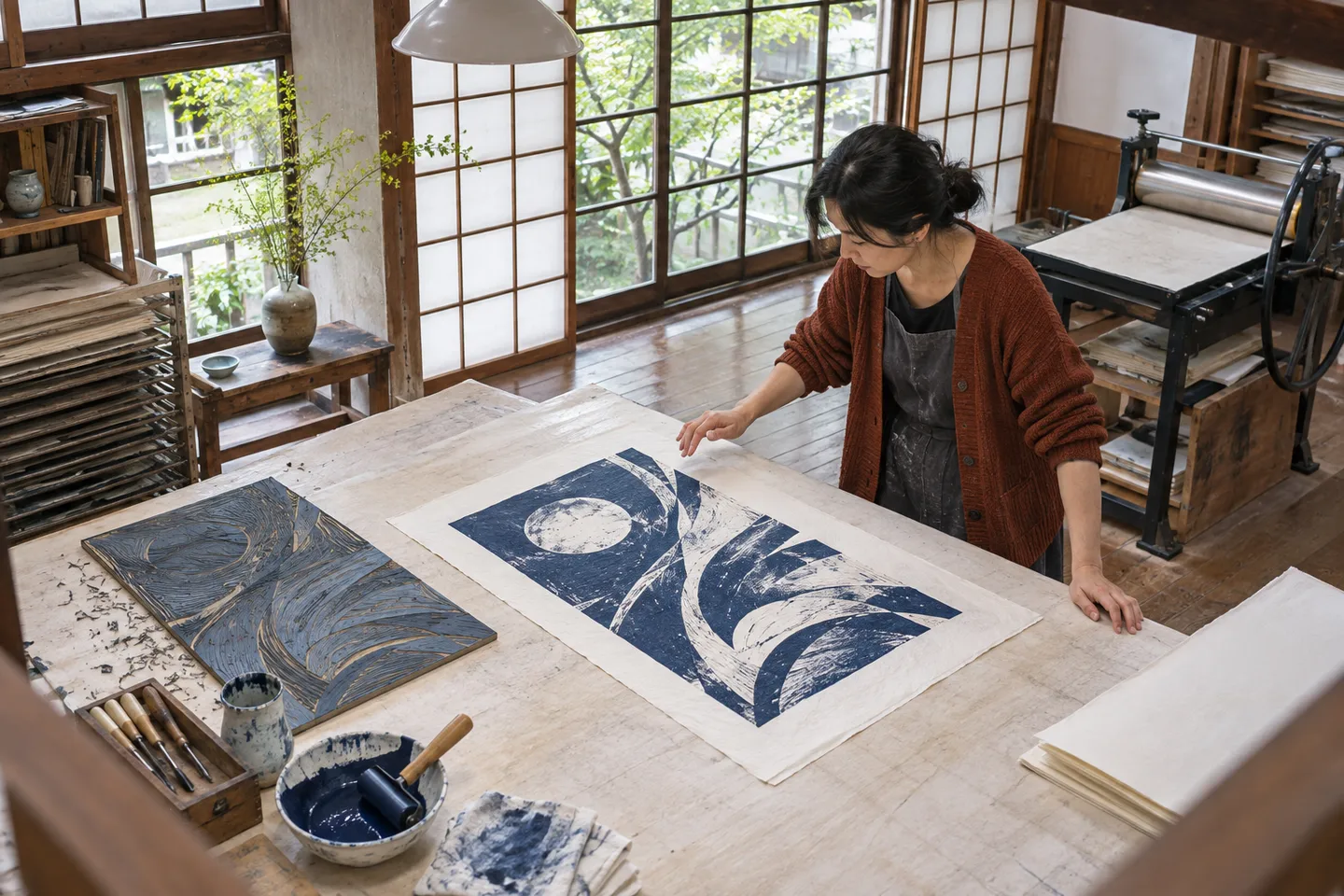
Tsui vs ukkari is a choice about what made an unplanned action happen. Imagine leaving a Japanese printmaking workshop. You meant to take one last look around, but a fresh proof caught your eye and you stayed to inspect it. When you finally left, the paper portfolio you meant to carry went unnoticed under the bench. Both outcomes depart from the plan. The first started with something that drew you in. The second happened because your attention missed something.
You can tell the two stories with much the same vocabulary. The choice of adverb tells the listener what to make of the action. The examples here move from an easy pair, where the causes differ clearly, to a pair where the exact same verb works with either word.
Tsui vs ukkari at the workshop
Use つい when an impulse, habit or understandable pull carries you into an action. 面白くて、ついもう一枚見てしまいました(おもしろくて、ついもういちまいみてしまいました)means “It was so interesting that I ended up looking at one more.” You looked at the print on purpose in the immediate sense. What slipped was the earlier plan to leave. The wording lets you acknowledge that the result was hard to resist without describing it as an outright blunder.
Use うっかり when you overlooked something or failed to pay enough attention. うっかり作品を置いてきてしまいました(うっかりさくひんをおいてきてしまいました)means “I accidentally left my work behind.” Here the portfolio stood in plain view, but you forgot it while gathering the rest of your things. The listener hears that you would have taken it if you had noticed it at the right moment.
To test the choice, imagine what would have prevented the action. Walking directly to the door would have helped you resist the extra look. Checking under the bench would have caught the forgotten work. The prevention test is a practice aid. Start with the reason you want to convey and use the test when the reasons are hard to separate.
A deliberate movement can still start with つい
Consider a print you know you have seen before. You see the edge of the paper on the drying rack and reach to turn it around again. Say 気になって、つい手に取ってしまいました(きになって、ついてにとってしまいました), “I was curious about it and ended up picking it up.” There is a recognizable moment of choice, but curiosity got ahead of your plan. The sentence sounds natural because you give the listener a reason for acting.
The same adverb can work for a positive reaction. つい笑ってしまいました(ついわらってしまいました)can be a good description of a laugh that escaped when the instructor made a dry joke. In a quiet room you might feel a little embarrassed. Among friends the sentence can sound affectionate. The reaction and the situation supply that emotional tone.
Compare 見るだけのつもりでした(みるだけのつもりでした), “I meant to just look.” Say that first if the listener has no idea what your plan was. Then say what you ended up doing. The guide to expressing intentions with tsumori gives you a few more ways to state the original plan. You can leave it implicit when everyone already knows you had to leave early.
Give an oversight something concrete to miss
Imagine you are asked to return the ink roller to the shelf and put your own tools in your bag. Back home you find the workshop roller among your pencils. うっかり持って帰ってしまいました(うっかりもってかえってしまいました)means “I took it home by mistake.” When you say it to the instructor, naming the item makes the problem easier to solve. ローラーをうっかり持って帰ってしまいました provides that information.
うっかり also works when the missed step is checking the recipient before sending a message. うっかり違う人に送ってしまいました(うっかりちがうひとにおくってしまいました)means “I accidentally sent it to the wrong person.” Compare the error with forgetting to send the message at all. In that situation, うっかり送るのを忘れました(うっかりおくるのをわすれました)is direct and useful. In both cases there is an omission, though only the first involves actually pressing send.
Try saying what had to be checked before adding the adverb. Was it the recipient, the contents or whether you had sent anything? An accurate sentence is often more helpful than a detailed excuse. If someone is waiting for you to fix the problem, add a practical next step such as 明日返しに行きます(あしたかえしにいきます), “I'll go and return it tomorrow.”

Tell two stories with the same verb
Suppose the instructor has a surprise lined up for the next group. An adult participant is excited and ends up telling someone about it in the corridor. つい話してしまいました(ついはなしてしまいました)suggests the temptation to tell won out. Now change the setting. The participant thought the person in the corridor had already heard, and mentioned it while packing away. うっかり話してしまいました suggests an oversight. The information revealed is identical. The speaker presents a different account of why it came out.
Put the adverb immediately before the action as a simple default. You can also put it near the front of the clause. In a longer report, give the situation in one sentence and the mishap in the next if that makes the link clearer. This is especially useful if you are still getting comfortable with the て-form attached to しまう.
You can say つい見ました or うっかり忘れました without using しまう. For many of these reports 〜てしまいました naturally adds a sense of an outcome you're looking back on, sometimes with regret. When you hear it, check the situation for the speaker's attitude. The guide to te shimau shows how the ending can also mark simple completion.
There is a gray area. For instance, つい忘れた can describe forgetting something that slipped your mind. The examples here give you clearly different reasons so you can hear the tendency first. The Japanese research on these related adverbs treats the overlap in more detail. When you actually hear a speaker, use the rest of the conversation to work out what happened. A rule you can apply to a clean workshop example should leave room for a speaker who describes a more complicated moment.

Use a familiar verb from KanaWay, then change the story
Open KanaWay on Android and pick a verb you already recognize from your regular review if a suitable one comes up. KanaWay is our app. Take that verb away from the screen and write two short situations on paper. A review item gives you a word to recall. The contrast between the adverbs comes from the situations you construct and compare here. If you cannot find a familiar verb in your current review, use 見る, “to look,” or 話す, “to talk,” from this lesson.
With 見る, give the first character a good reason to keep looking. They recognize part of the design and want to find out whether it is the same artist. For the second character, an oversight has to be plausible. They accidentally open and see another participant's print before the work is supposed to be revealed. Make the object and the circumstances clear before you pick your word. The two narrators might say つい見てしまいました and うっかり見てしまいました.
Turn the situations over for the next round. Keep only the finished Japanese line and see whether you can reconstruct the cause. If your first explanation works equally well for both, add a fact that changes what the listener knows. The useful bit of feedback is whether that fact makes the choice sound more natural to you. This is a paper exercise. Use the examples here to check the distinction or ask a Japanese speaker to compare your two contexts.
Practise the choice before apologizing
Imagine reaching the station after the workshop. The strap of your bag feels lighter than usual and you remember the portfolio under the bench. Make a short message to the workshop that says what you left and where you think it is. Lead with the mistake. If you're calling a stranger, use the polite ending. A useful first line is すみません、作品をうっかり置いてきてしまいました(すみません、さくひんをうっかりおいてきてしまいました), “I'm sorry, I accidentally left my work behind.”
Now imagine telling a friend why you're late. The instructor brought out a print with one corner that caught the light. You had planned to walk straight out and ended up looking again. つい見入ってしまった(ついみいってしまった)means roughly “I got absorbed in looking at it.” The plain ending fits a casual recap. If you're speaking to someone who needed you to arrive on time, acknowledge the delay directly. Describing the impulse does not take care of the apology.
Finally separate the explanations from the outcomes. Ask a practice partner to read you the two causes out of order, then tell each story from memory using the same verb where possible. Switch back to a simple verb if an unfamiliar reading gets in the way. A useful result is being able to say why you picked the adverb in your own words.
Questions about the method
Can both words appear together?
Yes. You can hear ついうっかり when a speaker groups an unintentional action and a lapse. For practice, keep the words separate first so you can hear what each contributes when the situation gives you a choice.
Is つい the same as ついに?
ついに means “finally” or “at last” when something comes about after a wait or build-up. つい見てしまった describes how you ended up looking. Learn ついに as its own expression and read the sentence for whether it describes a long-awaited outcome or a momentary pull.
Can I tell someone else they acted うっかり?
You can describe a mistake you witnessed, but choice of wording matters when you direct it at the person. An observation such as ローラーがまだ机にあります, “The roller is still on the table,” can be enough during a busy cleanup. Let the person explain why.
What if I genuinely don't know what caused it?
Report the fact you know. メールを送りました means “I sent the message.” Add that it went to the wrong person if you know that too. An adverb is worth using when its explanation fits what you want to say.