

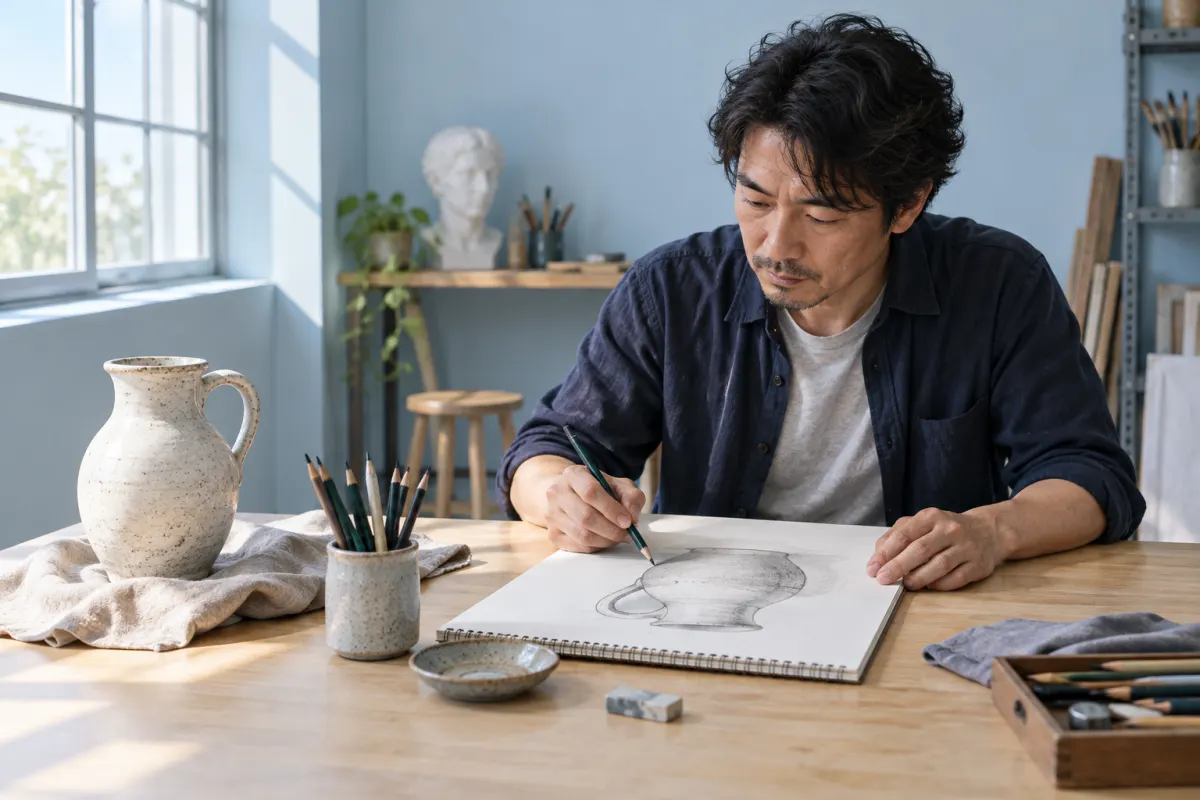
You remember two things you did on your day off: taking photographs and drawing. You want to give examples, rather than read out a complete timetable. Tari tari helps you frame that answer. The activities belong to the same account, but the construction does not claim that you performed them simultaneously or that the list contains everything you did.
Start with a small meaning decision before changing any verb ending. Are you offering examples, describing two actions happening together, or reporting a sequence? Those are different messages. This lesson concentrates on an illustrative list of ordinary activities, with a separate vocabulary-review step when a word blocks your answer. All people and situations in the exercises are fictional; the photographs illustrate activities rather than establish anybody's actual routine.
What tari tari contributes to your answer
休みの日は、写真を撮ったり、絵を描いたりします。Yasumi no hi wa, shashin o tottari, e o kaitari shimasu. “On my days off, I do things like take photographs and draw.” The expression 休みの日, yasumi no hi, means a day off. Here it establishes the situation in which these examples apply. We are describing a general pattern rather than identifying one dated outing.
写真を撮る, shashin o toru, means to take photographs. 絵を描く, e o kaku, means to draw or paint a picture in this context. The particle を marks the object of each activity and is read o. Keep the object with its verb while practising: remembering only the English words “photo” and “picture” is not yet enough to build the two activity phrases.
The answer leaves room for other activities. It does not say that drawing always follows photography, that both happen every day off, or that the person takes photographs while drawing. Those additional claims would need their own context. Think of the sentence as selecting useful examples for the conversation, rather than squeezing an entire day into two verbs.
Build each activity from the plain past form
For the pattern practised here, take the affirmative plain past form of each verb and add り, ri. 撮る, toru, becomes 撮った, totta, then 撮ったり, tottari. 描く, kaku, becomes 描いた, kaita, then 描いたり, kaitari. Join the two examples and finish the sentence with します, shimasu, for this polite nonpast model.
The Japan Foundation's grammar explanation presents this connection and describes activities selected as examples. Its examples also show why the ending of the whole sentence matters. Although the construction uses a form built from the plain past, the completed sentence is not automatically a report about yesterday. Do not translate every internal ta form as a separate past-tense sentence.
Work through one verb at a time. Write the dictionary form, its plain past, and the resulting tari form in three adjacent spaces. If you cannot justify the middle form, inspect that step before adding more examples. Our verb conjugation guide can support that review. Guessing by attaching tari directly to an unchanged dictionary form hides the very distinction this exercise is meant to reveal.
There is no need to memorise every possible verb in one session. Begin with the two activity phrases supplied here. Then add a third familiar verb only after checking its own form. For example, 読む, yomu, becomes 読んだ, yonda, and 読んだり, yondari. Notice that this particular result contains dari, not a forced unvoiced tari attached to yomu.

Change the final ending when the account changes
昨日は、写真を撮ったり、絵を描いたりしました。Kinō wa, shashin o tottari, e o kaitari shimashita. “Yesterday, I did things like take photographs and draw.” 昨日, kinō, supplies the time setting. The final しました, shimashita, makes this a polite past account. The two illustrative activity forms remain tottari and kaitari.
Place the habitual and yesterday versions next to each other. Underline します in the first and しました in the second. Then circle the time expression. This makes the change visible without inviting you to rebuild both activity forms unnecessarily. When you reread the sentences aloud, attend to the final ending instead of stopping after the second activity.
A useful diagnostic is to ask what new information your listener receives. In the first sentence, the listener learns examples of what you do on days off. In the second, the listener learns examples from yesterday. Neither version gives the exact start time, duration, or order. A correct ending does not supply facts that the sentence never expresses.
Examples are different from simultaneous actions
Imagine an exercise note that explicitly says a person listened to music while drawing. That is a simultaneous-action task. The earlier guide to nagara addresses that distinction.
Now change the note: “Yesterday: photography, drawing, several other activities. No order supplied.” An illustrative tari list fits the requested answer. The note does not establish overlap. You therefore should not turn it into a sentence claiming that one activity happened while the other was being performed. The mistake would concern the message, even if the individual words were all familiar.
A third note could ask for a detailed account of what happened first and what happened next. A two-example list is insufficient for that request. Supply the sequence from the given facts using language appropriate to that task. Do not treat tari as a universal replacement for English “and”; first decide what relationship between actions you actually need to communicate.

Keep vocabulary review separate from sentence review
This website and KanaWay share a publisher. KanaWay is in development. Its planned review and focused-practice approach can support returning to vocabulary you have studied. The workflow described here is conditional on suitable material being available. It is not an announcement of a released tari lesson, a particular activity deck, or automatic correction of your Japanese sentences.
If the missing item is the meaning of 撮る, make an attempt at that word before consulting support. Compare your answer with the actual prompt and its explanation. Then return to the paper exercise and build 写真を撮ったり separately. A successful vocabulary answer cannot by itself demonstrate that you selected the right construction, formed the verb correctly, or chose the right final ending.
If the vocabulary was available but you omitted します, repeating the noun “photograph” is poorly matched to the error. Your next task should require completing the whole sentence. Conversely, if you chose the right construction but forgot the verb for taking photographs, a focused word review may address the immediate gap. Our vocabulary guide explains the broader principle of retrieval followed by checking.
You can perform every sentence task here using paper and a covered answer. App support is optional. Keep two short notes: the word you could not retrieve, and the sentence decision you could not explain. These notes help you choose the next useful attempt without presenting a familiar word as proof that the entire grammar point is secure.
Six short tasks before you read the answers
First, use the supplied note “usual days off: photography and drawing, among other activities” to complete a polite illustrative sentence. Keep both objects and verbs. Second, change the account to yesterday. Write the complete sentence again rather than merely saying that it is now in the past.
Third, start from 読む, yomu, and write its plain past followed by its tari form. Fourth, a fictional learner says that two listed activities must have happened at the same time. Decide whether the illustrative list alone supports that conclusion. Explain your answer in one sentence in your own language.
Fifth, a learner remembers every word but finishes after 描いたり. Identify what is missing from the polite model practised here. Sixth, the note gives photography and drawing but says nothing about their order. Decide whether you can honestly add “first photography, then drawing” to your translation.
Make an independent attempt before uncovering the next section. If one question is difficult, leave a mark next to it and continue. That preserves the difference between what you could produce and what you understood only after seeing the model. These are diagnostic practice tasks, not a proficiency score or a promise about performance in conversation.
Check the meaning as well as the forms
For the first task: 休みの日は、写真を撮ったり、絵を描いたりします。Yasumi no hi wa, shashin o tottari, e o kaitari shimasu. Both actions are examples. For the second: 昨日は、写真を撮ったり、絵を描いたりしました。Kinō wa, shashin o tottari, e o kaitari shimashita. Check the time setting and the final ending separately.
For the third task, the chain is 読む → 読んだ → 読んだり, yomu → yonda → yondari. For the fourth, simultaneous action is not established. For the fifth, finish this polite model with します or しました as appropriate to the intended account. The exercise does not ask you to explain every possible conversational omission.
For the sixth task, the order is not supplied. Do not add it. Finally, cover both model sentences and answer a fresh prompt: give two examples from yesterday using the same verified activities. Compare your new attempt with the past model. A changed prompt is useful only when you check the actual message, not merely whether the sentence contains familiar syllables.

Questions about the method
Does the ta form inside tari mean the whole sentence is past?
No. In these models, attend to the completed construction and its final ending. Shimasu describes the nonpast habitual account; shimashita describes the past account. The time expression also helps establish what is being discussed.
Does listing two activities mean those were the only activities?
No. The purpose here is to select examples. Do not convert the answer into a complete diary, an exact sequence, or evidence that the activities occurred simultaneously. Those claims require additional information.
Should I review a word or repeat the whole sentence?
Choose the task that matches the error. A missing word calls for word retrieval and checking; a wrong construction or missing ending calls for a sentence attempt with a clear meaning prompt. You may need both, but assess them separately.