
Nagara in Japanese helps you describe two activities that overlap. The difficult part is not memorising a translation of “while”: it is keeping the same person responsible for both actions, choosing what your sentence is mainly about and building the first verb correctly. A familiar verb can still disappear from memory when those decisions arrive together.
This lesson separates the decisions in an ordinary evening at home. First retrieve a few action words, then build a sentence, then check whether the scene actually matches it. KanaWay’s source-verified word review can support the vocabulary step when suitable cards are available. The grammar examples and answer checks remain here, so a card result never substitutes for understanding the sentence.
Nagara in Japanese: name the person twice
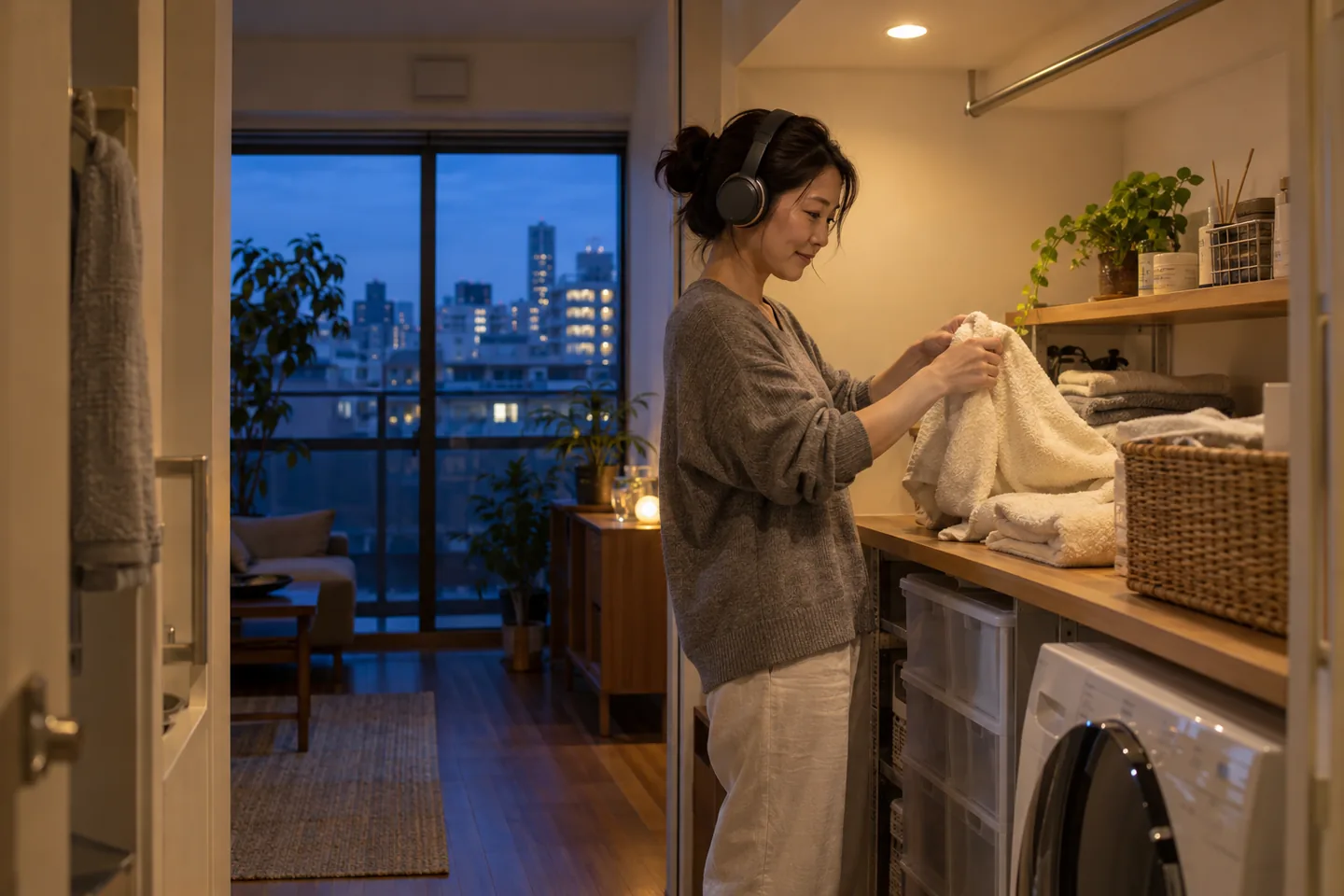
Imagine that you are cleaning your room and listening to music during the same activity. Write two notes: “I clean” and “I listen”. Circle the person in each note. The matching circles make this a suitable starting point for the temporal pattern in this lesson. The situation is an exercise prompt, not a claim that a photograph reveals what someone hears.
Now imagine that you read while your friend listens to music. The actions overlap, but the circles contain different people. Do not force this situation into our same-person construction. Keep two separate sentences until you have learned an appropriate way to express that different-person relationship. Similar English wording does not guarantee the same Japanese pattern.
Choose your main point before conjugating. If the question concerns your cleaning routine, cleaning ends the Japanese sentence and listening supplies the background. That choice determines which verb receives ながら.
Make a small stem set before joining clauses
Start from polite forms you can check: 聞きます, kikimasu, “listen”; 飲みます, nomimasu, “drink”; 読みます, yomimasu, “read”; and します, shimasu, “do”. Remove the final ます to obtain 聞き, kiki; 飲み, nomi; 読み, yomi; and し, shi. Attach ながら to that remaining stem. Thus 聞きながら is kikinagara, “while listening”.
Do not simply add ながら to the dictionary form. 聞く, kiku, is useful vocabulary, but this exercise needs the stem heard in kikimasu. Likewise, する, suru, becomes しながら, shinagara, through shimasu. Work from the complete polite form rather than guessing a single spelling rule from one verb.
The St. Olaf College grammar note confirms the verb-stem construction and the shared actor. Keep its short explanation beside your first attempt, then close it. If the surrounding word order is unfamiliar, our Japanese sentence structure guide provides the foundation. Today’s task is a small controlled pattern, not every possible use of ながら.
Build the cleaning sentence from its message
Use 音楽を聞きながら、部屋を掃除します。Ongaku o kikinagara, heya o sōji shimasu. “I clean my room while listening to music.” 音楽, ongaku, is music; 部屋, heya, is a room; 掃除します, sōji shimasu, means “clean”. The person is understood from the prompt. Both actions belong to that same person.
Point to 聞きながら and explain the background activity. Then identify 掃除します as the main statement. Cover the translation and recover who does what before trying to read faster.
For a second attempt, keep the Japanese hidden and read only this prompt: “Your cleaning routine includes music at the same time.” Retrieve ongaku and heya first. If one word is missing, note that specific gap. Then reconstruct the sentence and compare the two verbs. This gives vocabulary recall and clause choice separate, observable checks.
Read with tea and keep the focus clear
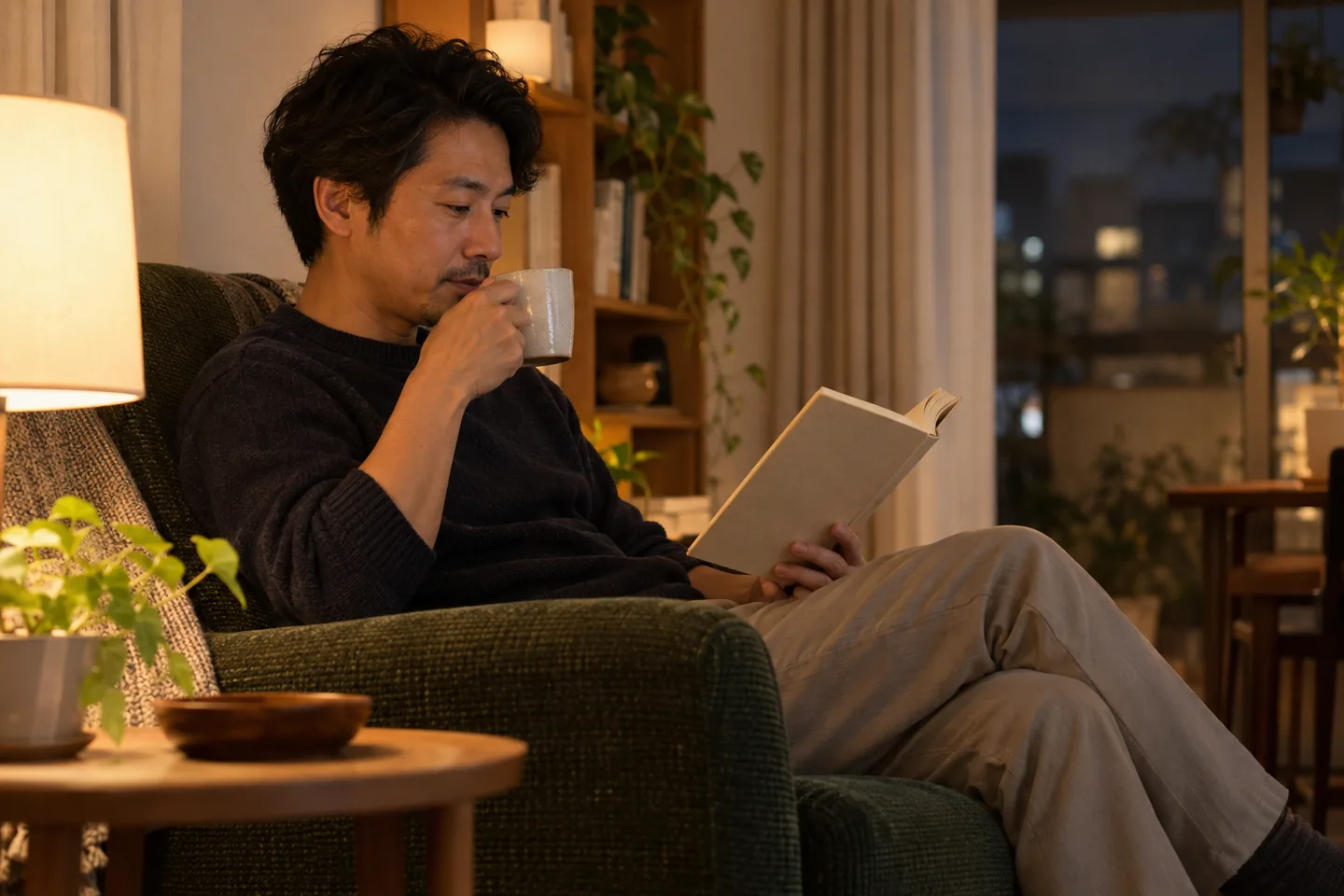
A second model is お茶を飲みながら、本を読みます。Ocha o nominagara, hon o yomimasu. “I read a book while drinking tea.” The written prompt establishes one person and overlapping activities. お茶, ocha, means tea; 本, hon, means a book. Reading is the main statement and drinking provides its setting.
Suppose the question changes to what you do while reading. 本を読みながら、お茶を飲みます。Hon o yominagara, ocha o nomimasu. “I drink tea while reading a book.” The basic scene can still contain tea and a book, but the final action now presents drinking as the main point. Swapping the clauses is therefore a decision about presentation, not a mechanical way to generate a second identical answer.
Neither sentence requires uninterrupted sipping during every instant of reading. Our scene describes an ordinary overlapping activity. Do not turn the lesson into advice to multitask, or choose an unsafe combination merely to fit a grammar pattern. A photograph supplies a possible setting; the written scenario establishes the relationship to practise.
Change the final ending for a past account
To report a completed reading session, use お茶を飲みながら、本を読みました。Ocha o nominagara, hon o yomimashita. “I read a book while drinking tea.” The Japanese final verb now has the polite past ending ました. The background form 飲みながら stays the same in this example.
English “read” looks identical in writing for present and past. Add “yesterday evening” to your English practice note so that you do not accidentally hide the tense decision from yourself. Compare yomimasu and yomimashita aloud and mark the changed part. The task is to report the time supplied by the prompt, not to alter every verb independently.
Keep the first practice round affirmative. Negation and more complex aspect can create additional interpretation questions that deserve their own examples. The nonpast form can describe a routine or a future situation depending on context; it is not proof that someone is doing both activities at this exact moment. State the intended context before judging your answer.
Two people need a different decision
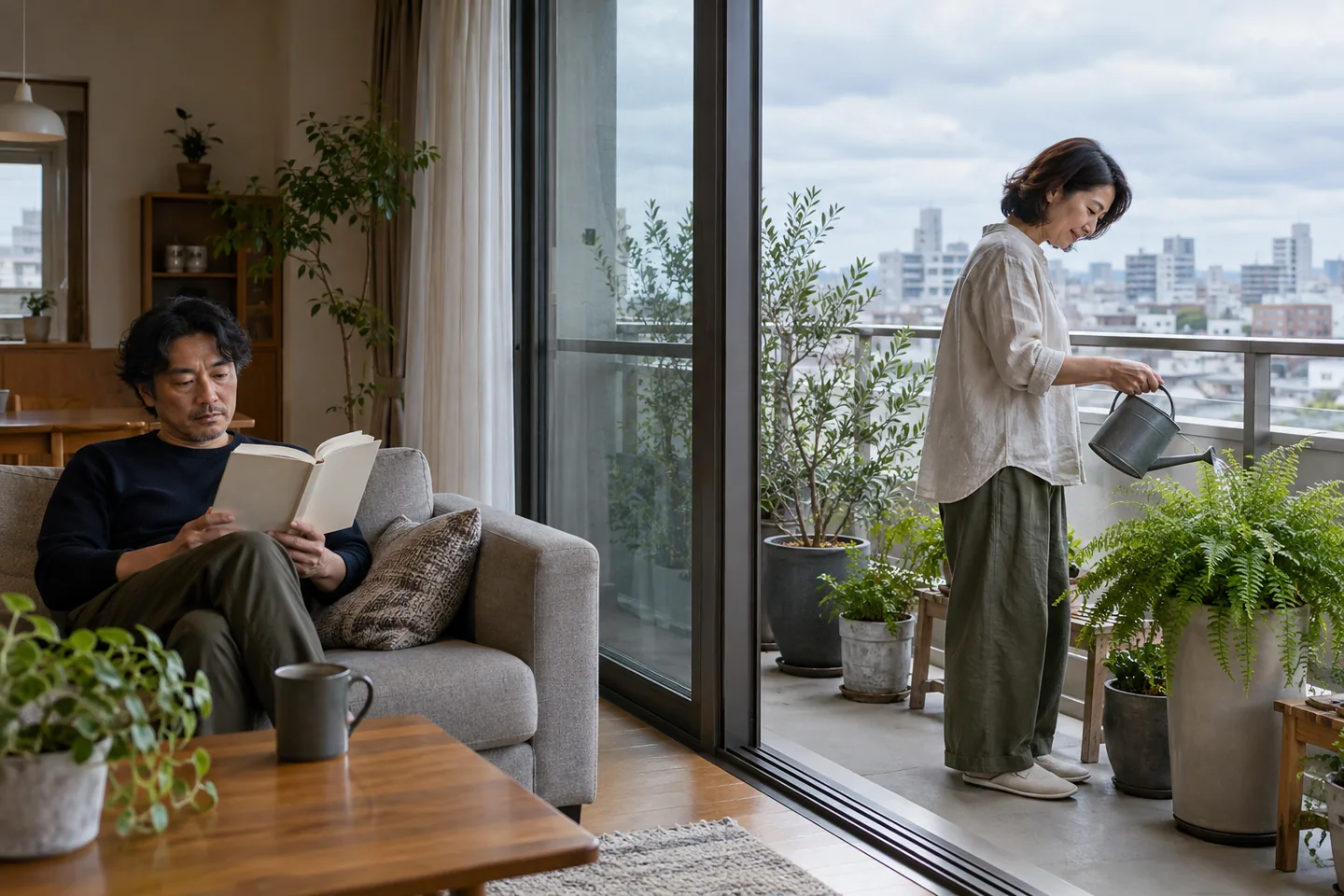
In the balcony scene, one adult waters a plant and another reads indoors. Even if those actions happen at the same time, “the reader also waters” would change the facts. Before choosing a connector, draw one small box for each person and put their activity inside it. The two boxes should remain distinct.
For a simpler written contrast, use サラさんは本を読みます。Sara-san wa hon o yomimasu. “Sara reads a book.” Then レンさんは音楽を聞きます。Ren-san wa ongaku o kikimasu. “Ren listens to music.” These two sentences preserve the separate actors. By themselves they do not explicitly encode simultaneity; your exercise note supplies that extra fact.
The LMU linguistic study discusses Japanese connections including temporal ながら. Here we deliberately keep to its beginner same-actor use. Expressions such as 残念ながら, zannen nagara, “unfortunately”, are outside this exercise. Do not extend our action recipe to every word that happens to contain the same kana.
Use KanaWay to isolate a missing verb
Publisher disclosure: Learn Japanese Hub is produced by the KanaWay publisher. KanaWay remains in development. The existing project source contains a word-review flow with an attempt, answer reveal, optional pronunciation playback and a self-rating that affects later review. This supports a bounded vocabulary task; it does not establish a released ながら course, automatic grammar correction or availability of these exact example cards.
If a suitable stored word card is available, attempt its answer before revealing it. For today’s sentence, a missed “listen” word should be reviewed as that word, rather than treated as proof that the entire grammar pattern failed. Reveal, compare the actual answer and choose a rating that reflects your recall. A correct isolated word still needs to be placed into the sentence afterwards.
Playback prefers a matching bundled clip where one exists and otherwise depends on a Japanese device voice. A missing voice can prevent playback. It does not analyse your pronunciation or judge the two-clause meaning. Our Japanese vocabulary guide explains keeping words in useful contexts; return to the written scenario after the card check.

Separate the study stages on purpose
Although the grammar describes overlapping activities, the practice does not require you to review cards while cleaning. Sit down for the recall step. Then put the device aside and build the sentence on paper. This removes distractions from a task whose goal is identifying a particular error, not demonstrating how many things you can do at once.
Keep three columns in your notes: word, form and message. Under “word”, record a missing ongaku or yomu. Under “form”, record a mistaken stem or final ending. Under “message”, record different actors or a mismatch between the prompt and the main action. One attempt may need more than one mark, but the marks tell you what to revisit.
After a short unrelated activity, retry one prompt without the model. Compare it with your earlier attempt rather than assuming that a self-rating guarantees retention. The Japanese practice guide offers broader ways to structure recall. For this lesson, a useful next step is one changed context with the same small verb set.
Try six checks before reading the answers
One: give the ながら form from 聞きます, including its reading. Two: the same person cleans a room with music playing and listening as background; identify the final action. Three: make the tea-and-reading model a polite past account without changing which activity is the main point.
Four: Sara reads and Ren listens simultaneously. Is our same-person ながら pattern suitable for joining those two actors? Explain before writing anything. Five: someone finishes cleaning, stops, and only afterwards listens to music. Does temporal overlap describe that prompt? Six: a word card was recalled correctly, but your sentence uses different people for the two actions. Which note column still needs work?
Explain four and five rather than guessing “no”. Identify the mismatching person or non-overlapping time. Underline the final ending in three to show your tense decision.
Check the reason, then change one detail
One is 聞きながら, kikinagara: remove ます from kikimasu and attach ながら. Two ends with 部屋を掃除します, heya o sōji shimasu, because the prompt makes cleaning the main statement. Three is お茶を飲みながら、本を読みました。Ocha o nominagara, hon o yomimashita. The final past ending reports the completed session.
Four needs a different construction or separate sentences because Sara and Ren are distinct actors. Five describes a sequence, not the overlapping activities practised here. Six belongs in the message column: remembering a vocabulary answer does not repair the actor relationship in a sentence.
For a final transfer task, replace tea with water: 水, mizu. Keep reading as the main activity and use the same person. Write the new line before comparing: 水を飲みながら、本を読みます。Mizu o nominagara, hon o yomimasu. Explain the person, overlap, stem and final action. If those four decisions remain clear when one noun changes, you have evidence of using the pattern beyond a memorised string.
Questions about the method
Can I attach nagara to the dictionary form?
Not in this temporal verb pattern. Start from kikimasu, remove masu and add nagara: kikinagara. The dictionary form kiku is useful for identifying the verb, but it is not the attachment form in this exercise.
Does this pattern join different people?
The temporal beginner pattern practised here keeps the same actor for both actions. If Sara reads and Ren listens, preserve those distinct people rather than using our model to make them one. Other constructions need their own explanation.
Does a successful KanaWay review validate my sentence?
No. The source-verified flow can support recall of an available stored word. Its self-rating and playback do not check the actor, overlap, verb connection or intended main action in your sentence. Verify those decisions with the written model.