
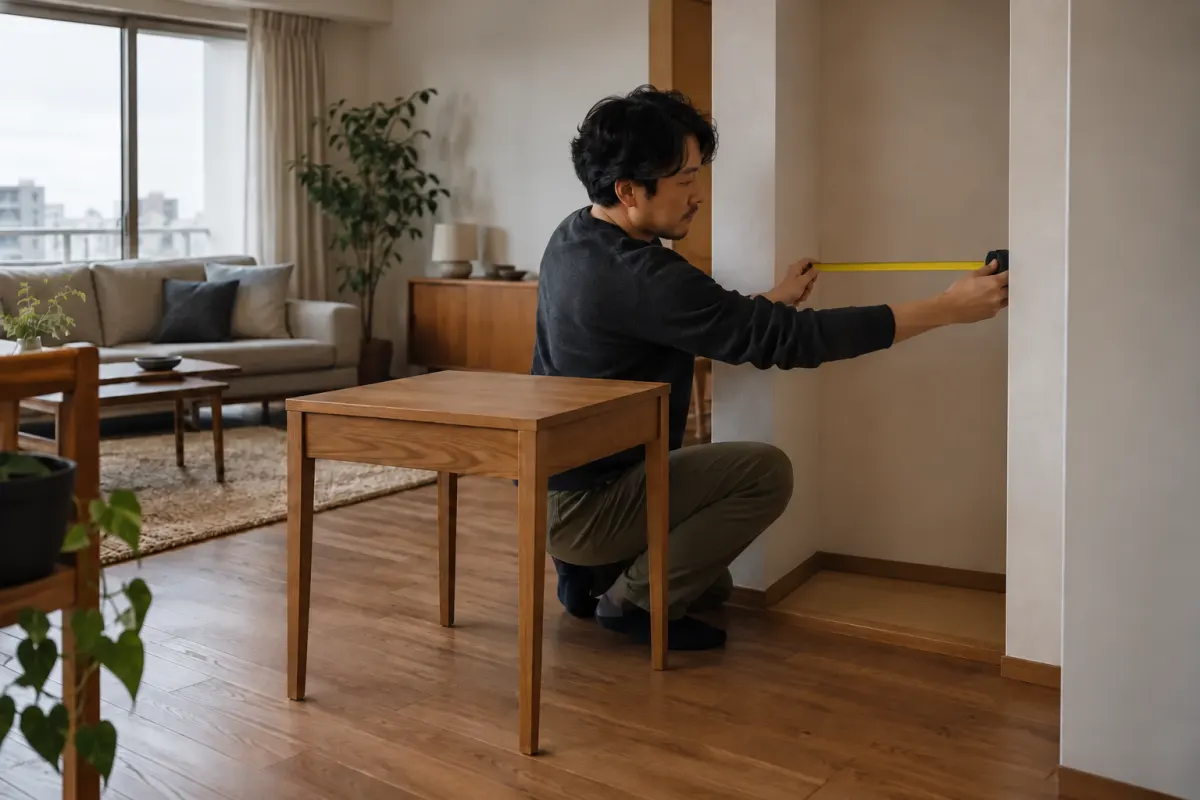
A table can be very large and still be exactly what a room needs. Another table can be too large for the space you have. Those descriptions do different jobs. Sugiru helps you express excess, rather than simply turn up the strength of an adjective. Before building the Japanese phrase, decide what is excessive and what purpose makes that judgment useful.
This lesson uses fictional adults arranging a small apartment and a home desk. A wide tray, a long curtain and an excessive pile of copied paper give us concrete meanings to check. The photos are illustrations, not measurements or evidence about real products. You can complete every task with paper and your own voice; no application or purchase is necessary.
Give sugiru a meaningful situation
このテーブルは大きすぎます。Kono tēburu wa ōkisugimasu. “This table is too big.” The sentence identifies a table and judges its size excessive. In our fictional situation, the available alcove is narrower than the table. That supplied fact makes the judgment understandable. The sentence alone does not give either measurement, and it does not say the table is poorly made.
Compare このテーブルはとても大きいです。Kono tēburu wa totemo ōkii desu. “This table is very big.” とても, totemo, intensifies the description. It does not by itself say that the size exceeds a requirement. A large table may be welcome when several people need to work together. Translate the intended judgment rather than replacing every English “very” with sugiru.
Try giving the two sentences different situations. For the first, imagine a table that cannot fit the chosen corner. For the second, imagine a spacious workshop where the same size is useful. We are changing the purpose against which size is judged, not claiming that one object physically grows or shrinks. Context helps you check meaning even when the adjective stays familiar.
Connect an ordinary i-adjective correctly
Start from 大きい, ōkii, “big.” Remove the final い and add すぎる: 大きすぎる, ōkisugiru. For the polite nonpast model used here, change the final verb to すぎます: 大きすぎます, ōkisugimasu. Do not keep the adjective's final i and then attach sugiru to an unchanged ōkii.
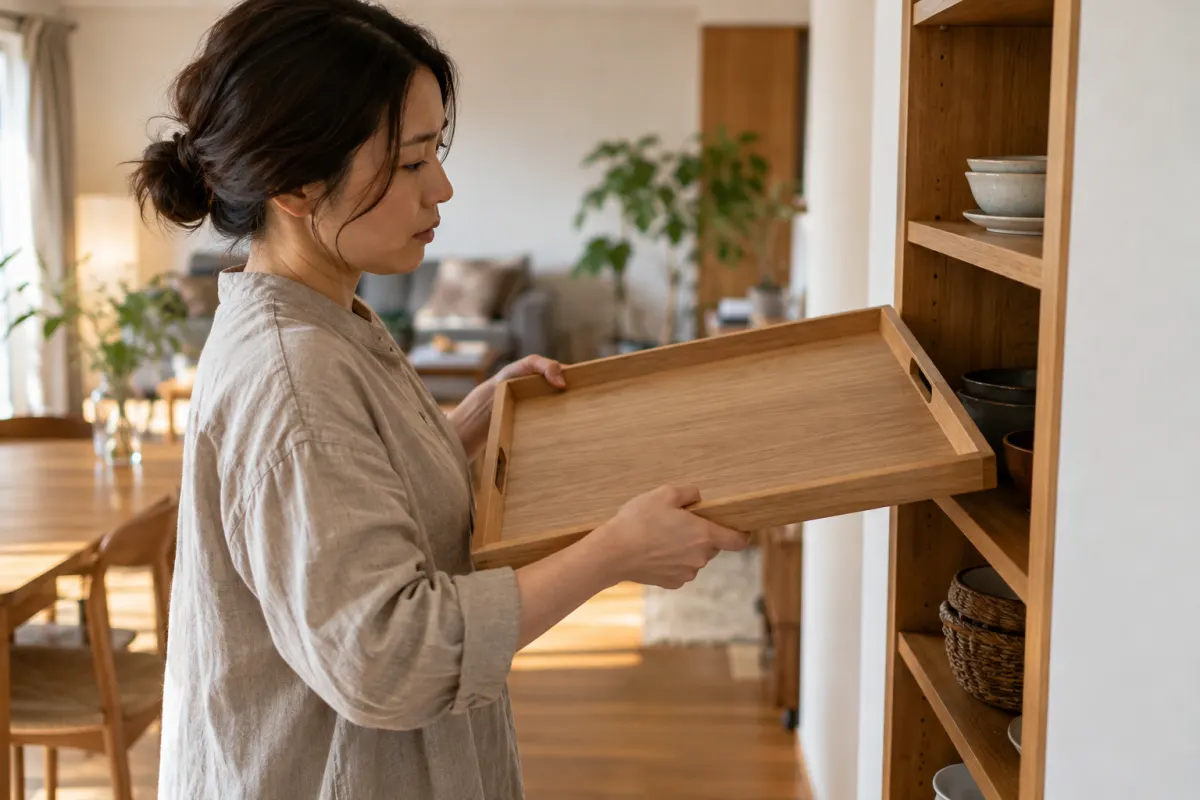
Apply the same ordinary pattern to 長い, nagai, “long.” You obtain 長すぎる, nagasugiru, and the polite 長すぎます, nagasugimasu. このカーテンは長すぎます。Kono kāten wa nagasugimasu. “This curtain is too long.” In the supplied example, the curtain extends farther onto the floor than the fictional person wants. The judgment concerns length, not automatically the fabric's quality or price.
The St. Olaf College grammar explanation describes attachment to verb stems and adjective bases, and explains that sugiru behaves as a regular ru-verb. This article keeps the practice to a few checked affirmative forms. It does not ask you to infer every exceptional adjective, negative construction or conversational shortening from this introductory pattern.
Write the transformation in three spaces: original adjective, base, completed polite form. For ōkii, that is 大きい → 大き → 大きすぎます. For nagai, it is 長い → 長 → 長すぎます. Read the full result, including its ending. A familiar meaning is useful, but it does not remove the need to inspect the actual form you produced.
A na-adjective uses its base too
静か, shizuka, is a na-adjective meaning “quiet.” In the pattern practised here, use 静かすぎる, shizukasugiru, or the polite 静かすぎます, shizukasugimasu. Do not insert na immediately before sugiru. The na you meet when this adjective modifies a noun is not something to carry into every construction involving that word.
この部屋は静かすぎます。Kono heya wa shizukasugimasu. “This room is too quiet.” That is a speaker's assessment in a situation. Perhaps a fictional recording exercise needs audible conversation, but the room is silent. It is not a general claim that quiet rooms are undesirable. Supply the task's context before treating an unfamiliar judgment as a cultural rule.
Keep the two adjective routes visible: an ordinary i-adjective loses its final i; a na-adjective supplies its base without na here. Our adjective guide gives a broader introduction to these categories. Do not classify shizuka by guessing from an English translation, and do not assume that every word ending in the letter i follows the ordinary i-adjective pattern.

With a verb, identify the stem first
コピーします, kopī shimasu, means “make copies” in this context. Remove masu from shimasu to obtain shi, then attach sugiru: コピーしすぎる, kopī shisugiru. For our polite past account, use コピーしすぎました, kopī shisugimashita. The excess now concerns an action rather than the size or length of an object.
昨日、コピーしすぎました。Kinō, kopī shisugimashita. “Yesterday, I made too many copies.” The fictional note says that the person needed a small number of copies and produced more than that. The Japanese sentence does not state the exact number. Do not insert a numerical claim into the translation simply because the photograph contains a visible pile.
The stem connection is a separate decision from choosing the final tense. First identify the relevant activity and its stem. Then build the excess expression. Finally choose the ending that matches the time and politeness of the account. Our verb conjugation guide supports that broader form review. Repeating the entire phrase quickly can hide which of those steps caused a mistake.

Let the final verb carry the ending
大きすぎます, ōkisugimasu, is our polite nonpast form. 大きすぎました, ōkisugimashita, is its polite past counterpart. 昨日のテーブルは大きすぎました。Kinō no tēburu wa ōkisugimashita. “Yesterday's table was too big.” In a fictional furniture comparison, this could refer to the table examined yesterday. The phrase needs that referent; it does not imply that today's table is a different size.
Notice what we do not rebuild: we do not turn ōkii into its ordinary adjective past form and then append sugimasu. The completed excess expression has a final verb whose ending we change. Keep 大きすぎます and 大きすぎました next to each other and underline the difference. You are checking one controlled contrast, rather than learning every tense at once.
When practising aloud, finish the whole sentence. A correct base followed by an unfinished ending is not the same answer as a complete polite statement. Conversely, a fluent ending attached to the wrong base does not solve the form task. Mark the connection and the ending separately so that your next attempt addresses the actual gap.
Six tasks with supplied facts
First, a table does not fit its chosen alcove because of its size. Use ōkii to describe the excess in a polite sentence. Second, a table is impressively large but perfectly suitable for a workshop. Does “very big” or “too big” match that note? Explain your choice before selecting the Japanese expression.
Third, a curtain is longer than the fictional owner wants. Begin with nagai and write the complete polite excess expression. Fourth, the activity note says “yesterday: made more copies than needed.” Produce the past sentence using kopī shimasu. Do not add a number that the note does not provide.
Fifth, form the polite excess expression from shizuka without inserting na. Sixth, another learner writes an ordinary adjective past before sugimasu when trying to say that yesterday's table was too big. Identify which part should instead carry the past ending, then write the model used in this lesson.
Cover the answer section while attempting these tasks. You can write an explanation in English beside a Japanese form if that helps reveal your reasoning. The aim is not to award yourself a proficiency score. It is to find out whether your difficulty concerns the intended judgment, the connection to sugiru, or the final ending.
Check your answer against the intended judgment
For the first task: このテーブルは大きすぎます。Kono tēburu wa ōkisugimasu. The given fit problem supports “too big.” For the second, the note supports このテーブルはとても大きいです。Kono tēburu wa totemo ōkii desu. The size is strong, but no excess relative to the workshop's need is stated.
For the third: このカーテンは長すぎます。Kono kāten wa nagasugimasu. Check the removal of the final i in nagai. For the fourth: 昨日、コピーしすぎました。Kinō, kopī shisugimashita. The stem shi connects to sugiru, and the ending expresses the polite past account. No exact quantity has been invented.
For the fifth, the expression is 静かすぎます, shizukasugimasu. For the sixth, the past belongs at the end of the completed verb: 大きすぎました, ōkisugimashita. Rebuild the supplied full sentence if you need practice identifying the referent and topic, rather than stopping at an isolated ending.
Now change only one fact. The curtain was too long yesterday: 昨日のカーテンは長すぎました。Kinō no kāten wa nagasugimashita. Use this only with a clear fictional referent, such as the curtain inspected yesterday. Explain what changed and what remained the same. Our sentence structure guide helps you keep the topic and final predicate connected during such comparisons.
Questions about the method
Is sugiru simply a stronger way to say very?
Not in the excess use practised here. “Very” describes a high degree; “too” judges that degree excessive for some context. Other conversational uses need their own context. Do not assume that every emphatic expression has an identical tone or function.
Does a photo tell me what counts as too big?
No. A photograph can illustrate the object, but the exercise must provide the requirement or judgment. Different people may need different sizes. Do not invent measurements, product defects or somebody's preferences from an image alone.
What should I practise after a mistake?
Match the next prompt to the error. If you confused very and too, change the situation and explain the meaning. If you chose the right meaning but built the wrong form, practise the base connection. If only the time was wrong, contrast the final endings while keeping the same verified expression.