
A colleague asks you to put two notebooks in a carton. You know the number two and the Japanese word for notebook, but joining them into a useful request still takes a decision. Satsu, written 冊, supplies the counting unit for books and similar bound items. Learning that unit with a concrete task helps you connect the object, quantity and action instead of reciting unrelated numbers.
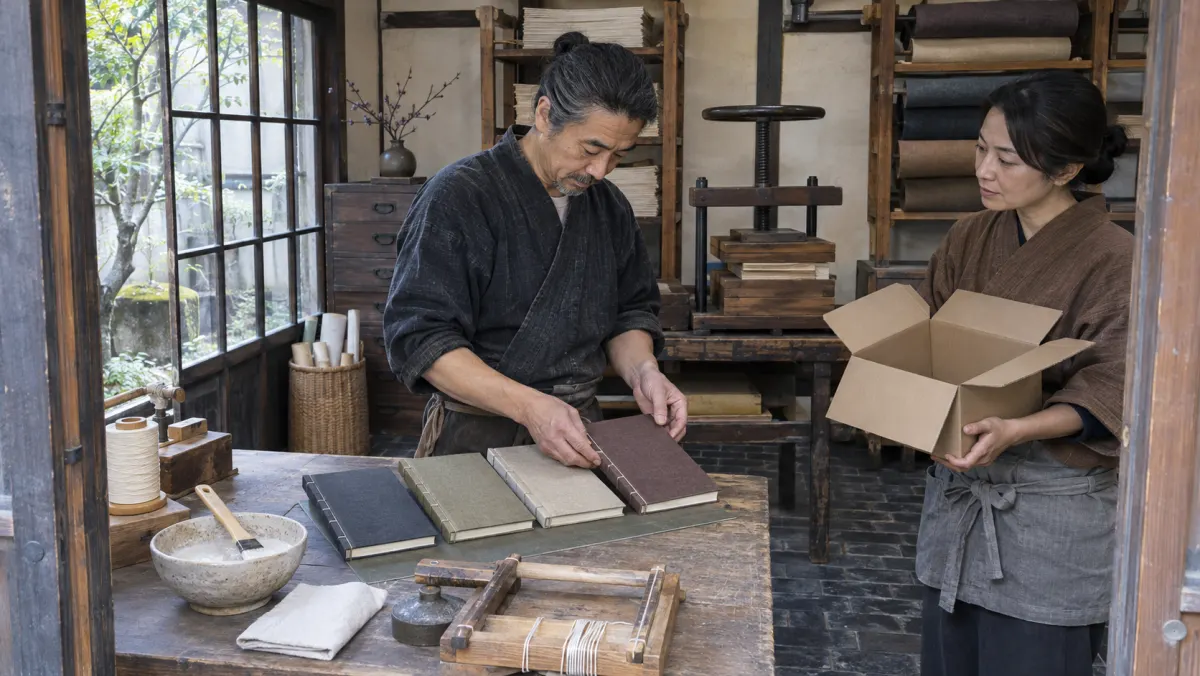
Our fictional setting is a bookbinding workshop preparing plain notebooks for a small event. The people and order quantities in the exercises are invented. You will count bound objects, ask how many are needed and distinguish a request from a report of what was packed. The photographs show the materials and work; the written prompts supply the exact quantities for your answers.
Use satsu for the bound item you mean
A notebook contains many sheets, but a request for two notebooks counts two bound objects. ノート, nōto, is the notebook noun; 二冊, nisatsu, is the quantity of two with the counter. Keep those roles separate. If you count every leaf inside the notebook instead, you have changed the unit, even if your arithmetic is accurate.
The National Institute for Japanese Language and Linguistics entry for 冊 identifies its book-counting use and includes notebooks in an example. Our workshop uses that familiar bound-item meaning. This lesson is not a complete guide to every publication format or to numbering volumes in a series. First establish what the present task asks you to count.
Try a physical contrast. Place one closed notebook beside several loose sheets. Point to the notebook as one bound item, then point to the separate sheets. You do not need to learn every paper-related counter today. You do need to notice that the same material can be organised into different countable things. Our Japanese numbers and counters guide gives the broader counting framework.

Retrieve the quantity as a complete expression
Start with 一冊, いっさつ, issatsu, one bound book or notebook; 二冊, にさつ, nisatsu, two; and 三冊, さんさつ, sansatsu, three. Say each full expression while checking its meaning. Do not pronounce the character 一 as ichi and assume that placing satsu after it will produce the correct spoken form automatically.
The small っ in いっさつ matters. In the romanisation issatsu, the doubled s represents the consonant timing. It is not a separate “tsu” syllable inserted between two ordinary words. Compare the kana with the complete reading, then return to the counted item. A memory for the sound is useful when it remains connected to the intended quantity.
Two further forms worth checking are 八冊, はっさつ, hassatsu, eight, and 十冊, じっさつ, jissatsu, ten. You may also encounter じゅっさつ, jussatsu, for ten. We use jissatsu in the exercises so that one answer convention remains consistent. The Mikuni International textbook chapter presents the sound changes for one, eight and ten and contrasts 六冊, rokusatsu, six, which keeps roku.

Put the number into a useful request
ノートを二冊ください。Nōto o nisatsu kudasai. “Two notebooks, please.” The notebook noun comes before を, read o; the counted quantity follows it; kudasai completes this simple request for the items. This is a practical model for our fictional counter exchange. It is different from the earlier negative-request construction telling somebody not to do an action.
Change the quantity to one: ノートを一冊ください。Nōto o issatsu kudasai. “One notebook, please.” The noun and request frame remain stable. The change affects the complete counted expression, including its reading. Say the whole request after checking issatsu, rather than practising the number perfectly and then losing it when the rest of the sentence arrives.
You can also recognise a quantity attached before a noun: 二冊のノート, nisatsu no nōto, “two notebooks.” Notice の in this noun phrase. It does not belong in the same position in ノートを二冊ください. These are two useful arrangements with different jobs. Our sentence structure guide can help you identify which part names the object and which part supplies the quantity.

Ask for the amount before choosing a number
ノートは何冊ですか。Nōto wa nansatsu desu ka. “How many notebooks?” In a context where the notebook order is already being discussed, this asks for its quantity. 何冊, nansatsu, is the question expression. The written 何 does not require you to pronounce a separate nani before satsu in this model.
Suppose the organiser's reply is 二冊です。Nisatsu desu. “Two.” The counter makes the unit recoverable from the shared notebook context. A short answer can be enough when everybody knows what is being counted. If the conversation has moved between notebooks, loose sheets and cartons, clarify the object rather than relying on a bare number to repair the confusion.
Practise the exchange in two roles. One person sees an order quantity; the other sees only the notebook item. Ask, answer and then make the request. Switch roles with a new quantity. The purpose is to retrieve the missing information, not to test whether your partner remembers a fixed dialogue. Keep the prompt visible to the answerer and hidden from the person asking.
Separate an order from a completed packing report
ノートを三冊入れました。Nōto o sansatsu iremashita. “I put three notebooks in.” In our workshop context, the carton has already been identified. 入れました, iremashita, reports the completed putting-in action politely. Compare it with the request for two notebooks: both contain a counted quantity, but they do not report the same event or the same amount.
For this exercise, the order is two notebooks and the packing report says three. The useful response is to notice a mismatch between requested and reported quantity. Correct pronunciation alone does not make the order fulfilled. You must keep the object, number and event connected. A request states what is wanted; a completed report states what the speaker says was done.
Do not turn this into a real inventory claim from a cropped photograph. Some notebooks may be outside the frame or already in the carton. Work from the supplied statements. If the task gives an initial quantity and a quantity packed, you can calculate a remainder only when it says those are the relevant objects and no other changes occurred. Language comprehension comes before subtraction.
Try six short checks without the model visible
One: the workshop needs one bound notebook. Write its counted quantity in kanji, kana and romanisation. Two: an order requests two notebooks. Produce the complete polite request used in this lesson. Three: you need the amount for the notebook order but the prompt supplies no number. Write the quantity question instead of inventing an answer.
Four: a colleague asks for eight notebooks. Give the complete reading of 八冊. Five: a note says six bound notebooks. A learner changes roku to a doubled consonant by copying a different counter. Give the reading needed for 六冊 here. Six: the order requests two notebooks, but the report says ノートを三冊入れました. Explain the discrepancy in your own words.
Attempt the checks in a mixed order after the first pass. An ascending sequence can provide a clue that disappears in a real request. Record whether a mistake concerned the object category, counted reading or sentence meaning. Those are different repairs. Repeating a full number list will not necessarily fix a misunderstanding of what the colleague asked to receive.
Check the answer and change one detail
One is 一冊, いっさつ, issatsu. Two is ノートを二冊ください。Nōto o nisatsu kudasai. Three is ノートは何冊ですか。Nōto wa nansatsu desu ka. Check whether you kept a real question for the unknown amount. A fluent sentence with an invented quantity does not answer an information gap.
Four is はっさつ, hassatsu. Five is ろくさつ, rokusatsu. Six describes three notebooks reported packed against two requested, a difference of one notebook in this controlled situation. It is not a statement that every notebook in the workshop has been counted. The scope remains the specific order and report supplied in the prompt.
For a final transfer, change the requested amount from two to ten while leaving the notebook and polite request frame intact: ノートを十冊ください。Nōto o jissatsu kudasai. Explain the unit, reading and purpose of the sentence. Then use our small-tsu lesson if you need a focused reminder of consonant timing. End with a new quantity prompt, not another look at the answer you already remember.

Questions about the method
Does 冊 count every sheet inside a notebook?
No. In this lesson it counts the bound notebook as an item. Counting loose sheets or individual pages asks a different question. Identify the unit before choosing the counted expression, especially when several paper objects appear on the same workbench.
Is 本 the counter here because it means book?
No. The noun 本, hon, can mean book, but our book-counting unit is 冊. Learn the complete noun-and-quantity expression rather than assuming that a familiar kanji has the same function everywhere it appears in Japanese.
Must I learn every Japanese counter before using this request?
No. Practise this limited bound-item task with verified readings and a clear context. You can expand to other counters later. Accurate use of one small set is more useful here than a long list whose numbers, objects and sentence roles remain disconnected.