
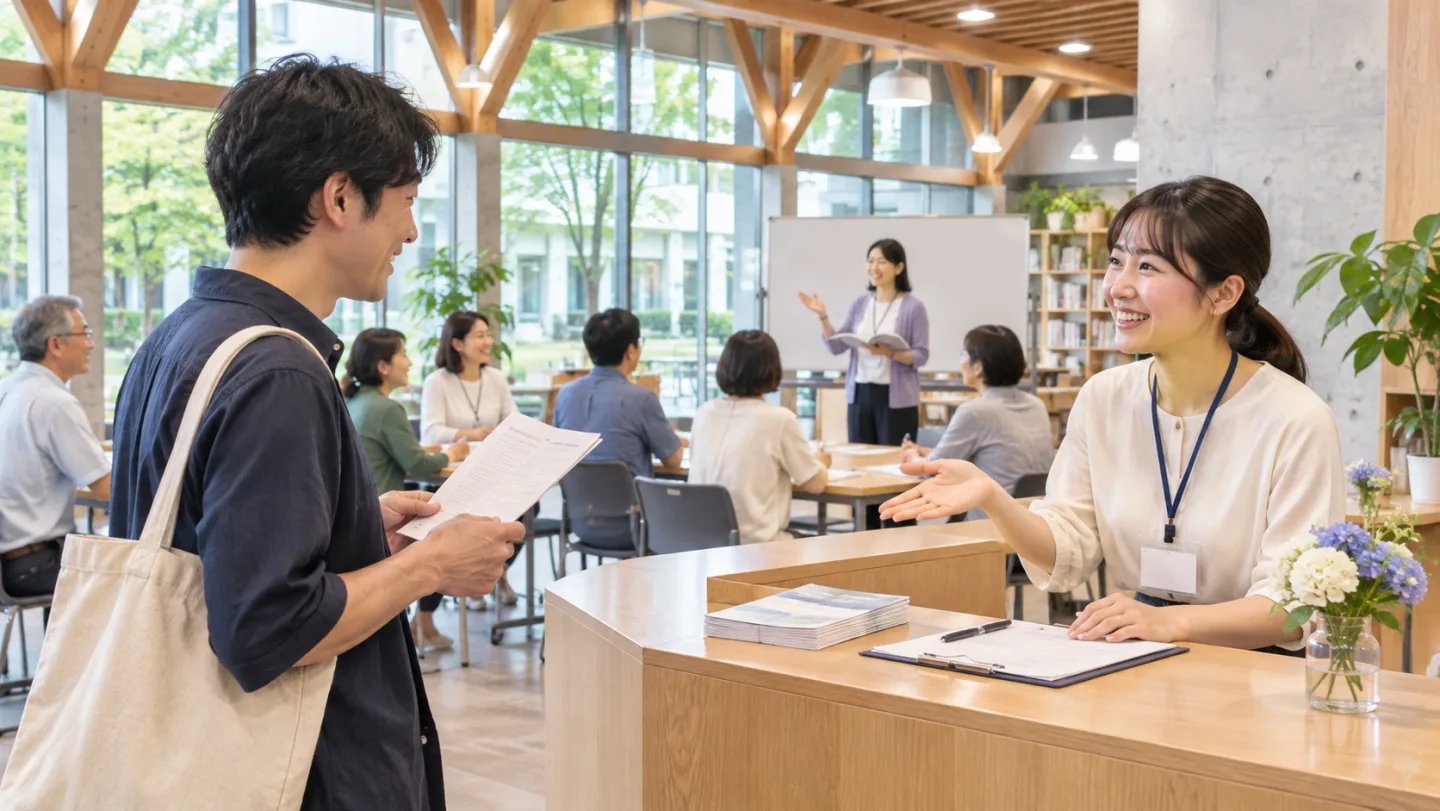
You're going to a workshop and already have the joining information. Do you still have to bring a printed copy? 印刷しなくてもいいです (いんさつしなくてもいいです) means that printing isn't required. **Nakutemo ii** leaves the choice open in this exchange. If you already printed a copy, the receptionist's reply gives you no reason to throw it away. Start by deciding whether someone can skip the action, must skip it or has to do it. Nakutemo ii makes the choice explicit.
Nakutemo ii leaves an action optional
At the reception desk, you ask whether a paper copy is required. The receptionist knows you already have the details. When they reply 印刷しなくてもいいです, they are saying that skipping the printing is acceptable. You can put the sheet back in your bag if you brought one. You can also arrive without one. The response does not tell you how the rest of the check-in works. Keep the answer attached to the action you asked about. A person can be excused from printing and still need to tell the receptionist their name.
Break the form into pieces. 印刷する (いんさつする) means “to print.” The plain negative is 印刷しない (いんさつしない). Change the final い of しない to くて to make しなくて, then add もいい. The resulting expression 印刷しなくてもいい can be understood as “It's fine even if you don't print it.” In this setting, “You don't have to print it” is natural English. The Japanese sentence tells you the relevant alternative is allowed. It doesn't issue a new instruction to avoid printing.
To check that you heard the form, imagine arriving with an empty folder. Would the receptionist's answer require you to go away and find a printer? No. Imagine arriving with a printed copy. Would it require you to get rid of it? Again, no. Both outcomes can be compatible with the answer. If the staff have a separate rule about where papers can go, they need to state that rule separately. Use this two-outcome check whenever “don't have to” starts to sound like “mustn't” in your head.

Listen for three distinct answers
Take the action 印刷する and keep the object the same throughout the exercise. 印刷してもいいです (いんさつしてもいいです) tells you that printing is allowed. If you asked whether you could use the printer, that answer resolves your permission question. It doesn't tell you that you must use it. 印刷しなくてもいいです tells you that skipping the printing is acceptable. It resolves a question about whether the action is required. 印刷してはいけません (いんさつしてはいけません) says you must not print. In a fictional workshop that might be an instruction about confidential material, but the grammar exercise doesn't make a claim about any actual venue.
The difference is easier to hear if you line up the verbs. 印刷して is the affirmative te-form. 印刷しなくて is built from the plain negative. Both can appear with もいい, so listening only for いい misses the difference between permission to do something and permission to skip it. In 印刷してはいけません, the end changes as well. Practise by keeping the first verb fixed and asking a partner to read the three forms in random order. Your first answer should be a short explanation of the practical instruction.
Ask yourself what the listener has to decide. “May I print?” is a question about whether printing is permitted. “Do I have to print?” is about whether going without a printout is allowed. They can be answered with different information even if the receptionist allows both choices. If you start by translating every answer as simply “yes” or “no,” the connection with the original question can disappear. Repeat the action in your paraphrase. It is clearer to say “You can skip printing” than to say “No” and hope the other person remembers which question you were answering.
The Japanese intensive course explanation describes how nakutemo ii removes the need to perform an action. Use the Japanese grammar guide to review the negative form.

Check whether another requirement still applies
Imagine the receptionist adds 名前を言ってください (なまえをいってください), “Please tell me your name.” That's a separate instruction. It doesn't cancel the earlier permission to skip printing. Put the actions in two lines in your notes. For “print the information,” write “optional.” For “give your name,” write “requested at check-in.” In an actual conversation, those two statements might come one after the other without a long explanation. Separating the actions helps you avoid treating the whole exchange as one general statement about whether there are rules.
Try a second example. Someone asks whether they must arrive twenty minutes early. 早く来なくてもいいです (はやくこなくてもいいです) says that coming early is unnecessary. The form 来なくて comes from 来ない (こない), not from a regular pattern that preserves the vowel in 来る (くる). The sentence doesn't say that the person can arrive after the start. If the start time is important, ask for it explicitly or state it in a separate line. The choice concerns early arrival, and the rest of the schedule still exists.

Use app review as a cue to recall the negative form
If you meet a suitable verb during a KanaWay review session on Android, say its plain negative aloud before moving to the next item. You can then say the form ending in なくて and add もいい yourself. Write down a verb that took you a while. If none of the session's words fit, use 書く → 書かない → 書かなくてもいい (かく → かかない → かかなくてもいい), “you don't have to write.” Repeat with 待つ → 待たない → 待たなくてもいい (まつ → またない → またなくてもいい), “you don't have to wait.”
Set the phone aside and write a short question for the person at reception. Use the same verb first in a permission question and then in a question about a requirement. Listen to how the answer changes. A review session can give you a word to practise. It doesn't decide whether a particular action is optional at a fictional workshop, and it doesn't check whether your answer fits the question. Learn Japanese Hub and KanaWay share a publisher. The reception dialogue is an activity to do alongside the app.
The Japanese practice guide gives ways to rehearse the two questions aloud.
Practise three short exchanges
**1. A printout you haven't made.** The staff say you can attend with the information you already have. Tell a friend they don't have to print the details. 印刷しなくてもいいです fits. Explain why it doesn't mean a friend who already has a sheet has broken a rule. They have simply done something they were allowed to skip.
**2. A printer that visitors cannot use.** Someone asks to print a copy at the reception desk. The staff say visitors may not use that printer. Here 印刷してはいけません matches the prohibition in the controlled example. If you replied 印刷しなくてもいいです, you would be telling them that printing isn't required. That would leave their actual question unanswered. Say the correct reply, then make a second sentence giving the reason if you know it.
**3. A check-in without an early arrival.** You ask whether you need to come early. The answer is 早く来なくてもいいです. Staff also ask you to give your name when you arrive. Say what you can skip and what you are still asked to do. You can skip coming early. You are still asked to give your name. Neither statement gives you a specific start time. Ask for it if you need it.

Transfer the pattern to a library orientation
A visitor asks whether they must write their name on a separate sheet. 名前を書かなくてもいいです (なまえをかかなくてもいいです) means it isn't necessary to write it. They might still need to say it aloud. Compare 名前を言わなくてもいいです (なまえをいわなくてもいいです), which instead removes the need to say the name. Swap the verb in the two replies and ask a partner to repeat the action that is optional. If they tell you that the entire orientation is optional, return to the verb and object before the ending.
Ask a follow-up without losing the distinction
Imagine you hear 印刷しなくてもいいです over the phone, but the line cuts out before the next sentence. You know the answer to the printing question. You don't know what you should have ready at the desk. Ask 当日は何が必要ですか (とうじつはなにがひつようですか), “What will I need on the day?” This question doesn't suggest that printing is required after all. It opens a separate question about the remaining steps. If the answer names another item, write it on a new line rather than replacing your first note.
Try a listening round where each speaker gives two instructions. One removes a requirement, the other states a separate action. In a second round, let one speaker prohibit an action and allow another. Ask the listener to classify each action before repeating any wording. If they remember the nouns but mix up the rules, read the endings again. If they remember the endings but attach them to the wrong actions, practise with a small pause between the sentences. Then remove the pause to check that the listener can still separate the instructions at a more natural pace.
Questions about the method
Does this mean the action is forbidden?
No. The pattern allows the person to omit it. A prohibition needs its own expression.
What if I want to ask whether I can skip the action?
Make it a question, as in 印刷しなくてもいいですか. The person can confirm whether going without the printout is acceptable.
Does the pattern say that every related task is optional?
It applies to the action you name. Listen for any separate requirements in the exchange.