

Mou and mada help you describe whether a relevant change has happened by the moment you are talking about. Yet “mou means already” and “mada means still” do not tell you enough to build a reliable answer. A negative ending can change the English translation, and a question about lunch needs a different decision from a report about continuing rain.
This lesson gives you four small situations and a paper exercise you can check independently. First decide what is true at the checkpoint. Then choose the adverb and the whole predicate together. You will work with polite everyday examples, readings and explanations, without needing a special app lesson or a complete new vocabulary list.
Mou and mada: draw the checkpoint first
Imagine a community lunch at one o’clock. In situation A, you ate your lunch at twelve thirty. In situation B, you have not eaten it yet. The clock time is the same in both prompts. What differs is whether the relevant event has taken place by that point. Write “lunch eaten” or “lunch pending” before looking for a Japanese sentence.
Now change the task. Rain began earlier, and you look outside at one o’clock. In situation C, it continues. In situation D, it has stopped. You are tracking whether an earlier condition continues, rather than whether someone has completed lunch. Keep those two questions separate on your page: “Has it happened?” and “Does it continue?”
These prompts establish the facts for the exercise. A photograph of a lunch box cannot tell you whether its owner has eaten, and wet paving cannot prove that rain is falling now. Use the written information when choosing an answer. That habit also helps when a real conversation leaves an important detail unstated.
Already: report the event that happened
For situation A, use もう昼ご飯を食べました。Mō hirugohan o tabemashita. “I have already eaten lunch.” 昼ご飯, hirugohan, means lunch; 食べました, tabemashita, is the polite past form of 食べます, tabemasu, “eat”. In this context, the completed meal matters to the current conversation. The Japanese ending does not need to resemble an English present perfect mechanically.
The long vowel in mō is written もう. Keep it distinct from the particle も, mo, “also”. When reading aloud, leave enough time for the long vowel instead of treating both spellings as one identical syllable. You can write mou in a search phrase, but the Japanese spelling and the pronunciation remain your learning targets.
Cover the model and answer this fictional prompt: “Someone offers you lunch, but you ate earlier.” Recover the event and its completion before reconstructing the sentence. Your answer says what happened; it does not automatically explain whether you want another meal. Keep extra intentions out of the translation unless the conversation supplies them.
Not yet: describe what remains pending
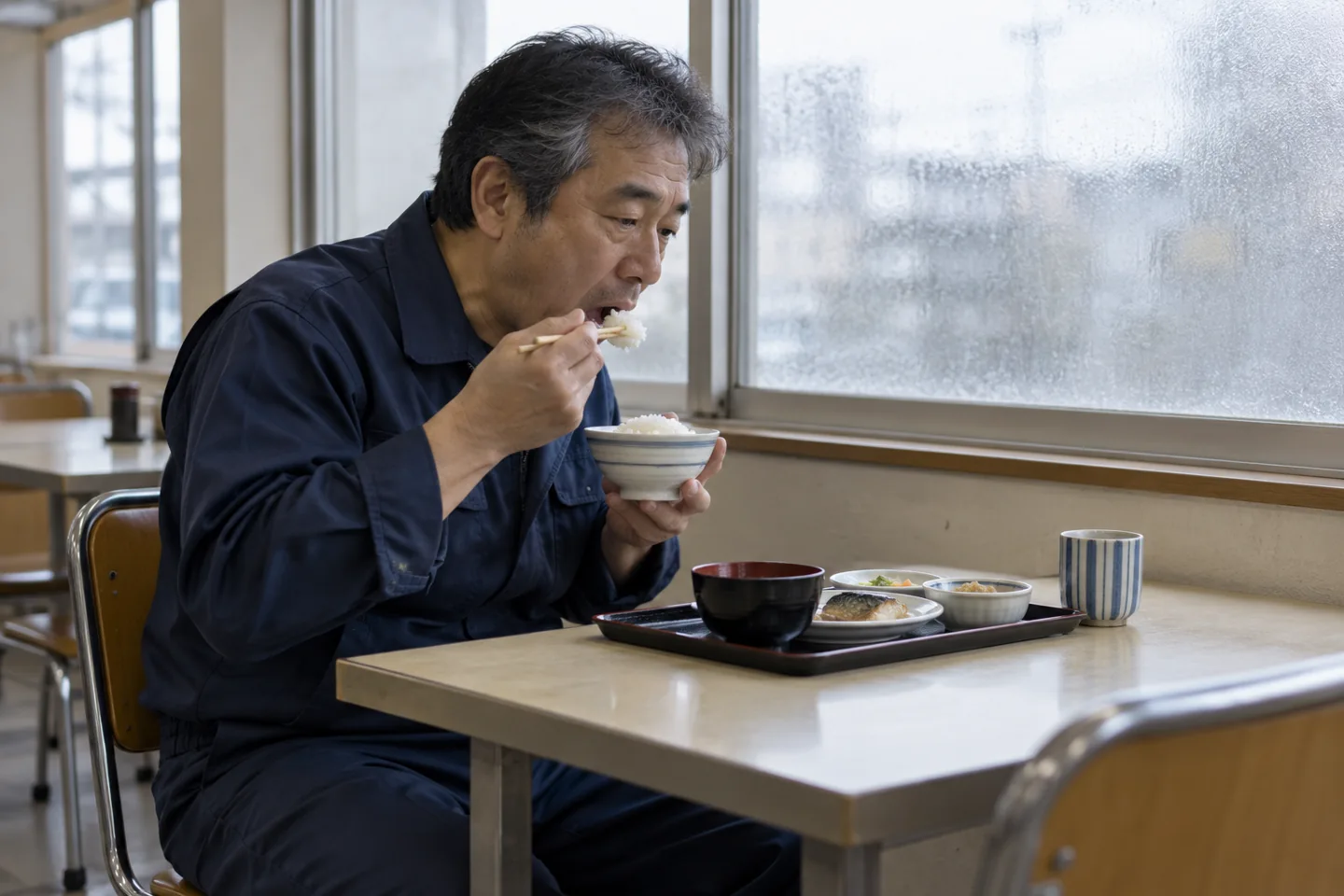
For situation B, use まだ昼ご飯を食べていません。Mada hirugohan o tabete imasen. “I have not eaten lunch yet.” Here 食べていません, tabete imasen, combines the te-form 食べて with いません. Learn that complete ending with this meaning. Simply choosing the word mada while copying the previous past ending does not produce the intended answer.
The Japan Foundation grammar explanation, printed pages 25–26, contrasts an event already completed with one still pending. Our lunch scenario applies that distinction to a new exercise. For the attachment form itself, revisit the Japanese te-form guide and check 食べます → 食べて before adding the rest.
Do not treat “not yet” as a promise. The meal is pending at the checkpoint, but this sentence does not guarantee when you will eat. It also does not make every Japanese negative sentence a “not yet” sentence. Keep the adverb, predicate and conversational purpose together instead of translating an isolated ending as a universal rule.
Answer the lunch question without mirroring it
Ask もう昼ご飯を食べましたか。Mō hirugohan o tabemashita ka. “Have you eaten lunch already?” For the completed case, answer はい、もう食べました。Hai, mō tabemashita. “Yes, I have already eaten.” The shared question allows you to leave out the repeated word for lunch. The full sentence is useful while learning, but repetition is not compulsory in every reply.
For the pending case, answer いいえ、まだ食べていません。Iie, mada tabete imasen. “No, I have not eaten yet.” A shorter polite reply is いいえ、まだです。Iie, mada desu. “No, not yet.” The question supplies the missing event. Memorise the exchange as a question followed by two possible factual answers, rather than as one string with a replaceable yes or no.
Practise with two folded slips marked in your own language: “ate earlier” and “has not eaten”. Draw one and answer the question. If you keep the question’s mou when the slip says pending, stop and explain the mismatch before trying again. The fact card determines the reply; the adverb in the question does not force agreement.
Still: follow a condition that continues
For situation C, use まだ雨が降っています。Mada ame ga futte imasu. “It is still raining.” 雨, ame, means rain; 降っています, futte imasu, describes the ongoing rain in this context. There is no negative ending here. Mada accompanies an affirmative predicate because the condition continues at the moment of observation.
Compare that with the lunch example carefully. “Still raining” and “not eaten yet” are different English expressions, but both keep an earlier situation from giving way to a relevant change. Do not translate mada as “not yet” before checking whether the Japanese predicate is affirmative or negative. Read right to the end of the sentence.
On paper, draw a horizontal line for the rain and put a small checkpoint through it. Let the line continue beyond the checkpoint for this prompt. The drawing is a memory aid for one example, not a claim that every use of mada has identical grammar. Explain the complete message aloud: rain started earlier and is continuing now.
No longer: mark the end of the rain
For situation D, use もう雨は降っていません。Mō ame wa futte imasen. “It is no longer raining.” The rain has stopped by the checkpoint. The negative predicate works with mou to express that change; it does not turn the sentence into “it has not rained yet”. The earlier rain is part of the supplied context.
Notice は, wa, in this model and が, ga, in the previous one. We are presenting a contextual report about the rain, not teaching that one particle belongs permanently to one adverb. Keep each complete model intact during your first practice. A separate Japanese sentence structure lesson can help you inspect how the topic and predicate fit together.
Draw a second rain line ending before the checkpoint. Then cover both Japanese models and choose the one for a new written situation. Do not decide from a dry umbrella or a patch of wet ground alone. Neither sentence is a weather forecast: reporting that rain has stopped now does not guarantee a dry afternoon.
Keep other uses and extra meanings outside the first round
You may already know もう一度, mō ichido, “one more time”, or もう少し, mō sukoshi, “a little more”. Those familiar expressions do not mean that an event has already happened. The word appears with a repetition or quantity expression. Put them in a separate note so that the new four-situation exercise does not overwrite something you learned correctly elsewhere.
Likewise, もう食べません, mō tabemasen, can express that someone will not eat any more in an appropriate context. It is not our answer for a lunch still pending. That contrast is useful as a warning against changing only one word, but you do not need to master every implication of every negative verb today. Start with the complete checked models.
Avoid labelling one adverb inherently polite, impatient or friendly. Timing words can carry expectations in a real exchange, and delivery matters. Our neutral polite prompts teach the factual distinction. They do not establish the speaker’s feelings, a universal etiquette rule or an official fixed exam vocabulary list.
Try six decisions with the models covered
One: you ate lunch earlier and are asked about it now. Give a full polite statement containing “already”. Two: the same question is asked before you have eaten. Give the full “not yet” reply. Three: shorten that pending reply politely while keeping the event supplied by the question. Write each answer before looking back at the lesson.
Four: rain began earlier and is continuing at the checkpoint. Choose mada or mou and give the complete predicate. Five: the rain stopped before the checkpoint. Give the corresponding report. Six: someone says mō ichido. Does this by itself report a completed event? Explain what makes this expression different from the first answer.
Add a reason beside every response. For one to three, identify whether lunch has been eaten. For four and five, identify whether rain continues. You can use the same recall routine with other material in the Japanese practice guide, but keep these prompts small enough that you can check the actual grammar rather than merely recognise a familiar translation.

Check the ending as carefully as the adverb
One: もう昼ご飯を食べました。Mō hirugohan o tabemashita. Two: いいえ、まだ食べていません。Iie, mada tabete imasen. Three: いいえ、まだです。Iie, mada desu. The second answer describes the pending meal through the complete negative construction. The third relies on the question to supply what remains pending; it is not a universal substitute for every sentence containing mada.
Four: まだ雨が降っています。Mada ame ga futte imasu. Five: もう雨は降っていません。Mō ame wa futte imasen. The continuing condition takes the affirmative model here, and the ended condition takes the negative model. Six: mō ichido concerns repetition, “one more time”, rather than an already-completed event. Check the accompanying expression before assigning a translation.
For a final transfer task, change only the lunch time in your original English prompt. Keep the actual meal either completed or pending. Does a later clock time alone change the answer? No: the relevant fact still determines the sentence. If you can explain that and recover the correct ending with the model hidden, you have practised a decision rather than memorised a timetable.
Questions about the method
Can I answer a mou question with mada?
Yes. In our lunch exchange, mou asks whether the event has happened. If lunch is still pending, iie, mada tabete imasen or the contextual short reply iie, mada desu gives the appropriate answer. The facts determine your reply.
Does mada always mean not yet?
No. In mada ame ga futte imasu, the predicate is affirmative and the meaning is “it is still raining”. Read the complete predicate before deciding between “still” and “not yet”.
Does mou with a negative mean the event has not happened yet?
Not in our rain example. Mou ame wa futte imasen says it is no longer raining in a context where rain occurred earlier. A pending lunch needs the separate mada tabete imasen model. Keep the situation with the sentence.