

Kikoeru vs kikeru becomes easier when you ask what the listener needs to know. In a recording booth, “Can you hear my voice?” is a check on a sound reaching someone now. “Can you listen to yesterday’s interview here?” is a question about the opportunity to listen to a particular recording. English often uses “can hear” for both kinds of situation. Japanese gives you two familiar choices, and the choice helps coordinate what happens next.
In this guide, two adults are testing a small studio. One is speaking behind the glass while the other sits outside with the recordings. You’ll learn to describe a sound, ask about access and explain what you still need. A partner can read the examples, but pen and paper are enough for the practice. The lesson works even if you have no audio at hand: the evidence you need is stated in each scene.
Kikoeru vs kikeru starts with the question you’re answering
Start with 聞こえる(きこえる, kikoeru). It describes a sound as audible or says that you hear it. 声が聞こえますか(こえがきこえますか, koe ga kikoemasu ka)asks “Can you hear the voice?” When the speaker is testing their own microphone, “Can you hear me?” may be a more natural English rendering. The Japanese does not have to spell out who owns the voice if everyone knows whose voice is under discussion. A reply such as はい、聞こえます(hai, kikoemasu)is enough to say it is coming through.
聞ける(きける, kikeru)is the potential form of 聞く(きく, kiku), “listen” or “hear” in this lesson. If the studio has a recording available at a listening station, ここで録音が聞けます(ここでろくおんがきけます, koko de rokuon ga kikemasu)means “You can listen to the recording here.” The room may be completely silent as you say it. You are describing a possibility the station provides, not reporting a sound that has already reached your ears.
Check the answer against the situation. For a sound check, find out whether the voice comes through. For an access check, find out whether the recording is available to play. The two questions call for different evidence even if both use “hear” in English.
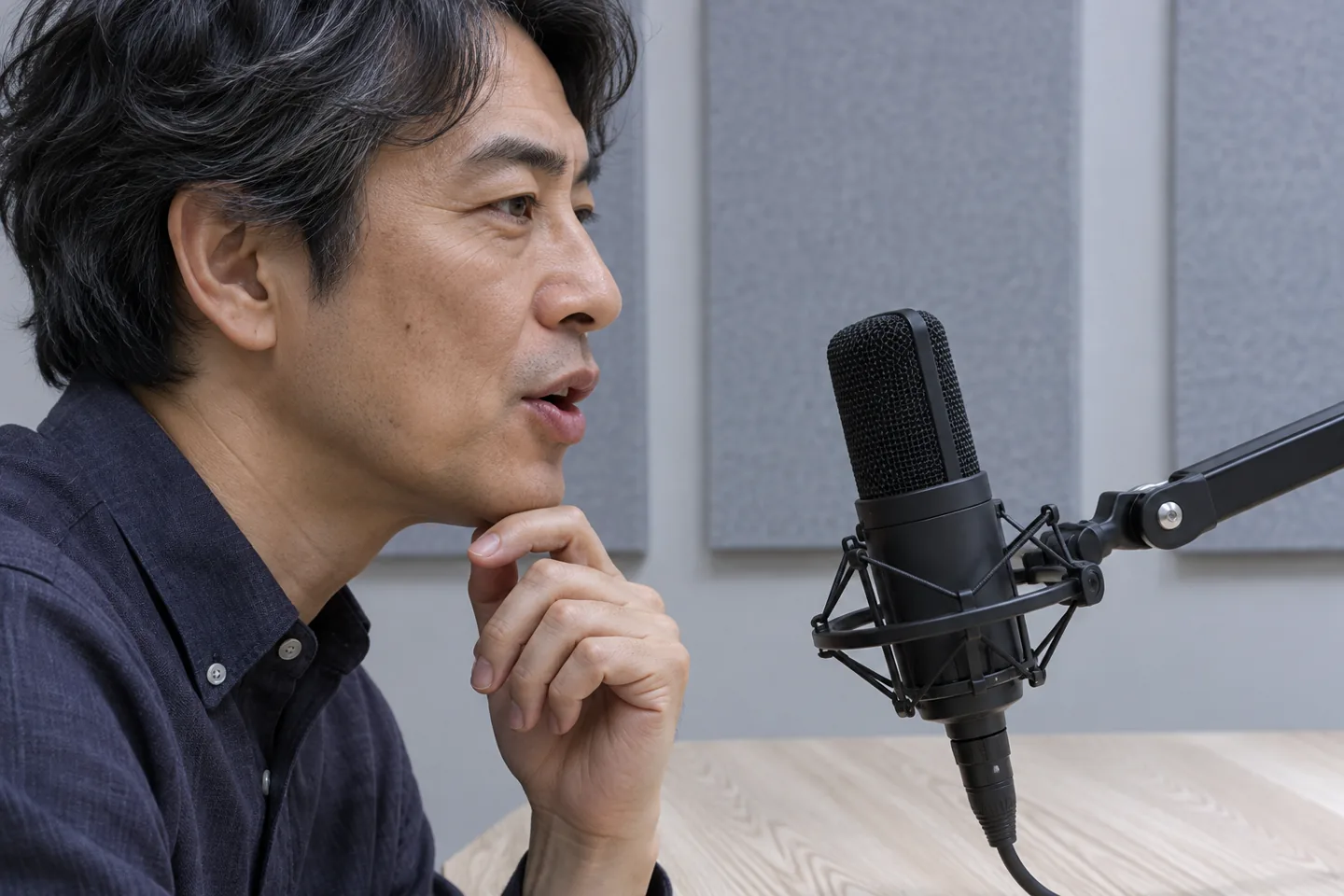
Check the signal before you check the words
The technician hears a faint voice but has trouble following what is said. 声は聞こえます(こえはきこえます, koe wa kikoemasu)can acknowledge that the voice is audible, with は setting it up as the point under discussion or as a contrast. If the technician needs to clarify the problem, they can add 内容はよく分かりません(ないようはよくわかりません, naiyō wa yoku wakarimasen), “I don’t really understand what is being said.” The two statements can both be true. Sound getting through is not the same as words being clear or understood.
For a failed signal check, 声が聞こえません(こえがきこえません, koe ga kikoemasen)means “I can’t hear the voice.” Add a concrete request if needed: もう少し大きな声でお願いします(もうすこしおおきなこえでおねがいします, mō sukoshi ōkina koe de onegaishimasu), “A little louder, please.” This request suits a person speaking too quietly. If the issue is the listening volume, 音量を上げてもらえますか(おんりょうをあげてもらえますか, onryō o agete moraemasu ka), “Could you turn up the volume?”, targets a different fix. You need not diagnose equipment in Japanese to explain what you can and cannot hear.
Keep this distinction when you practise with our Japanese listening guide. A rough first pass might establish that a voice is audible. A later pass can check the words against a transcript. If you combine the two into a single pass-or-fail judgement, you miss a chance to work out whether the difficulty was the signal, speech clarity or the language itself.
Tell someone when listening is possible
Imagine a colleague arrives after the recording session. They want to know whether they can listen to the interview before leaving. この録音は今聞けますか(このろくおんはいまきけますか, kono rokuon wa ima kikemasu ka)asks whether listening to this recording is possible now. The recording is already the topic, so は is natural. The question can be asked before any playback. Perhaps the only copy is still with the other technician. A suitable answer is 今は聞けません(いまはきけません, ima wa kikemasen), “You can’t listen to it right now.”
The potential form does not itself tell you why listening is or is not possible. It can be a question of availability, time or circumstances. If the recording will be available tomorrow, 明日なら聞けます(あしたならきけます, ashita nara kikemasu)means “You can listen tomorrow.” That is a meaningful answer about when there is an opportunity. Telling the person 声が聞こえます would answer a different question about the voice.
Notice where the distinctions come from. With 聞こえる, the audible thing commonly takes が, as in 声が聞こえる. With 聞ける, the item one can listen to can also take が in this pattern. The particle alone cannot settle which sentence you need. Use the verb and the situation together. The Japan Foundation’s guide to the potential form sets the two patterns alongside one another. Our Japanese grammar guide gives the broader groundwork for reading particles and predicates together.
Shift from the studio to the street
An adult waiting by an open window hears a bus outside without having gone there to listen for it. 外からバスの音が聞こえます(そとからバスのおとがきこえます, soto kara basu no oto ga kikoemasu)means “I can hear the sound of a bus from outside.” 外から indicates where the sound comes from. Compare ここで, “here,” in the studio example: it tells you where you can listen, not where the sound originates. The choice of location expression follows the job each sentence has.
Now imagine the same person is staying to listen to a concert recording. 今夜ここでコンサートの録音が聞けます(こんやここでコンサートのろくおんがきけます, kon’ya koko de konsāto no rokuon ga kikemasu)means “You can listen to the concert recording here tonight.” Once the recording starts, 音楽が聞こえます(おんがくがきこえます, ongaku ga kikoemasu)can report that the music is audible. These describe two parts of one scene: having the chance to listen and actually hearing a sound. You can choose either viewpoint as the conversation changes.
The street example is a helpful way to remember perception because the sound arrives without an invitation. Avoid turning this into an absolute rule about your intentions. You can deliberately stop and listen for a familiar sound and then say whether it was audible. The point of the verb is what you report, not whether you made an effort before making the report.

Change politeness or tense without changing the question
For a quick check with a friend, 聞こえる?(kikoeru?)can be enough. 聞こえますか is a useful polite default for the studio check. If you heard a sudden sound a moment ago, 聞こえた?(kikoeta?)asks “Did you hear that?” The time changes, but the question is still about a sound that reached the listener. With 聞ける, the polite form is 聞けます and the plain negative is 聞けない. Ask 聞けますか when assessing whether listening is possible in the circumstances. Only then select the level of politeness the relationship calls for.
In the past, 聞けた(きけた, kiketa)can report that someone got to hear or listen to something. If a friend was finally able to listen to a particular recording, やっと聞けた(やっときけた, yatto kiketa)means “I finally got to listen to it.” 聞こえた can also refer to a successful hearing event, but it presents the sound as coming through. The forms can produce similar translations. Look for the question the previous line poses before committing to a single English equivalent.
For review, write the two meanings as separate prompts: “a voice is coming through” and “there is a chance to listen to a recording.” Read each prompt and say a short polite sentence. Then make both sentences negative while keeping the viewpoint. Compare 聞こえません with 聞けません aloud. If you swap the two, name the focus problem first and fix the ending in a second pass.
Rehearse the next line in four short scenes
A colleague at the microphone has just said something. You need a signal check, so ask 声が聞こえますか if you are the speaker asking if the other person can hear you, or respond 聞こえます if you are the listener confirming the signal. Next, someone wants to hear a recording later, and you can offer access from the studio: ここで聞けます. If audio is already playing and someone asks what you can hear from the corridor, report 音楽が聞こえます. Finally, if a recording is unavailable for now, answer 今は聞けません rather than implying a fault with the speakers.
For a partner exercise, give one person a problem to solve and the other a fact to share. The first partner may need a louder sound or may need to know when the recording can be played. The second partner chooses a reply without seeing the label on the other person’s card. Compare what the reply would cause the first person to do. If they would adjust volume when they actually need to wait for a file, try the other viewpoint and hear how the exchange changes.
On another day, try the same test in a station, a lecture room or at home. Supply a specific sound or reason to listen so that your answer has a point. If you can say which part of the situation your sentence describes and suggest a plausible next step, you have a better check on your understanding than a translation flashcard alone.

Questions about the method
Does hearing the sound mean I understood the sentence?
No. 聞こえます reports that you hear the sound. It can be entirely accurate when you can’t make out the words. Mention that separately, or ask your partner to repeat the line. In a practice session, distinguish hearing a voice from identifying a word and understanding it. Each of those problems benefits from a different adjustment.
Is kikoeru a potential form of kiku?
聞こえる is a distinct verb. The regular potential form of 聞く is 聞ける. Because both can sometimes be translated as “can hear,” use a complete example to remember them. A voice coming through is a useful model for 聞こえる; a recording you can listen to is a useful model for 聞ける.
Can both be correct with the same recording?
Yes. A recording in a library can be available to listen to, and once played, its sound can be audible. The two sentences tell you different things about that recording. If the listener’s concern is about access, address access. If it is about a sound coming through a speaker, address the signal.