
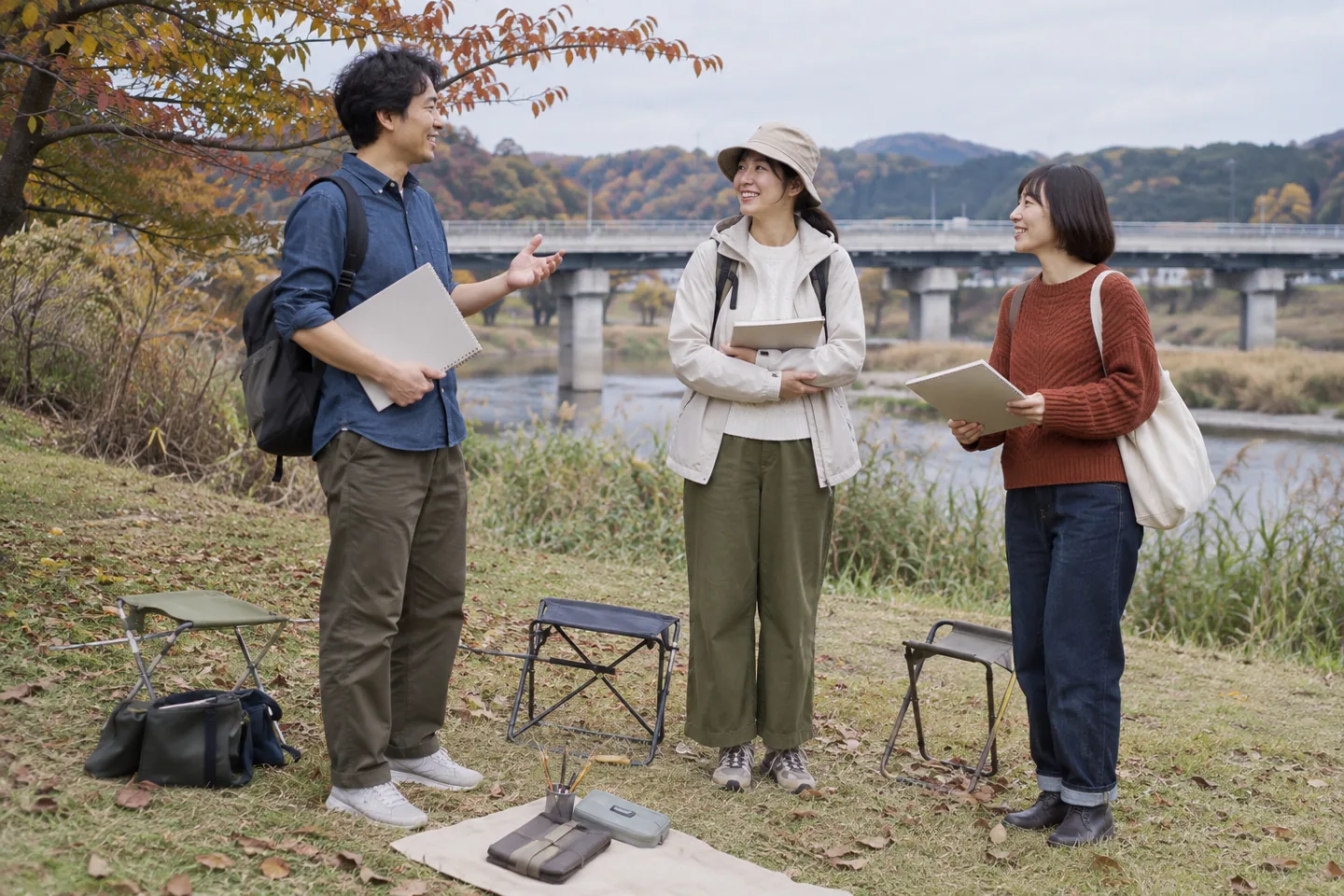
Japanese clothing verbs let you describe an outfit accurately, but English “wear” does not map to one verb for everything. A shirt, shoes and a hat call for different choices. Our fictional riverside sketching meetup gives those choices a purpose: tell a friend what you are wearing, then recognise someone from a description. You will practise a small set of garments, distinguish putting something on from already wearing it, and check whether your description actually identifies the right person. You can do every exercise with paper and a partner, or work alone using the answers below.
Japanese clothing verbs begin with the item
Start with three useful pairings. シャツを着る (しゃつをきる, shatsu o kiru) means to put on or wear a shirt. 靴をはく (くつをはく, kutsu o haku) is the pairing for shoes. 帽子をかぶる (ぼうしをかぶる, boushi o kaburu) is the pairing for a hat. The particle を marks the item and is pronounced o here. Learn each noun together with its verb instead of memorising an English label such as “wear” and choosing the Japanese verb afterwards.
着る is useful for shirts, jackets, coats and dresses. はく goes with trousers, skirts, socks and shoes. かぶる goes with hats and other headwear. These categories are a practical starting map, not a claim that every object worn on the body fits one of three boxes. Glasses and accessories will need other expressions. For now, sort six cards: shirt, coat, trousers, shoes, socks and hat. Say the Japanese noun and verb only after you have selected its group.
Do not classify a dress simply by whether some fabric falls below the waist. ワンピースを着る uses kiru. A skirt takes スカートをはく. This contrast shows why complete combinations are more reliable than a rule based only on height. Put the dress beside the shirt, and the skirt beside the trousers, then explain your choice. If you cannot remember the noun yet, keep a small vocabulary note visible; the first exercise is about choosing the verb, rather than testing every skill at once.

Describe clothing already on the person
For an outfit someone is currently wearing, use the corresponding ている form. シャツを着ています (しゃつをきています) means “is wearing a shirt”; 靴をはいています (くつをはいています) means “is wearing shoes”; 帽子をかぶっています (ぼうしをかぶっています) means “is wearing a hat.” The polite ending います makes these useful for a first conversation. In this context the form describes the state after getting dressed. It does not necessarily mean that the person is halfway through putting the item on.
Notice the different connections: 着る becomes 着て, はく becomes はいて, and かぶる becomes かぶって. The small っ in かぶって matters. Do not produce かぶて by removing its held consonant, and do not change はいて into はきて. Write each complete expression beside the garment, then cover the ending and reconstruct it. The Japanese grammar guide provides a broader place to review sentence forms; here the immediate job is to connect a visible outfit with a suitable description.
In the sketching scenario, 青いシャツを着ています (あおいしゃつをきています) says “is wearing a blue shirt.” The person can be standing, talking or drawing while the shirt remains on. Compare that with an empty shirt hanging nearby: the garment exists, but this sentence needs a wearer understood from context. When a practice picture has several people, point to the person before describing their clothes. This avoids a grammatically plausible sentence whose subject your listener cannot identify.
Keep getting dressed separate from a description
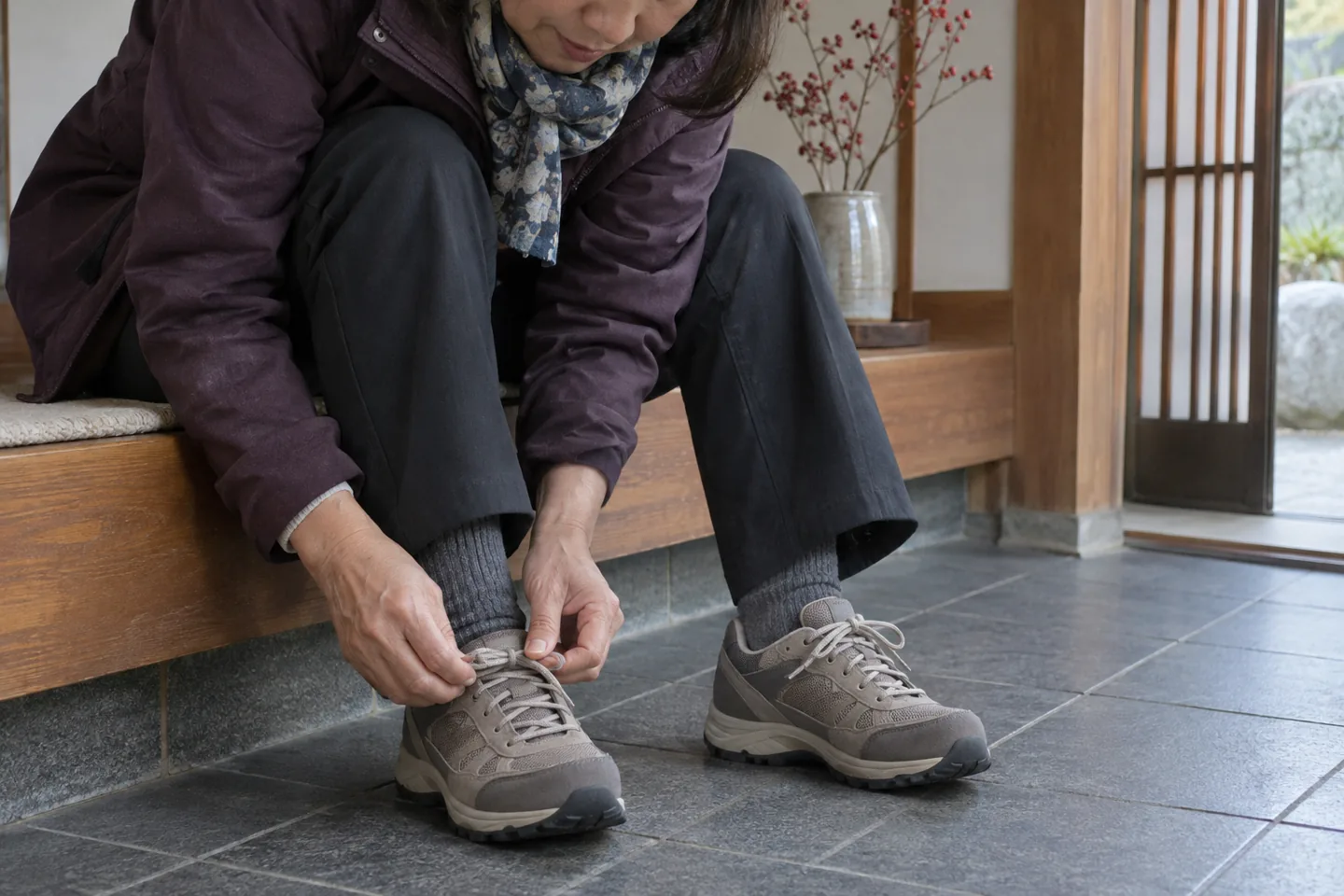
Imagine you are still at home before the meetup. 今からシャツを着ます (いまからしゃつをきます) means “I will put on a shirt now.” Later, when your friend asks how to recognise you, 青いシャツを着ています gives a description of what you have on. The noun can stay the same while the form and context change the message. Do not translate every instance of 着ます as “am wearing” simply because that feels natural in an English conversation about clothes.
Use three written prompts: “before leaving,” “already outside” and “item on the bench.” For the first, choose 靴をはきます when you mean that you will put your shoes on. For the second, 靴をはいています describes shoes already on your feet. For the third, do not attach a wearing verb to an absent person. 靴があります says there are shoes, with the location supplied if needed. Keeping the prompts separate makes it easier to notice what information your sentence actually provides.
The same distinction works for a hat: 帽子をかぶります can announce putting it on, while 帽子をかぶっています describes wearing it. A photograph of hands at a brim may be ambiguous about whether the action is starting or finished. Give your partner a short situation as well as the picture. Ask them to choose a sentence and justify it. If two interpretations remain possible, discuss the context rather than pretending that the image proves one exact moment.

Add one useful detail to find a person
At the fictional meetup, your friend has not met the organiser. Ask どの人ですか (どのひとですか), “Which person?” A short answer might be 青いシャツの人です (あおいしゃつのひとです), “The person in the blue shirt.” A fuller answer is 青いシャツを着ている人です, “The person wearing a blue shirt.” Before 人, use 着ている here, rather than inserting polite 着ています into the middle. The sentence can still end politely with です.
Choose a detail that separates the person from the group. If two people both have hats, 帽子をかぶっている人です is insufficient by itself. You can add a visible colour or ask for another clue. Do not invent a name, occupation or personality from an outfit. Our picture is a language prompt, not evidence about real strangers. A useful description supplies information the listener can check and allows them to ask again when the clue does not narrow the choice enough.
The Japan Foundation’s Irodori lesson 2 offers further clothing expressions in the context of identifying people. For your own practice, draw three simple figures with different outfits. Give one description without pointing, and let your partner select a figure. Then reverse roles and change one garment. Success means choosing the intended figure for the reason given, not merely repeating a memorised line while both of you already know the answer.

Extend the set without forcing one universal verb
Glasses provide a useful boundary: めがねをかけています means “is wearing glasses.” Learn かける with that item instead of forcing it into kiru, haku or kaburu. With a watch, 時計をしています (とけいをしています) is a useful expression. You do not need a complete accessory dictionary to describe one person. Add an item when it helps your conversation, and keep its usual combination in the same note as its reading and meaning.
For taking off the basic garments in this lesson, learn 脱ぐ (ぬぐ, nugu): シャツを脱ぎます, 靴を脱ぎます and 帽子を脱ぎます. The て form is 脱いで. This is not a universal instruction to use nugu for glasses and every accessory. For glasses, めがねを外します (めがねをはずします) means taking them off. Keeping that limit visible prevents a useful simplification about shirts, shoes and hats from becoming an inaccurate rule for everything someone can wear.
Check sounds as well as categories. 帽子 has a long vowel, often written bōshi in romanisation; かぶって has a held consonant; 着ています begins kite, not kitte. The Japanese pronunciation guide explains those distinctions more broadly. Say one expression slowly enough to keep its shape, then use it in a meaningful answer. Faster repetition is useful only if the same garment, verb and intended situation remain clear to the listener.
Test the choice with a new outfit
Try these five prompts before reading the answers: a coat already on someone; shoes you will put on before leaving; a person already wearing a hat; a dress already on someone; glasses being worn. Suitable answers are コートを着ています; 靴をはきます; 帽子をかぶっている人; ワンピースを着ています; and めがねをかけています. The third is a noun phrase, “a person wearing a hat,” rather than a complete polite sentence. Add です if you are identifying that person as your answer.
Now examine the bench photograph. It shows a hat and a folded shirt beside drawing materials, without a wearer. A description claiming that someone is wearing those exact items would add information the picture does not provide. Name what is there, or create an explicitly fictional continuation in which somebody puts the items on. This checks meaning independently of conjugation: a perfectly formed 着ています is still the wrong description if the clothes are lying on a bench.
Finish with a short exchange using your own outfit or a drawing. Ask what your partner has on; give one accurate description; request a clarification if two people match. Record whether an error came from the garment word, verb choice, connection or missing context. Correct that one part and repeat with a different item. A small set of reliable expressions is enough to make this exchange work, and it gives you a clear basis for adding more clothing vocabulary later.
Questions about the method
Can I use kiru for every kind of clothing?
No. Shirts, coats and dresses commonly take kiru, whereas trousers, skirts, socks and shoes take haku, and hats take kaburu. Learn the item with its verb. Glasses use a different expression, megane o kakeru, so the three main groups are a starting point rather than a universal system.
Does kite imasu mean someone is putting a shirt on?
In a description of an outfit, it normally means the person is wearing it. For putting a shirt on now or next, context such as ima kara shatsu o kimasu states that action. Decide whether you need an action or the resulting state before choosing the form.
How can I practise without another learner?
Draw three outfits, write descriptions on separate cards and match them after shuffling. Include one unworn item on a bench so that a wearing expression is not always the answer. Check the noun, verb and situation separately. For pronunciation, compare with a reliable spoken model rather than judging sound from a silent picture.