
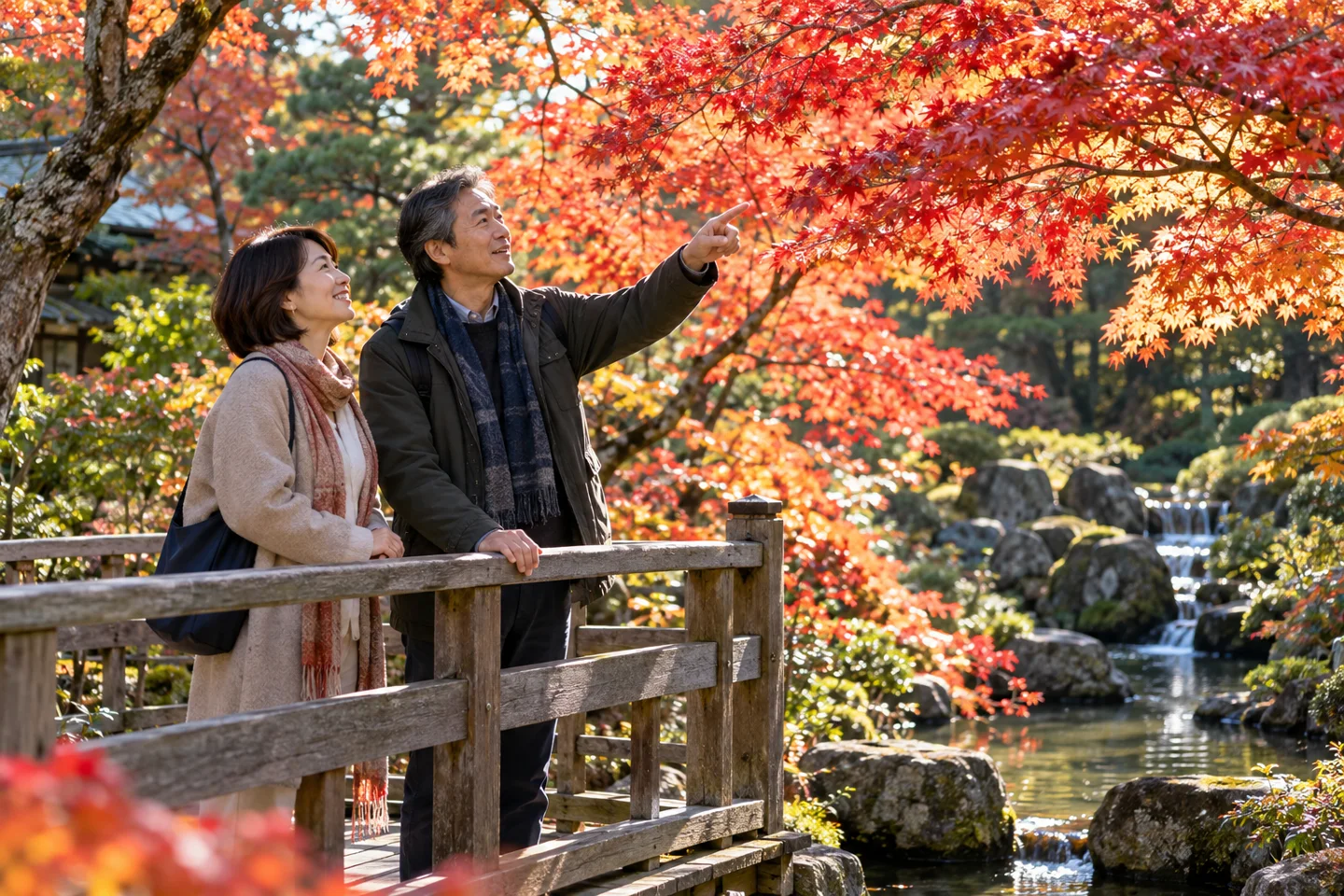
The difference between ne and yo becomes easier to notice when you ask what the speaker is doing with the sentence. Two people standing outside may share an observation about the cold. An attendant may instead direct a visitor’s attention to an entrance. Both exchanges can use polite language, yet they ask different things of the listener. Adding a familiar final syllable without considering that purpose can change the exchange.
This lesson starts with three small situations in a fictional garden visit. You will choose an ending, explain the choice and check what remains unknown. A source-verified KanaWay word-review flow can help when you cannot retrieve a word such as 寒い, samui, “cold”. It does not decide which ending fits your relationship or intention. Keep word recall, the sentence’s factual content and its conversational purpose visible as three separate decisions.
Decide what response you are inviting
Before choosing an ending, write one plain-language cue: “We both feel the cold; I am inviting agreement.” That is different from “I am telling the visitor where to enter” or “I think I heard three o’clock and want it checked.” A useful exercise states the purpose rather than making you infer somebody’s private knowledge from a photograph.
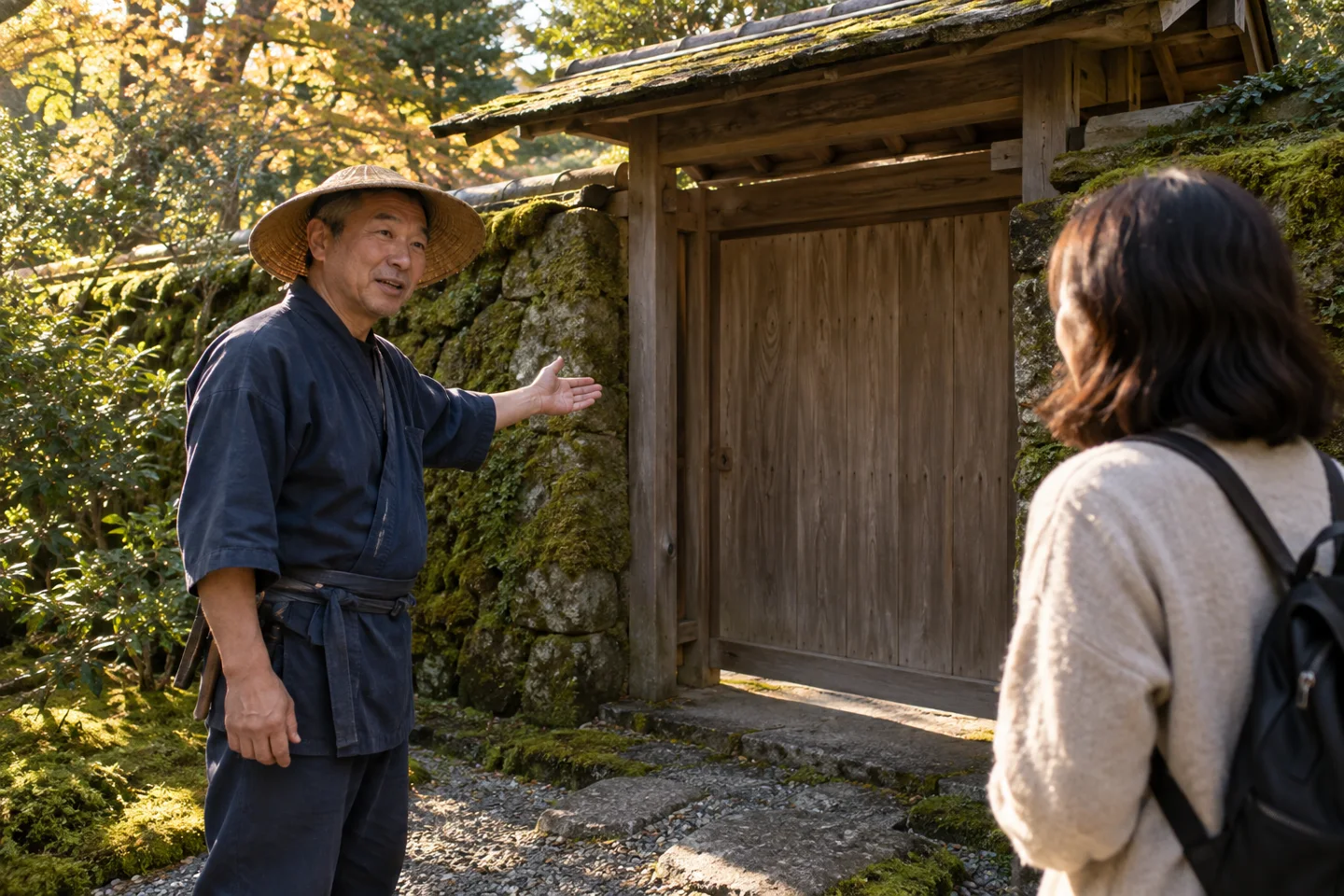
Use the garden pictures as settings, not as proof of agreement. Two people facing the same tree may be discussing unrelated things. A pointing gesture may draw attention, but it cannot tell us the precise words being spoken. Our written cues supply those details. This keeps the task checkable and avoids pretending that facial expressions identify a particle automatically.
If the word for cold has disappeared, mark that gap before solving the ending. Our Japanese vocabulary guide explains retaining useful words in context. Here the context includes a listener and a purpose. You can know every noun and adjective and still choose an ending that does not match the response you intended to invite.
Ne and yo begin with the purpose of the exchange
For the shared cold observation, try 寒いですね。Samui desu ne: “It’s cold, isn’t it?” The basic content is that it is cold. In this controlled situation, ね invites the other person into that observation. The English tag is a useful translation here, not a promise that every Japanese ね must become an English question with exactly the same wording.
The polite base 寒いです, samui desu, already expresses “It is cold.” Adding ね changes how that statement addresses the listener. You are not changing the adjective into another tense or turning it into a different weather measurement. Read the base meaning first and then ask what the final particle contributes to this particular exchange.
Iori Hamada’s introductory textbook section presents the basic contrast between seeking agreement or confirmation and highlighting information. It is a starting point for these exercises, not a complete map of every use. Keep our purpose cue beside the example. If the cue changes, reconsider the ending rather than treating “weather sentence” as a category that always requires ね.

Give useful information without demanding agreement
Now an attendant knows where the entrance is, and a visitor is looking in the wrong direction. Use 入口はあちらですよ。Iriguchi wa achira desu yo: “The entrance is over there.” In this exercise, よ highlights information the attendant wants the visitor to notice. The cue supplies the reason for informing; the photograph of a gate does not establish what either person knows.
入口, iriguchi, means entrance. あちら, achira, points to “over there” in this polite model. The final よ is not a separate word meaning “please”, nor does it mean that the listener must agree with an opinion. Keep the information and the purpose together: the visitor needs a direction, and the attendant is drawing attention to it.
Do not turn this into “yo is rude” or “yo always means brand-new information”. Those shortcuts are too broad. Delivery, relationship and the preceding exchange affect the result. A clear beginner task can distinguish two intentions without claiming that one syllable guarantees friendliness. Begin with the supplied polite model and ask for feedback on the whole exchange when moving beyond the written exercise.
Check a heard detail instead of inventing one
Suppose a colleague has just said that the meeting is at three. Repeat 三時ですね。Sanji desu ne: “Three o’clock, right?” You are checking your understanding of a stated time. This is different from announcing a timetable to somebody who has not heard it. It is also different from asking an open question when you have no plausible time to confirm.
If you did not catch the time, ask 何時ですか。Nanji desu ka: “What time is it?” In this meeting context, it asks what time the meeting is. Do not select an arbitrary hour and attach ね simply because a worksheet asks you to practise it. The listener needs to know whether you are checking a specific detail or requesting the missing information.
Japan Foundation’s Irodori lesson demonstrates targeted confirmation and asking again when a time or amount is unclear. Our Japanese listening guide offers broader exchange practice. Here the narrow check is enough: identify what was heard, what you are checking and what still needs an answer. A confirmation attempt does not make an uncertain detail true.
Use word review for recall, then return to the exchange
If a suitable stored 寒い card is available in KanaWay, attempt the requested answer before revealing it. The current local implementation retains an attempt draft, reveals the card and accepts a self-rating with an interval preview. Its playback action can speak the stored Japanese. A matching bundled clip is preferred; otherwise a Japanese device voice may be used, depending on availability.
Use that bounded flow to check the word you actually attempted. Did samui come back before the reveal, or did you merely recognise it afterward? If playback is available, listen to the stored item without treating it as a full model of our garden conversation. A word’s reading and a sentence’s social intonation are different targets; neither an interval preview nor a successful reveal measures conversational tact.
Then leave the word card and choose between the written purpose cues. Publisher disclosure: KanaWay and Learn Japanese Hub share a publisher. This source-verified workflow does not establish that a dedicated ne/yo lesson or these exact sentences are publicly available. It does not record or grade your tone automatically. When no suitable card exists, use the supplied words and complete the conversation exercise separately.
Try six decisions before reading the answers
One: two people have just stepped into the same cold courtyard. The speaker wants to share the observation. Complete 寒いです_ with the ending that fits our cue. Two: a visitor cannot find the entrance, and an attendant points it out. Complete 入口はあちらです_ for the informing purpose given here. Explain the intended response, not just the translation of the adjective or noun.
Three: you heard “three o’clock” and want to check it. Produce the short confirmation. Four: you heard no usable time at all. Should you repeat a guessed hour with ね, or ask 何時ですか? State what information you still need. These are separate listening situations; do not merge them because both concern the same meeting.
Five: you correctly recalled samui on a word card. Does that prove that your sentence ending and intonation suit a particular colleague? Six: a photograph shows two adults smiling near a gate. Can that picture alone tell you whether the speaker should use ね or よ? Give each answer with a reason tied to the written cue, leaving unsupported assumptions out.
Check the purpose as well as the final syllable
One: 寒いですね。Samui desu ne fits the shared-observation cue. Two: 入口はあちらですよ。Iriguchi wa achira desu yo fits the supplied informing purpose. These are intended answers to controlled situations, not claims that no other utterance could ever work in a richer real conversation. The reason matters as much as filling the final blank correctly.
Three: 三時ですね。Sanji desu ne checks the time you think you heard. Four: ask 何時ですか。Nanji desu ka when the time is missing. Guessing three would introduce information you did not receive. Five: no. A word-card attempt gives evidence about that word task; it does not assess the social purpose or delivery of your own sentence.
Six: no. The picture provides a setting, not the speakers’ complete exchange or knowledge. If your word was missing, note a recall problem. If you knew the words but selected an ending for the wrong purpose, note a conversational-choice problem. If you inserted a guessed meeting time, note missing evidence. Each diagnosis points to a different next attempt.
Keep one short exchange and change its purpose
Write the base sentence 寒いです and a cue for a shared observation. Add the ending and explain why it fits. On a later attempt, give the speaker a different reason for mentioning the cold, such as alerting someone about conditions outside. Discuss the whole situation instead of assuming that changing a final syllable is the only possible revision.
For delivery, use contextual human examples and feedback when available. A written particle does not prescribe one universal pitch contour, volume or facial expression. Our Japanese practice guide can help you choose a manageable spoken task. Keep the sentence short enough that you can attend to its purpose without losing the words or inventing an automatic pronunciation score.
Finish with three notes: what the sentence states, what the speaker is trying to do and what the listener could reasonably respond. Do not force either particle into every sentence. A neutral base statement is also something you will encounter. The goal is to notice the contribution of the ending in context and then make a deliberate choice, with uncertainty left visible.
Questions about the method
Is ne always a literal question?
No. In our shared-observation example it invites the listener into the statement, and in the time example it checks a detail. The English wording is a contextual translation. Do not treat every ne as a request for exactly the same type of answer.
Does yo automatically make a sentence rude?
No. Our informing example uses a polite base, but appropriateness also depends on the relationship, delivery and preceding exchange. Avoid judging a real conversation by one final syllable. Ask for feedback on the complete situation rather than applying a universal friendly-versus-rude rule.
Can KanaWay playback assess my use of ne and yo?
The verified flow plays a stored item and supports review of the attempted word answer. It does not establish automatic assessment of your own intonation or social intent. Use the separate conversation cues and contextual feedback for those decisions.