
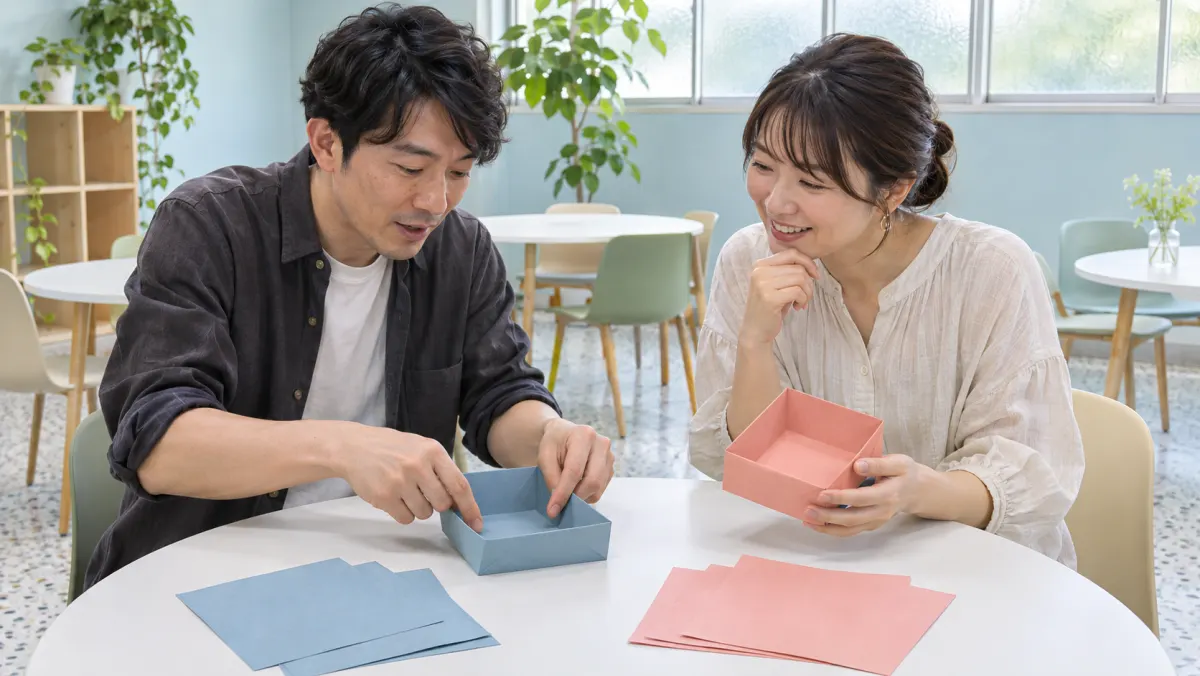
You have a square sheet of paper and a simple box idea. Saying that you will make the box names an action; saying that you will try making it presents the activity as a trial. Te miru helps express that exploratory meaning. You do something to find out what it is like or how it goes, rather than merely announce that you are looking at an object.
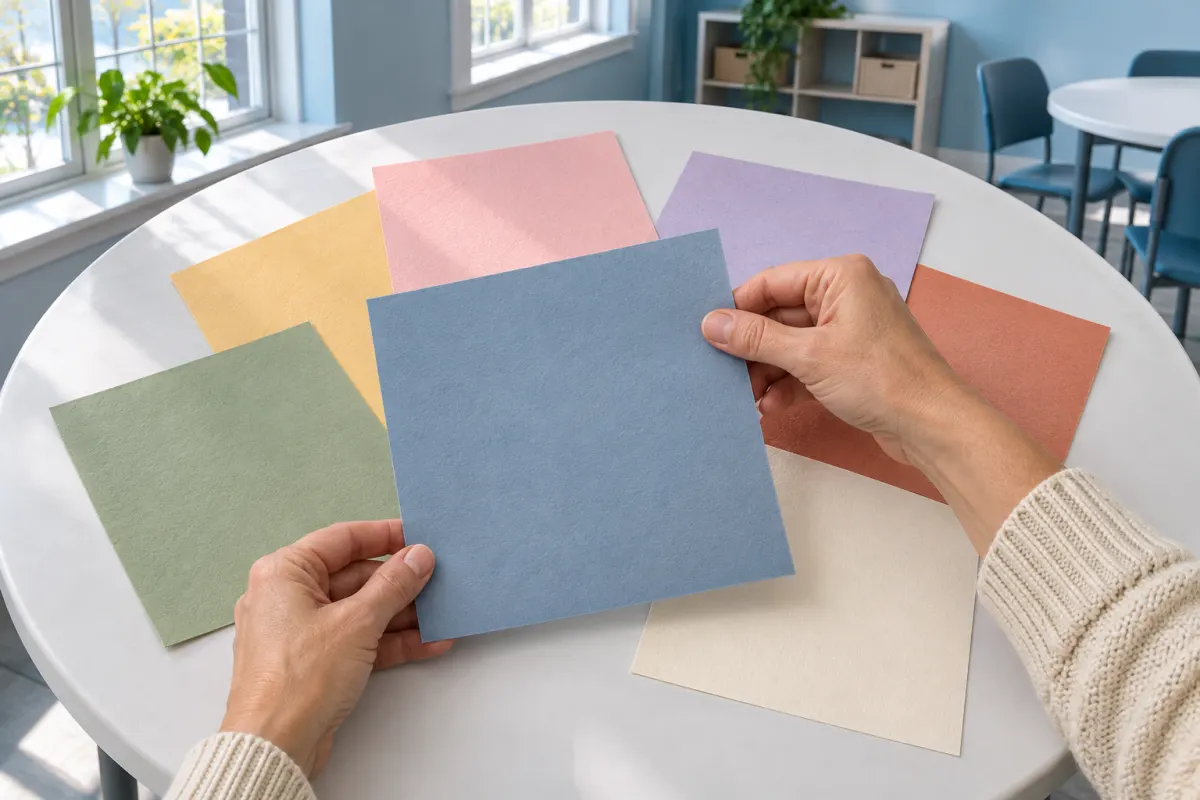
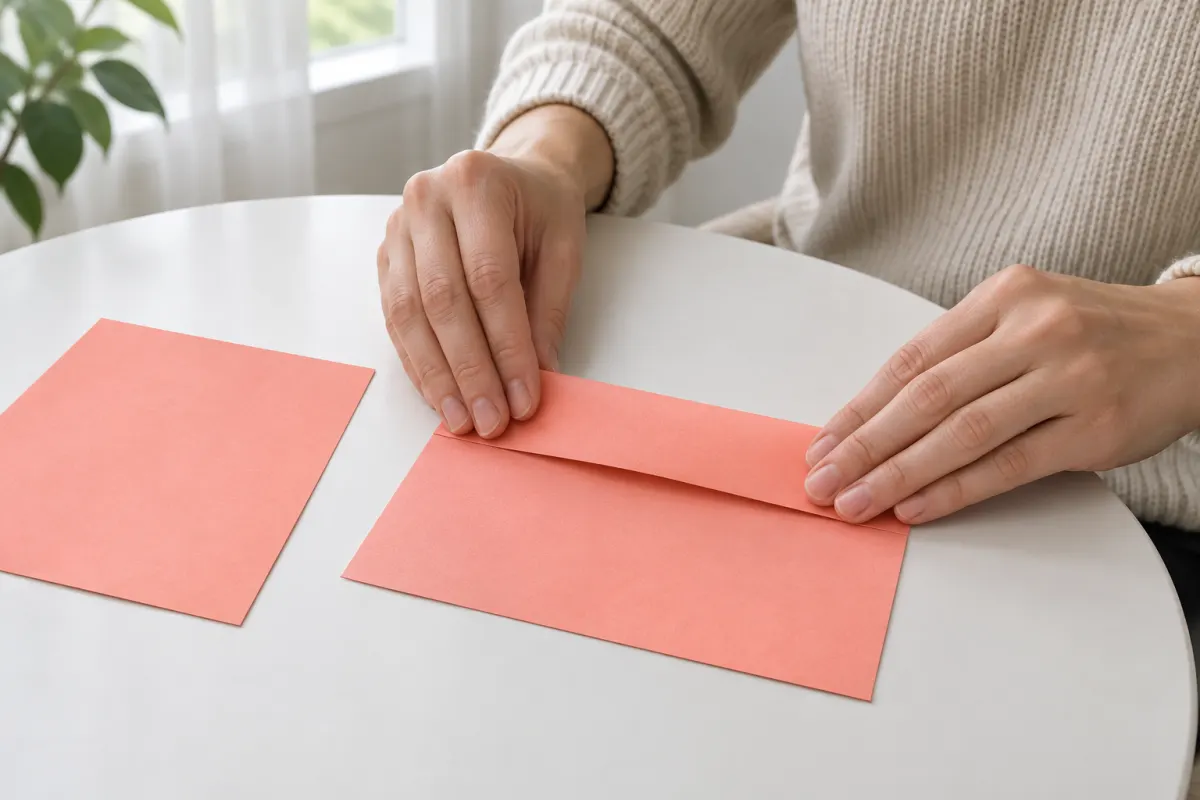
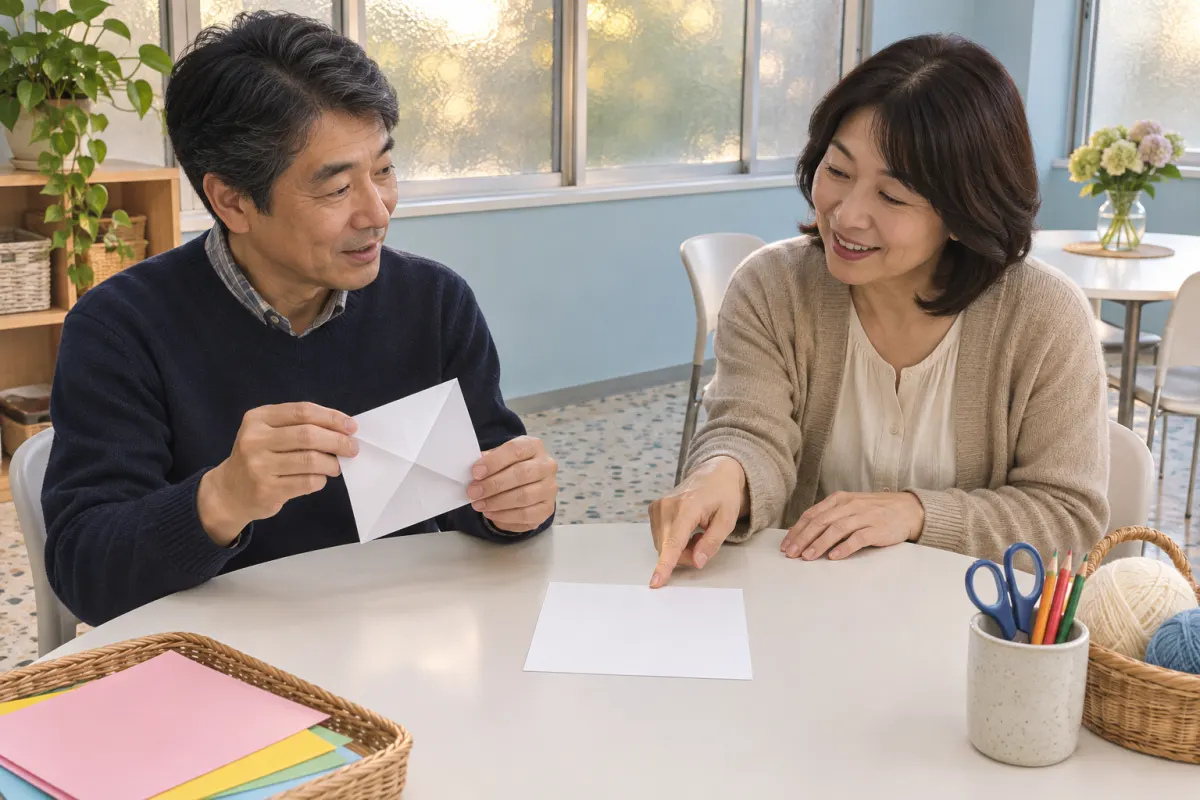
Our fictional adults are experimenting with paper in a community craft room. Their statements are supplied in the exercises. The pictures illustrate paper selection, folding and discussion; they do not provide a hidden report of what somebody tried. You can complete the language work on paper. A planned KanaWay conjugation-practice format can support a separate form check, with the limits explained below.
Te miru starts with an action to try
この紙で箱を作ってみます。Kono kami de hako o tsukutte mimasu. “I will try making a box with this paper.” 紙, kami, is paper; この紙で, kono kami de, identifies this paper as the material used. 箱を作る, hako o tsukuru, names making a box. The complete 作ってみます presents doing that activity as a trial.
Keep the material and the object distinct. The paper is what the speaker uses; the box is what the making action concerns. If you swap those roles in a meaning note, adding the correct ending will not restore the intended activity. First explain the task in your own words, then identify the verb you need to connect to the trial construction.
The University of Texas JOSHU explanation of te miru describes doing an action to find out what it is like. It connects the verb's te-form with みる, normally written in hiragana in this use. Our paper-box model applies that limited idea to an original fictional task rather than copying the source's examples.
Form the action first, then add mimasu
Start from 作る, tsukuru, “make.” Its te-form is 作って, tsukutte. Add みます, mimasu, to obtain 作ってみます, tsukutte mimasu. The small っ belongs inside tsukutte. Do not attach mimasu directly to the dictionary form tsukuru or to the full polite tsukurimasu. The connection requires the action's te-form in this pattern.
Now take 使う, tsukau, “use.” Its te-form is 使って, tsukatte, giving 使ってみます, tsukatte mimasu, “I will try using.” Tsukutte and tsukatte look similar in romanisation but refer to different verbs. Read the kana and match the meaning before attaching the shared final part. A familiar sound sequence can hide the wrong activity if you check only the ending.
Our te-form guide provides the broader formation reference. For this lesson, you need these two verified connections, not a new chart of every verb group. Write tsukuru → tsukutte and tsukau → tsukatte separately. Then cover the answers and retrieve the needed form from the activity meaning instead of relying on the neighbouring example as a clue.
Change the material without inventing a result
別の紙を使ってみます。Betsu no kami o tsukatte mimasu. “I will try using different paper.” 別の紙, betsu no kami, identifies a different paper choice. The action is using it as a trial. This sentence does not by itself explain why the speaker wants a change or state that the first sheet was defective. Those details would require more information.
In our exercise, the speaker wants to find out how another sheet behaves during folding. That intention is supplied by the task, not inferred from colour or texture in the photograph. The sentence communicates the trial, while a later observation could describe what happened. Keep the trial statement and any evaluation of its outcome in separate notes so that one does not silently become the other.
A useful conversation exercise gives one learner the intended trial and asks the other to identify the action and material. Change the colour or paper choice in the meaning prompt, but do not add unverified Japanese adjectives just to make the sentence longer. The core check remains whether the new material and the intended activity are represented accurately in the complete statement.
Report a past trial at the final verb
箱を作ってみました。Hako o tsukutte mimashita. “I tried making a box.” The final みました, mimashita, reports the trial in the past. 作って remains the connecting te-form. Do not change it to tsukutta and then add mimasu merely because the prompt says yesterday. The past ending belongs on the final part of this construction.
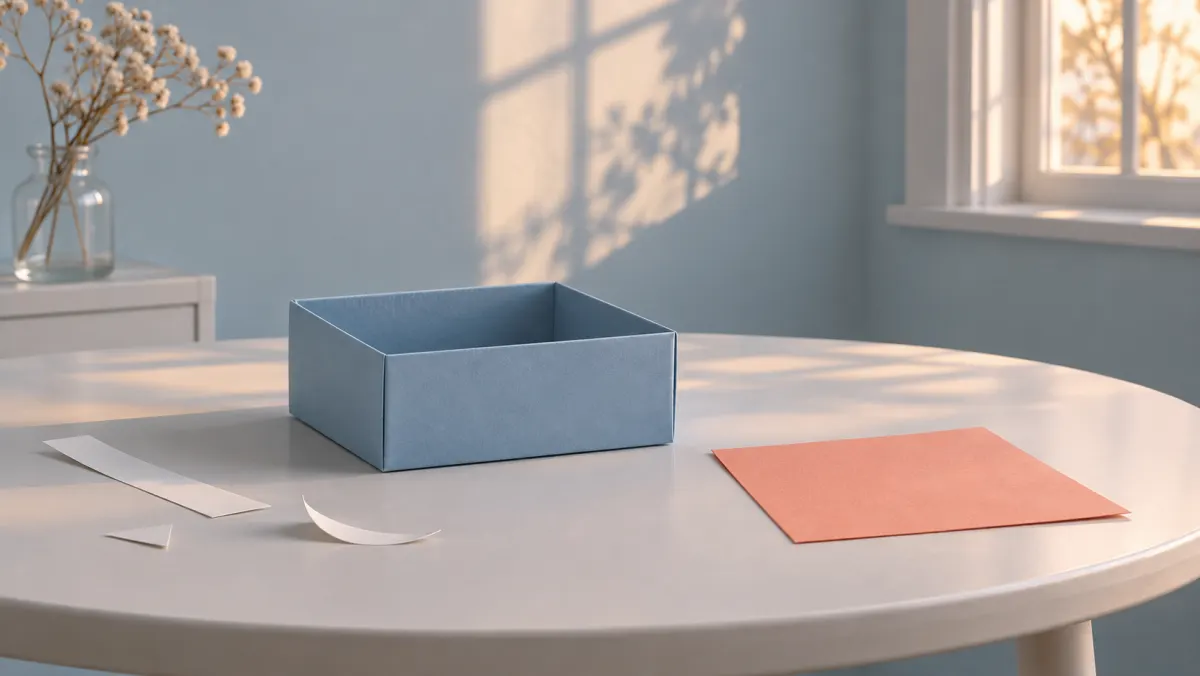
The report presents an activity carried out as a trial. It does not provide a quality score, prove that the box is suitable for a particular use or tell you how the speaker felt about the result. Those are separate statements. Avoid expanding a short trial report into “the method worked perfectly” simply because the illustration contains a tidy folded object.
Compare the three messages: making the box as the action, trying the box-making activity, and reporting that trial afterward. The trial construction contributes meaning; it is not a decorative extra syllable. A useful translation preserves that contribution while sounding natural in the reader's language. Our verb conjugation guide can help you distinguish a connecting form from the final polite tense.
Check the te-form, then return to the whole trial
Learn Japanese Hub and KanaWay share a publisher. KanaWay is in development. Its official local app information lists planned conjugation practice among its learning formats. That supports a narrow supporting step: practise a verb form, inspect the correction and return to the full sentence. It does not establish a released paper-folding lesson, these exact exercises or automatic judgement of the trial's outcome.
For a paper version, write “make” on one side of a note and tsukuru → tsukutte on the other. Attempt the te-form before revealing it. After checking, immediately produce 作ってみます in the complete paper-box sentence. A correct isolated te-form is useful, but you still need to preserve the material, object and trial meaning when reconnecting it to the message.
If you retrieve tsukutte but choose the using verb for the box-making prompt, another round of te-form drills alone will not fix the meaning selection. Return to the action note. Our Japanese practice guide explains how to match an error with a specific repair. Keep the planned app format optional: this exercise remains complete with covered paper notes and the model answers supplied here.
A small workshop exchange to complete
The first task note says that the speaker will try making a box with this paper. The second says that they will try using different paper. The third says that they already tried making a box. Nothing in the notes grades the result or says that the speaker merely looked at a finished box. Use those three facts as the complete basis for the following checks.
One: produce the first full polite trial sentence. Two: write the different-paper statement, preserving “use” as the action. Three: report the past box-making trial. Four: a learner writes tsukuru mimasu for the first activity. Explain the missing connection and repair it. Five: another writes tsukatte when the supplied activity is making the box. Which verb choice needs attention?
Six: a learner concludes from the past trial report that the box was perfect and the speaker will use the same paper forever. Which claims were added? Answer before looking at the solutions. This task checks interpretation, not your ability to invent a plausible craft story. A clear language exercise should leave unstated information open instead of rewarding an attractive guess.
Use the answers to locate the actual gap
One is この紙で箱を作ってみます。Kono kami de hako o tsukutte mimasu. Two is 別の紙を使ってみます。Betsu no kami o tsukatte mimasu. Compare tsukutte and tsukatte while keeping “make” and “use” in your meaning notes. The forms are close enough to merit a deliberate contrast, but the actions should not collapse into one memorised sound.
Three is 箱を作ってみました。Hako o tsukutte mimashita. Four needs the te-form connection: tsukutte mimasu, not tsukuru mimasu. Five requires the making verb and its te-form tsukutte. Six adds a quality judgement and a permanent future preference that were never stated. A past trial supplies neither conclusion on its own.
For transfer, ask a partner to choose between a new trial and a past-trial report using the same box-making action. Hide the model while you answer. Then explain the time setting, action and exploratory meaning in your own words. Record a missing word, a te-form error and a mistaken outcome inference separately. Each points to a different next step, and none requires repeating every original sentence without a purpose.
Questions about the method
Does miru mean looking at the box here?
Not in the construction practised here. The te-form plus miru presents performing the action as a trial. Looking at an object is a different message. Read the whole expression instead of translating miru alone and discarding the action attached to it.
Is this every possible meaning of English try?
No. We concentrate on doing something experimentally to find out how it goes. Effort toward an action, a failed attempt that never gets underway and other senses of try need their own context. Do not mechanically substitute te miru into every English sentence containing that word.
Does a past trial prove a successful result?
No. It reports the trial, not a detailed evaluation of quality or usefulness. A later sentence can describe the result. Keep the report and the outcome separate when checking a paraphrase or answering a comprehension question.