
Ni iku lets you explain what you go somewhere to do. Knowing the name of a destination is not enough: “I go to the library” and “I go to borrow a book” answer different questions. When you combine them, you need a place, an intended activity and a movement verb, each doing its own job.
We will build a small two-errand plan, check its meaning and separate a forgotten word from a grammar error. KanaWay’s source-verified stored-word review can support the recall step when a suitable card exists. The sentence work stays in this lesson. You will not need to assume that a correct card answer checks your purpose, particles or whole Japanese sentence.
Ni iku starts with “what for?”, not just “where?”
Imagine leaving a small town square for the library because you want to borrow a book. Your destination is the library; your purpose is borrowing the book. Write those as two separate notes. If a partner asks only where you are going, “the library” identifies the place. If they ask what you are going there to do, repeating the place leaves their question unanswered.
Next, imagine going to a shop to buy flowers. The place and activity have both changed, but the relationship is the same. You travel somewhere with an intended activity. This gives us a reusable pattern rather than two unrelated sentences to memorise. Keep the scenarios fictional: the lesson does not give opening hours, borrowing conditions or stock information for an actual establishment.
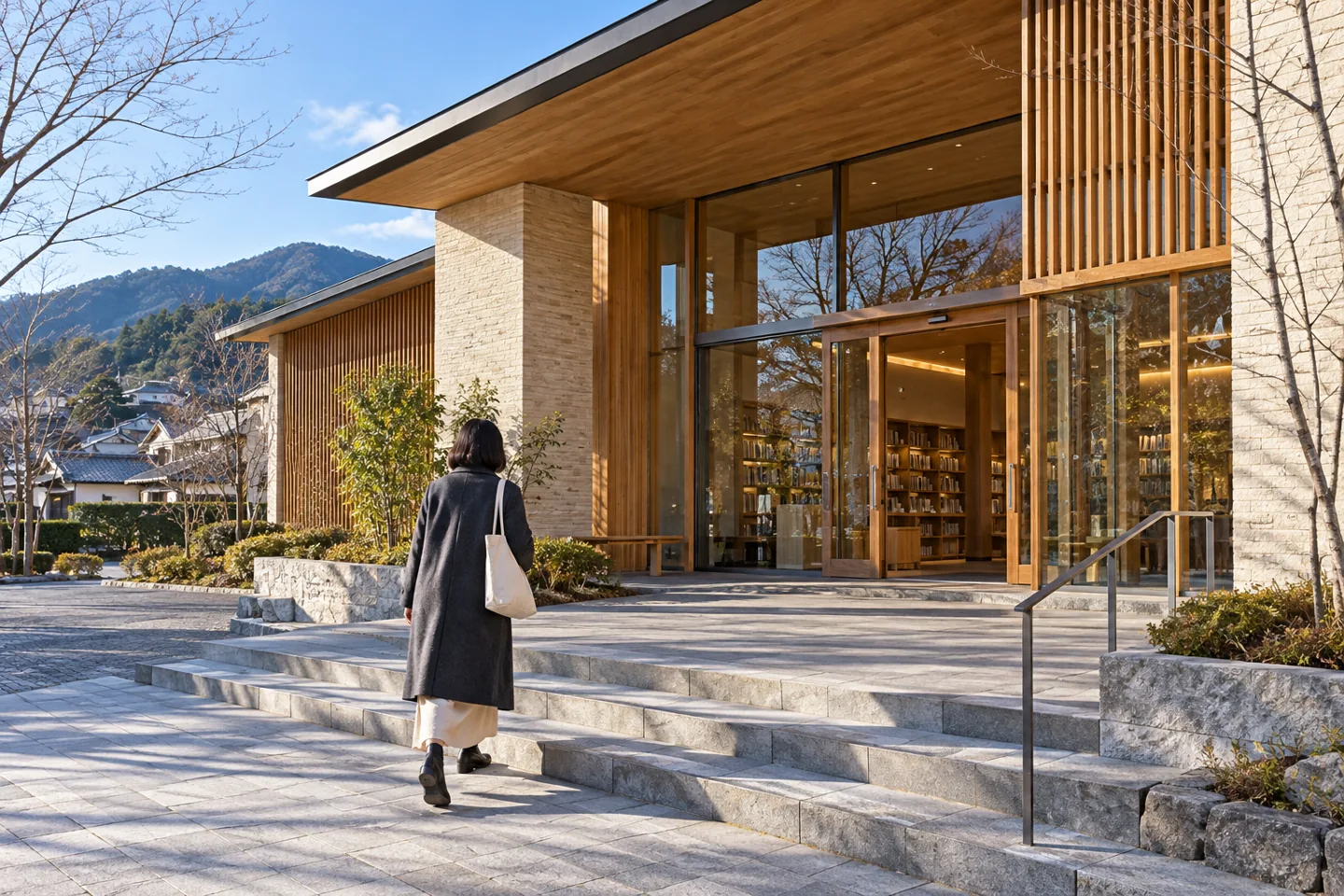
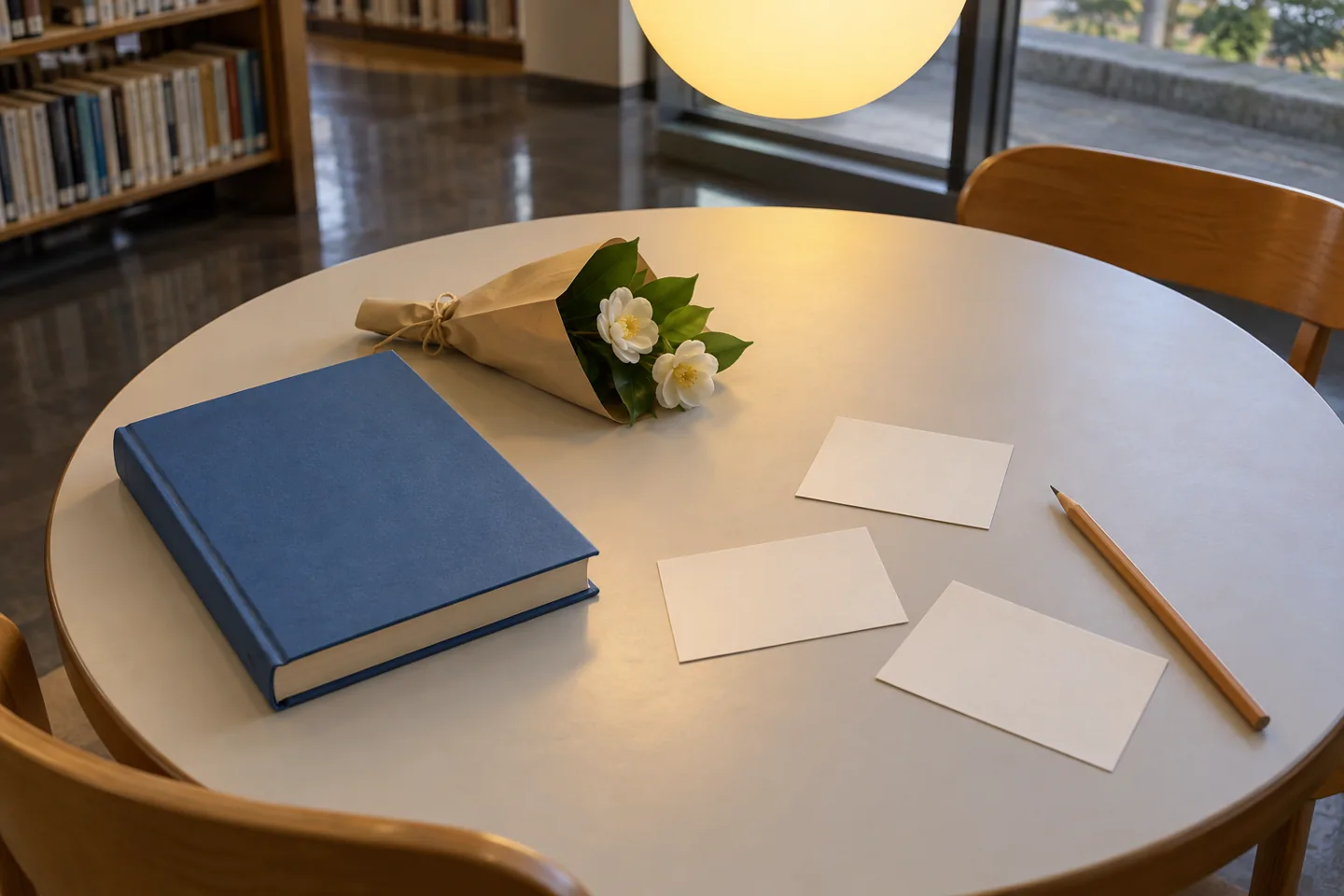
The entrance photograph suggests a possible place. It cannot establish why the person is visiting. Our written prompt supplies that intention. Before choosing Japanese forms, explain the difference between destination and purpose in your own words. That explanation will help you notice when a sentence names one but accidentally leaves out the other.
Retrieve three polite forms, then remove masu
Start with 借ります, karimasu, “borrow”; 買います, kaimasu, “buy”; and 読みます, yomimasu, “read”. Remove the final ます from each checked polite form: 借り, kari; 買い, kai; 読み, yomi. Those are the forms we place before purpose に in this lesson. The dictionary forms are 借りる, kariru; 買う, kau; and 読む, yomu.
Work from the complete polite form instead of applying “remove the last character” to every dictionary entry. 買う does not produce the required 買い by simply losing う. If you remember the meaning but not kaimasu, look it up before building a longer phrase. A small verified set is more useful here than a guessed list of many verbs.
The St. Olaf College grammar reference confirms movement with a purpose and the stem attachment. We use original library and flower errands below. Keep the reference available for checking, then hide the model when you attempt your own answer. Recognition while reading and retrieval without the answer visible are different tasks.
Put the intended activity before the movement
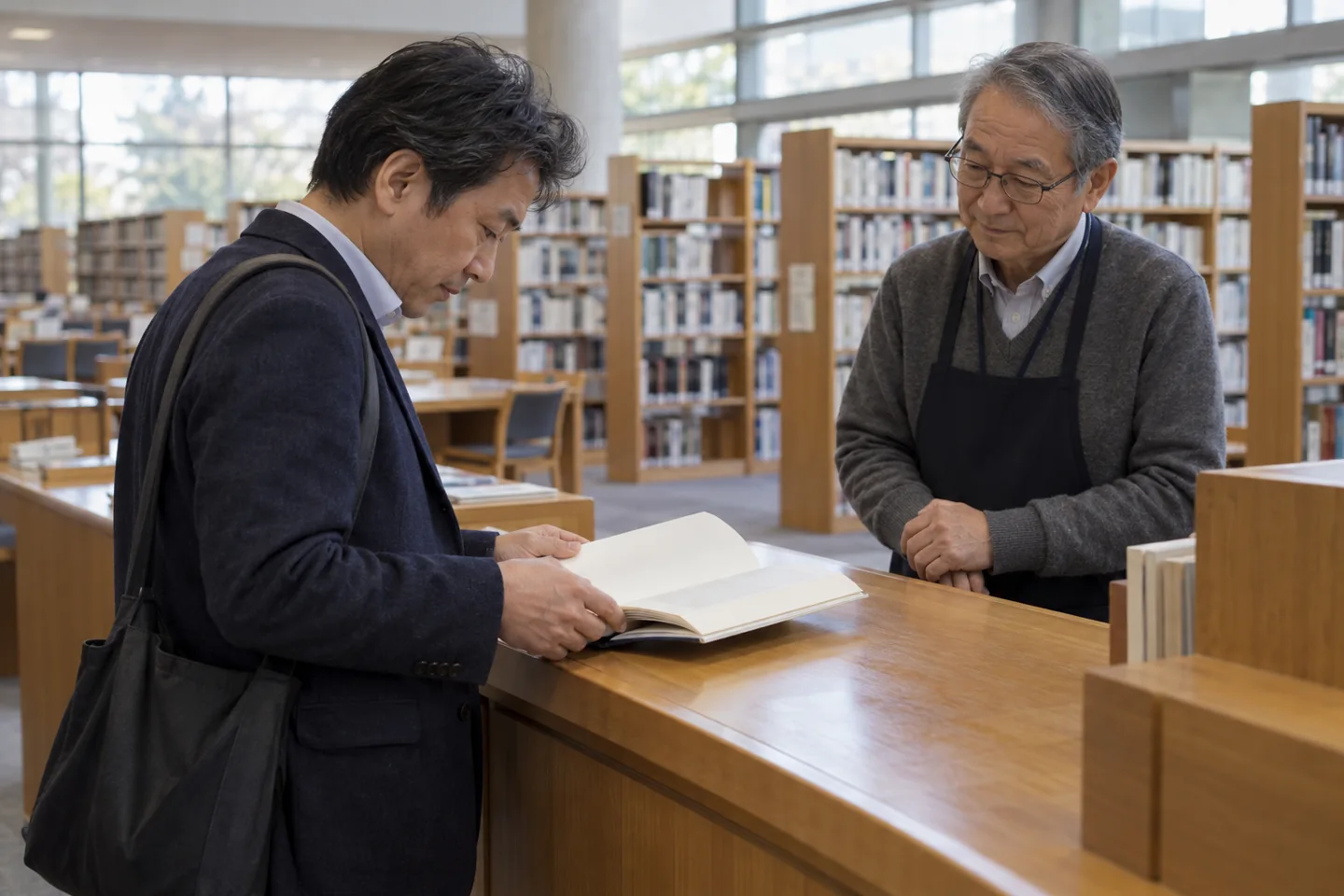
Build 本を借りに行きます。Hon o kari ni ikimasu. “I go to borrow a book.” 本, hon, is a book; を, pronounced o, marks what is borrowed; 借りに gives the purpose; 行きます, ikimasu, means “go” in polite form. In the supplied planning context, “I will go to borrow a book” is also a natural translation.
Now add the destination: 図書館へ本を借りに行きます。Toshokan e hon o kari ni ikimasu. “I go to the library to borrow a book.” 図書館, toshokan, is library. The particle へ is written he but pronounced e when marking direction here. Read the sentence as three meaningful groups: library as destination, borrowing a book as purpose, and going as the final statement.
Keep the model’s order for your first attempt. You do not need to discover every possible word order at once. Our Japanese sentence structure guide provides broader help with locating the predicate and its related phrases. After reading, cover the Japanese and recover the three groups from the scenario, rather than copying the line one character at a time.
Change the errand while preserving the relationship
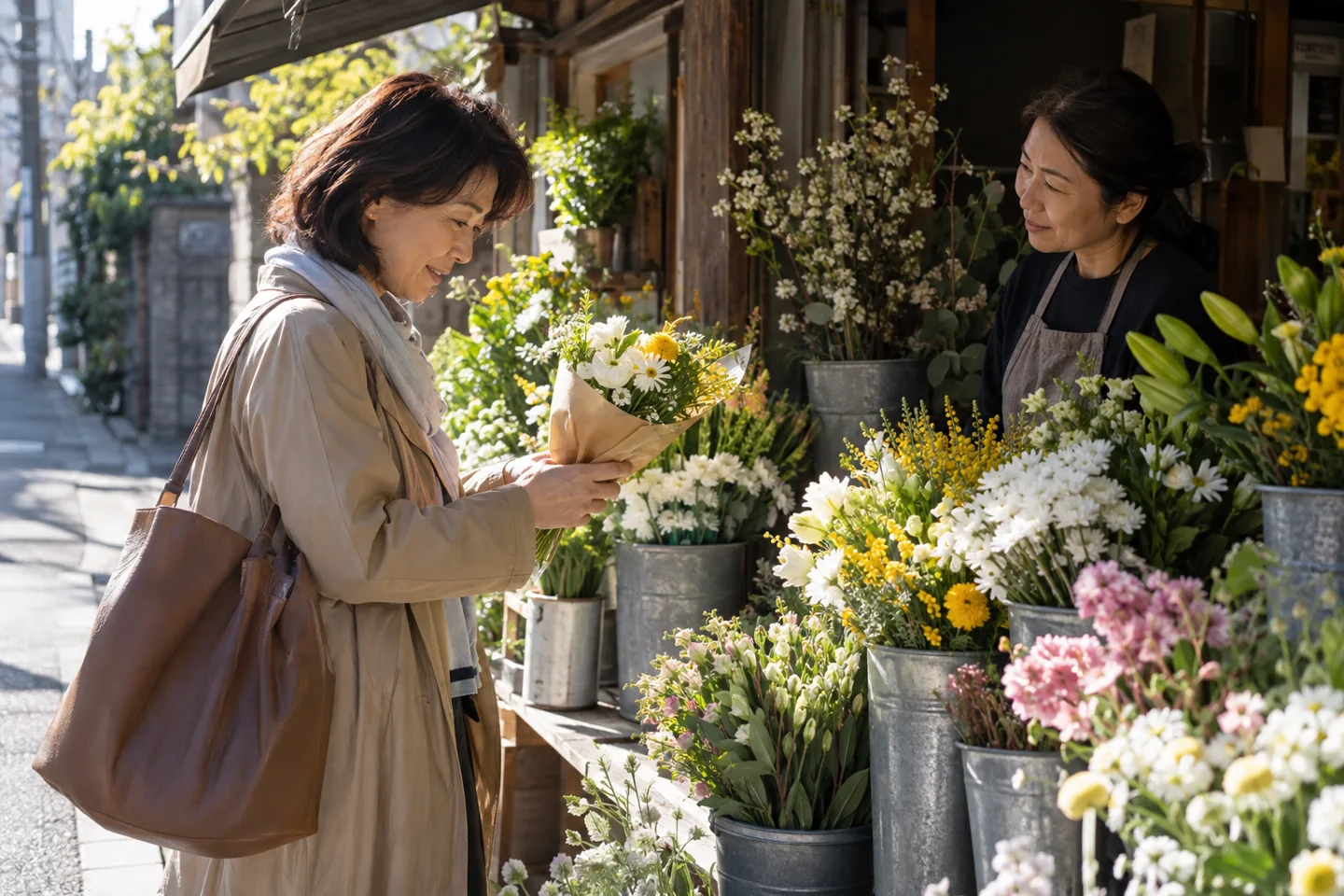
For the second errand, use 店へ花を買いに行きます。Mise e hana o kai ni ikimasu. “I go to the shop to buy flowers.” 店, mise, means shop; 花, hana, means flower or flowers according to context. Japanese does not require a plural ending on hana simply because our fictional bouquet contains more than one flower.
Compare 本を借りに with 花を買いに. Each small phrase keeps the object with its intended action. If you accidentally combine 花 with 借り, you have changed the message to borrowing flowers. That combination is not rejected merely because of its grammar, but it does not match our buying prompt. Check the meaning before treating every wrong answer as a conjugation problem.
For a controlled variation, keep the shop destination and replace flowers with a book: 店へ本を買いに行きます。Mise e hon o kai ni ikimasu. “I go to the shop to buy a book.” Explain what changed and what stayed. The setting is a language exercise; the sentence does not guarantee that a particular shop sells the item or that the purchase succeeds.
Change the final verb when the visit is past
Suppose you are describing yesterday’s library trip. Use 図書館へ本を借りに行きました。Toshokan e hon o kari ni ikimashita. “I went to the library to borrow a book.” The final 行きました reports the past movement. 借り remains the purpose stem. Do not turn it into a second past verb simply because the visit happened yesterday.
The sentence states why you went, but does not by itself confirm that you successfully borrowed the book. Perhaps the copy was unavailable. To say whether the borrowing happened, you would need additional information. This distinction is useful when reading plans and accounts: an intention, a journey and its successful outcome are related facts, not interchangeable claims.
The negative model 本を借りに行きません, hon o kari ni ikimasen, says that the person does not or will not go to borrow a book in the relevant context. It does not mean the person cannot borrow anything anywhere. Keep your first practice affirmative and past-positive, then inspect the negative only after you can explain which part of the message it changes.
Use KanaWay to check a missing word separately
Publisher disclosure: Learn Japanese Hub is produced by the KanaWay publisher. KanaWay remains in development. The current project source contains a stored-word review screen with an answer attempt, reveal, self-rating and later review interval. This is evidence for a bounded word-review workflow, not for a released ni iku lesson or the availability of these exact example cards.
If a suitable stored card is available, attempt “borrow” or its Japanese reading before revealing the answer. Compare what you actually recalled with the displayed word. Then choose the self-rating that fits that attempt. The screen presents review intervals and records the rating; it does not establish that you can now connect the word to a destination and purpose in a sentence.
If no suitable card is present, make the same short recall check on paper and continue with the lesson. You do not need to create a new deck or assume an unsupported app feature. The Japanese vocabulary guide explains keeping words in useful contexts. Return from the isolated word to our complete errand prompt, because recognising kari or kai is only one part of the task.
Decide whether the problem is recall or sentence assembly
Try the library prompt with the model covered. If the word “borrow” is missing, record that specific gap and check karimasu. If the word is known but you write its dictionary form directly before に, revisit the attachment form. If the stem is correct but your sentence says only 図書館へ行きます, you have supplied the destination while leaving the purpose unstated.
Those observations suggest different next attempts. A vocabulary gap calls for retrieving the word again. An attachment error calls for rebuilding karimasu → kari → kari ni. A missing-purpose answer calls for identifying both pieces of the original prompt before writing. Repeating the whole model ten times without naming the difficulty gives you less useful information about what needs attention.
Keep this ni separate from destination に. A destination can also take に, but we use へ in our full examples to make the two jobs easier to see. This is a teaching choice, not a rule banning destination に. Likewise, purpose ni iku is not the same construction as a te-form followed by iku. Save that separate pattern for its own checked examples.
Build six answers from the supplied intentions
One: give the purpose stem from 買います and read it aloud. Two: say that you go to borrow a book, without naming a destination. Three: add the library destination using へ. Four: say that you go to the shop to buy flowers. Write the full Japanese sentences before comparing them with the models above.
Five: make the full library sentence an account of yesterday’s trip, keeping borrowing as the purpose. Six: a learner correctly recalls karimasu on a word card, then writes a sentence containing only the library destination and 行きます. Has the successful word review supplied the missing purpose in that sentence? Explain exactly what still needs to be added.
Check your answers in two passes. First identify the intended activity and its object; then inspect the attachment and final movement verb. The Japanese practice guide offers other ways to organise a small retrieval session. For this round, the important result is a sentence whose separate parts you can explain, not the number of attempts you finish.
Check the purpose, then try one new activity
One is 買い, kai: remove ます from kaimasu. Two is 本を借りに行きます。Hon o kari ni ikimasu. Three is 図書館へ本を借りに行きます。Toshokan e hon o kari ni ikimasu. Four is 店へ花を買いに行きます。Mise e hana o kai ni ikimasu. In each complete sentence, identify the final movement verb after naming the purpose phrase.
Five is 図書館へ本を借りに行きました。Toshokan e hon o kari ni ikimashita. The final past ending changes; the purpose stem does not become a past form. Six still needs 本を借りに, hon o kari ni, if borrowing a book is the intended activity. A correct word-card attempt cannot add words or relationships to a different sentence automatically.
For transfer, use the third checked verb: 図書館へ本を読みに行きます。Toshokan e hon o yomi ni ikimasu. “I go to the library to read a book.” Compare it with going to borrow one. The destination and object remain, but the purpose changes. Recover the reading purpose without looking, then explain why reading there and borrowing a book are different errands even when both can involve the same building.
Questions about the method
Does the dictionary form go before purpose ni?
Use the checked masu-stem in this pattern: karimasu gives kari, and kaimasu gives kai. Keep the object with its activity, as in hon o kari ni.
Does went to borrow mean borrowing succeeded?
No. Our past sentence reports the journey and its purpose. Whether the book was actually borrowed needs further information. Do not turn an intention into a confirmed outcome.
Can KanaWay word review check my whole sentence?
The verified stored-word flow supports an available word attempt and self-rating. It does not judge the destination, purpose connection or full sentence. Check those here.