
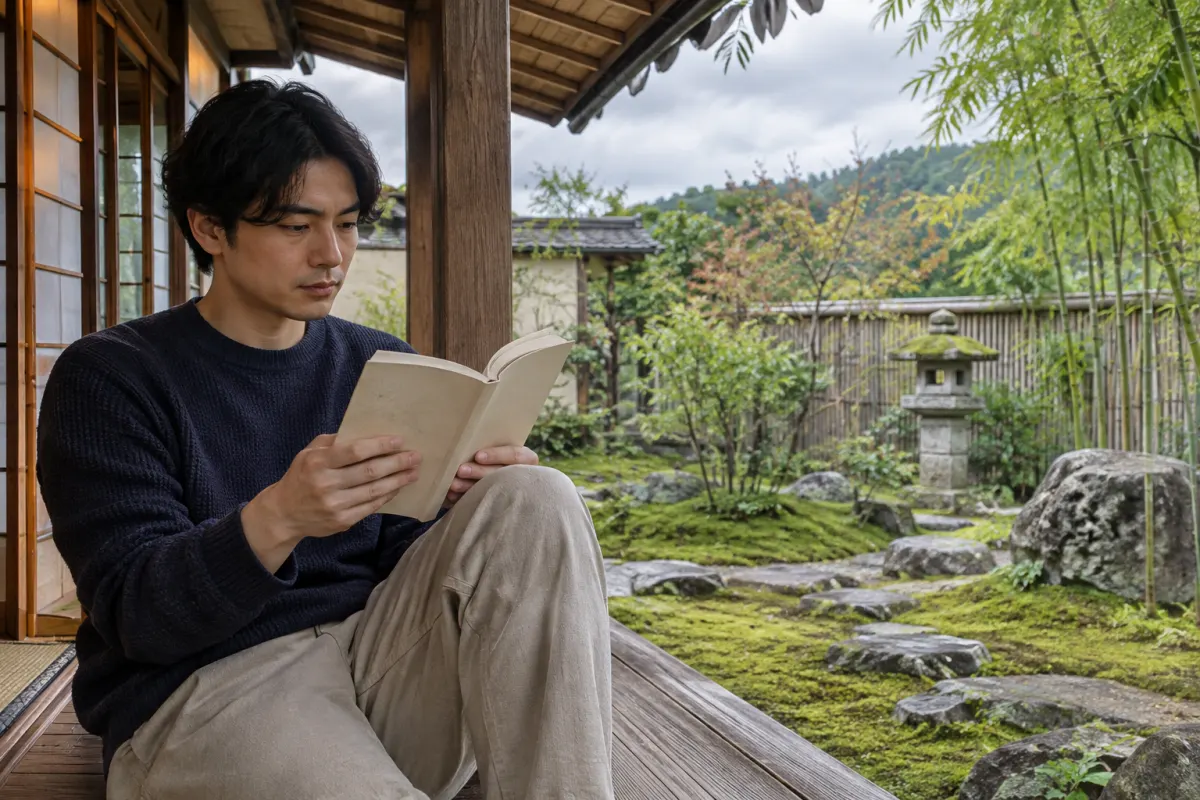
There is a book beside the window, and someone reads beside the window. English can use the same place expression in both sentences. Japanese asks you to notice the relationship between the place and the predicate. Ni and de help express that difference. 窓のそばに本があります (まどのそばにほんがあります) locates a book. 窓のそばで本を読みます (まどのそばでほんをよみます) locates the activity of reading. The window has not changed, but the sentence is doing a different job. Follow that job before choosing a particle.
Ni and de depend on what the sentence says
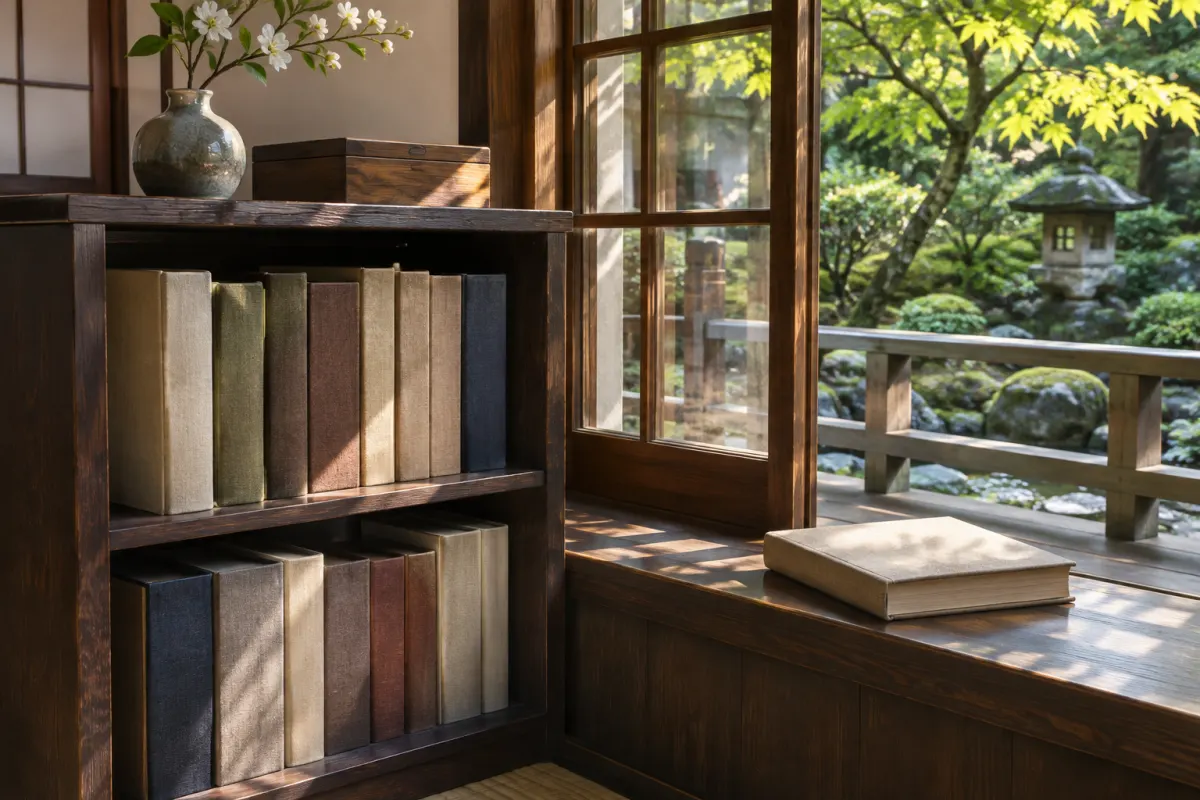
Imagine a small reading room opening onto a garden. A low shelf stands beside the window. Your friend wants to know where the book is. 窓のそばに本があります says there is a book beside the window. Here に marks the location associated with the existence of the book. It is useful when you are helping someone find an object. The sentence does not tell you what anyone does with that object or whether the room is open to visitors today.
Now your friend asks where you read. 窓のそばで本を読みます says that you read beside the window. Here で identifies the setting of the action. The place expression 窓のそば is identical. It is not a special kind of place that always demands one particle. Look at あります or 読みます and decide whether you are locating a thing or describing where an activity happens. That comparison is the starting point for this lesson, not a complete account of every use of either particle.
Write the two sentences on separate lines and underline only the predicate. Then explain in English what each listener wanted to know. For the first, the relevant missing information is the book's location. For the second, it is the place of reading. If you can describe that difference before looking at に and で, the particle choice becomes connected to meaning. If you only memorise “window plus ni,” the second sentence will seem like an exception for no good reason.
Keep the place fixed while changing the message
Use the garden as a second setting. 庭に人がいます (にわにひとがいます) tells you there is a person in the garden. For the ordinary location of a person, います is appropriate. 庭で本を読みます (にわでほんをよみます) describes reading in the garden. The first sentence establishes someone's presence; the second gives the setting for an action. Both may be true at the same time. You do not have to choose which description is the only correct account of the scene.
A picture of a seated reader can support several possible conversations. Someone looking for their friend may need the person's location. Someone comparing study places may want to know where reading happens. The photograph cannot supply the intended question by itself. State that question before choosing your sentence. This prevents a useful pair of examples from becoming an exercise in guessing what a picture is supposed to mean. It also helps you notice when two grammatical answers convey different information.
To practise, keep 庭 unchanged and alternate the question on a paper card. One card says “Who is present?” The other says “Where do you read?” Answer the first with a presence statement and the second with a reading statement. Let a partner check that your explanation answers the chosen question. The Japanese grammar guide gives you a place to review the basic roles of particles before trying more combinations.

Do not turn physical movement into the rule
The reader may sit perfectly still and continue reading. That does not turn the reading location into a に expression in our example. Reading is still the activity described by 読みます. Conversely, a person whose presence is reported with います might be moving around in the garden. The sentence is locating that person rather than narrating the movement. “Moving versus not moving” is therefore an unreliable shortcut for the contrast we are practising.
Try this check with writing. 庭で手紙を書きます (にわでてがみをかきます) means “I write a letter in the garden.” The writer may remain in one chair throughout. で locates the writing activity. Put a closed notebook on the table and describe its location separately with あります. Your hand does not need to move dramatically for the two sentences to ask for different particles. Focus on the predicate and the message, rather than judging how active the photograph looks.
This lesson does not claim that every state uses に or every verb involving movement uses で. Both particles have other roles, including destinations, means and time-related constructions. A destination in a sentence about going somewhere needs its own explanation. Keep the exercise limited to ordinary existence with あります or います and a familiar activity such as reading or writing. Learning one clear contrast is more useful than applying an oversimplified rule to every new sentence.
Use KanaWay review to recall a verb, then change the context
If 読む appears in a KanaWay review session on Android, try saying 読みます and make a sentence locating the reading activity. If it does not appear, use the verb on paper. Say 窓のそばで本を読みます. Now put the reading action aside and locate the book with 窓のそばに本があります. You have kept the place and the book while changing the relationship expressed by the sentence. This is an off-device sentence exercise alongside vocabulary review, not a claim that the app automatically presents this exact pair.
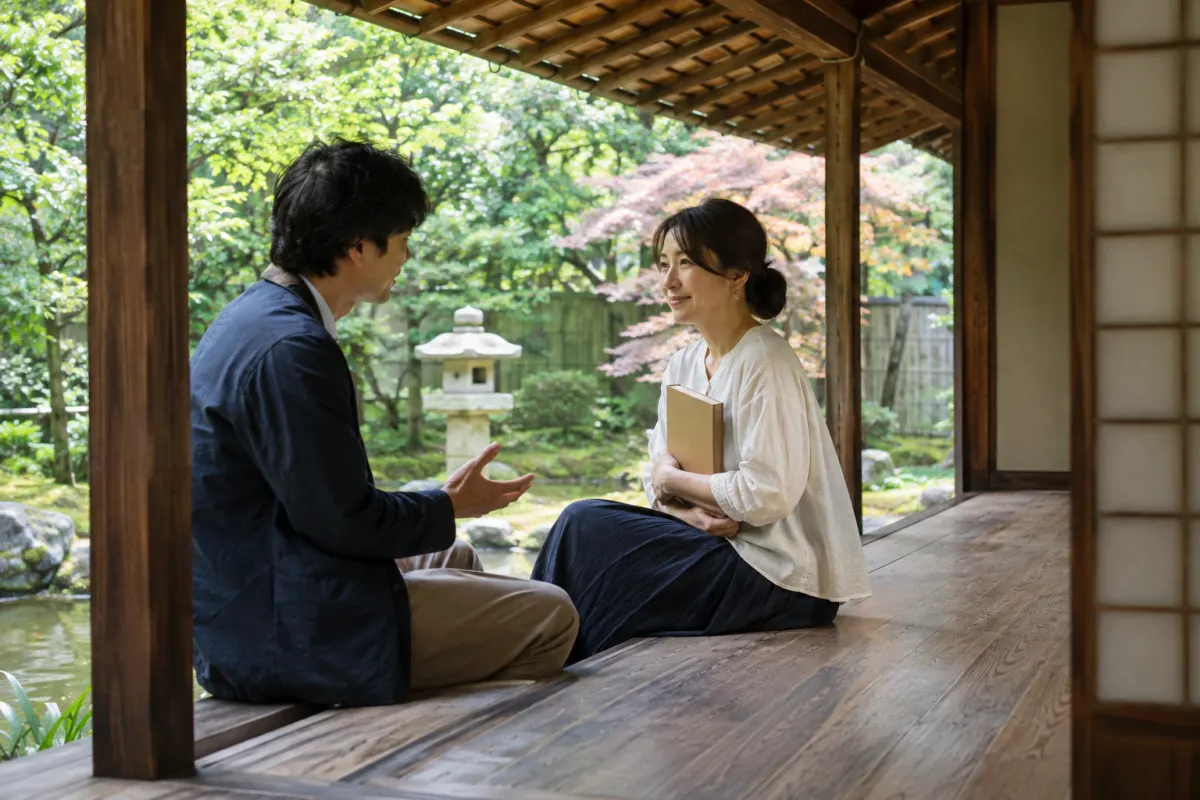
Ask a partner to give you either a location question or an activity question. Retrieve the relevant verb before filling in the particle. For a book's location, build the existence statement. For the activity, build the reading statement. A review prompt can help bring a word to mind, but it does not establish that your sentence answers the intended question. Learn Japanese Hub and KanaWay share a publisher. Use the conversation to check communication, rather than interpreting successful recognition in an app as proof of complete particle mastery.

Ask the question that matches the information you need
本はどこにありますか (ほんはどこにありますか) asks where the book is. A natural short answer in our scene is 窓のそばにあります, “It is beside the window.” The book is already the topic, so it need not be repeated in every reply. Keep に when you shorten the answer. If you replace the full sentence with an isolated place word, you may understand the location but lose an opportunity to practise how that place connects to the predicate.
どこで本を読みますか (どこでほんをよみますか) asks where you read books. 窓のそばで読みます answers the activity question. It does not assert that a particular book is currently beside the window. Imagine you usually read there but put today's book on the shelf afterwards. The reading statement can remain true while the object's present location changes. This small scenario helps separate a habit or activity setting from an inventory of what is in the room now.
Practise a short misunderstanding. One learner asks where the book is; the other answers where they usually read. Have the first learner explain the missing information instead of simply saying “wrong particle.” The response may be grammatical and still fail to answer the question. Repair it with a location statement, then ask the activity question separately. The Japanese practice guide can help you turn this into a short recall task with a specific question and a checkable answer.
Transfer the contrast and recognise its limits
Move the exercise from the veranda to a bench. ベンチのそばに本があります (ベンチのそばにほんがあります) locates the book beside the bench. ベンチのそばで本を読みます locates reading beside the bench. Changing the noun for the place should not automatically change the particle. Change the message instead: first something is present, then an action happens. If you can keep that distinction through a new place expression, you are doing more than remembering the original window sentence.
There is one useful warning about あります. An event can occur at a place, and Japanese can use で with an event even when the predicate is あります. 庭で読書会があります (にわでどくしょかいがあります) says there is a reading-group meeting in the garden. 読書会 names an event, rather than a physical book whose location is being given. This is why “aru always takes ni” is too broad. Keep the ordinary object example and the event example distinct.
Finish by writing three lines: the location of a book, the setting of reading, and the location of a fictional reading-group meeting. Label the information each line provides. Ask a partner to invent the corresponding question. If they need clarification, revise the message before adding more vocabulary. The point is to connect place, predicate and intended information. You can then recognise when a future sentence needs a new explanation rather than forcing it into this introductory contrast.
Questions about the method
Does a seated activity use ni because nobody moves?
No. In our reading and writing examples, で locates the activity even when the person stays in one chair. Physical movement is not a dependable test. Ask what the predicate says about the place.
Can the same place take either particle?
Yes, in different sentences. 窓のそばに本があります locates a book; 窓のそばで本を読みます locates reading. The place stays the same while the relationship changes. The particles are not freely interchangeable within one unchanged message.
Is every sentence ending in arimasu a ni sentence?
No. Ordinary object existence uses に in these examples, but an event can be located with で, as in 庭で読書会があります. Both particles also have uses beyond this lesson. Look at the whole construction and the information it conveys.