
Mae ni and ato de connect two events in Japanese, but their verb forms can seem to disagree with the calendar. You may be describing yesterday and still need a dictionary form before mae ni. You may be planning tomorrow and need a ta-form before ato de. The useful question is which event is earlier relative to the other, rather than whether every visible verb looks like English past or future.
This guide gives you a paper exercise with an outing, a closed window, a return home and a phone call. You will draw the sequence, choose a frame and check six original situations. The lesson works independently of any app. Its aim is narrow: preserve the order of two familiar events while distinguishing the linking form from the time expressed by the final predicate.
Draw the events before arranging the words
Write two short event labels: “close the window” and “go out.” Put them in the intended chronological order, with closing first. You now have a meaning to check against your Japanese. Without this step, it is easy to produce a grammatical-looking sentence that reverses your plan. The first activity mentioned in a sentence is not necessarily the first activity that happens.
Choose one event as the reference point. If going out is the reference, you want to say what happens before it. If closing the window is the reference, you could describe what happens after that. These are two ways to view a sequence, not two automatically different real-world schedules. Keep the people and activities fixed while comparing the viewpoints.
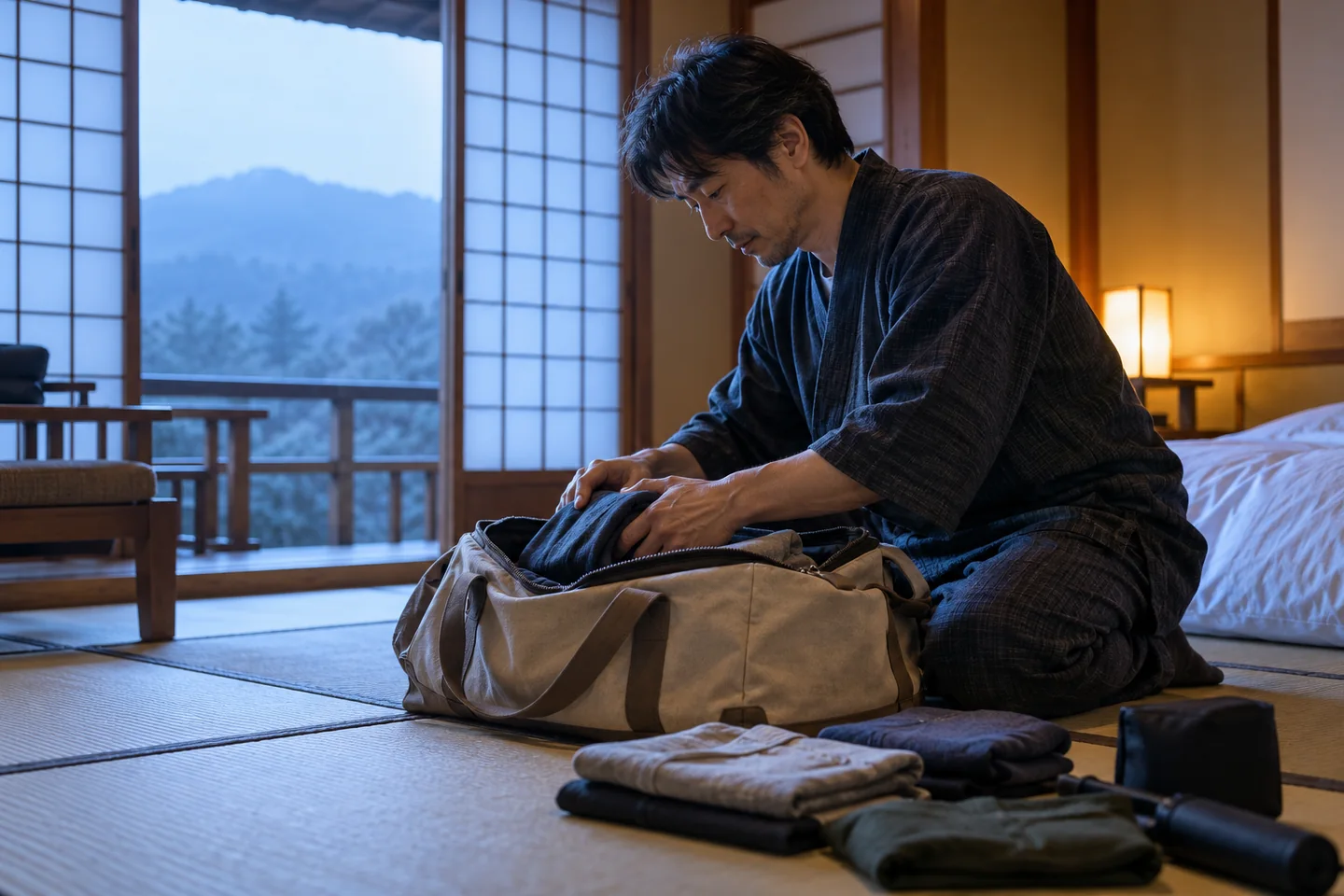
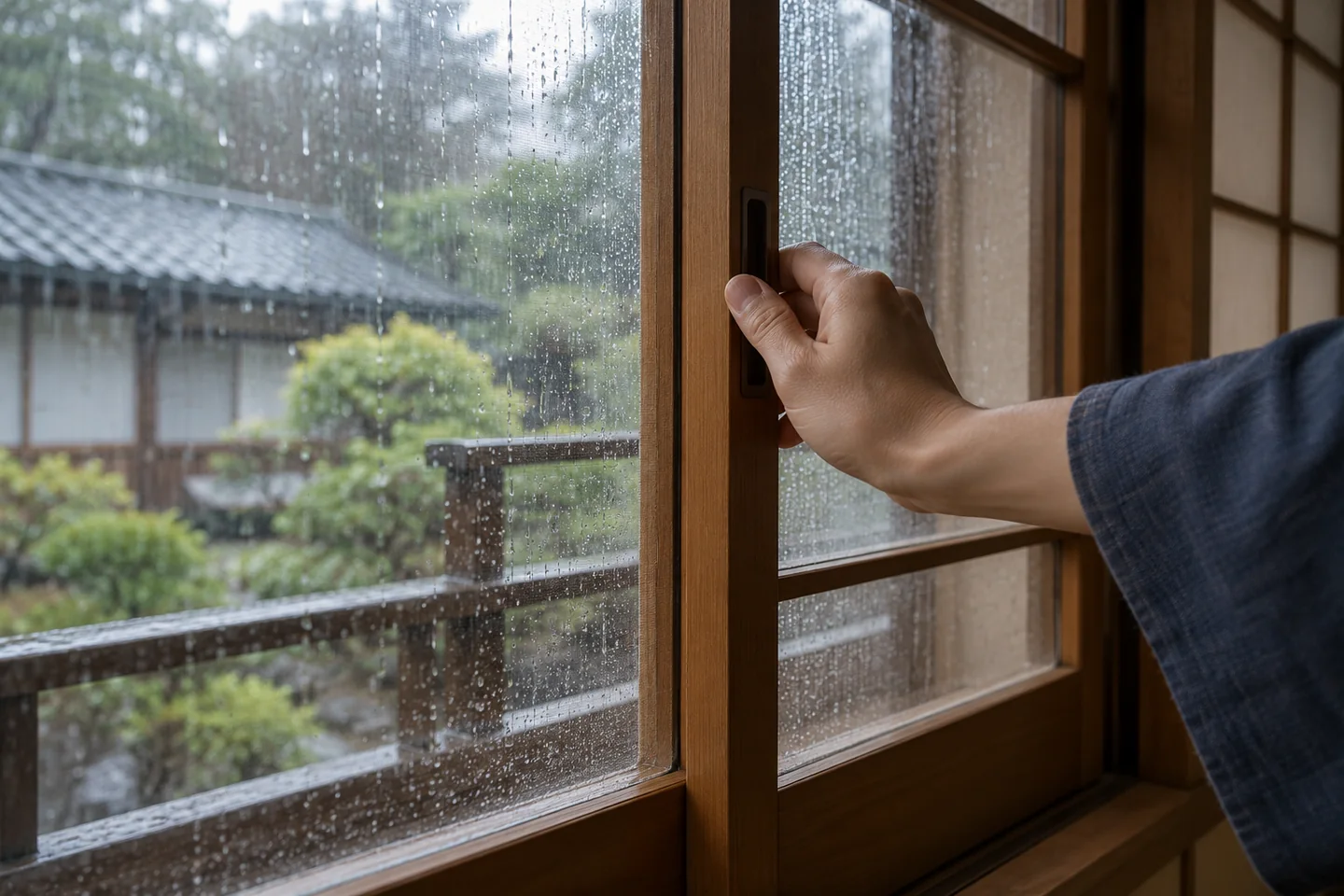
Use photographs only as activity prompts. A packed bag cannot prove that someone has already left, and a closed window cannot establish when it was closed. Our written scenarios supply the order. The Japanese sentence structure guide helps with assembling a clear message; this exercise adds a separate check of the relationship between its two events.
Mae ni and ato de start from different reference points
For our first frame, use a dictionary-form verb followed by 前に, mae ni: “before doing.” 出かける前に、窓を閉めます。Dekakeru mae ni, mado o shimemasu means “I close the window before going out.” Going out is mentioned first, but closing occurs first. Point back to your event labels and check that you have not mistaken sentence order for chronological order.
出かける, dekakeru, means to go out; 窓, mado, is a window; 閉めます, shimemasu, is the polite form for closing it. In this controlled frame, the verb attached to 前に is 出かける, not 出かけます. The final predicate remains polite. A plain form inside a time clause does not require the whole sentence to become a casual statement.
The University of Texas JOSHU reference presents the verb and noun patterns for before and after. Use its basic distinction to inspect our original outing example. Learn the complete connection 出かける前に as one meaningful unit, then identify the main action separately. This is more useful than attaching a translation to mae while ignoring the surrounding verb.
Ato de places the main action after completion
For the matching after frame, attach 後で, ato de, to a plain ta-form: “after doing.” 家に帰った後で、友達に電話します。Ie ni kaetta ato de, tomodachi ni denwa shimasu means “I call a friend after returning home.” The return is the reference event and the call follows it. Draw return → call before deciding whether your translation preserves the order.
Keep a small verified form list beside your attempt: 帰る → 帰った, kaeru → kaetta; 閉める → 閉めた, shimeru → shimeta; 読む → 読んだ, yomu → yonda; 書く → 書いた, kaku → kaita. The ta-form is not made by adding た to every dictionary form. In particular, 帰る is a godan verb despite ending in る.
The Japan Foundation’s explanation of time expressions discusses the completed reference event in ~たあとで. Keep the practical consequence modest: the second event follows the first in our sentence. The wording alone does not give an exact gap, say that the call happens immediately or establish why the person calls. Do not add a schedule that the message has not provided.

Yesterday and tomorrow do not change both forms
Now describe yesterday: 昨日、出かける前に窓を閉めました。Kinō, dekakeru mae ni mado o shimemashita: “Yesterday, I closed the window before going out.” The final 閉めました locates the closing in the past. 出かける stays in the dictionary form inside our before frame. Changing it to 出かけた just because yesterday appears would break the controlled pattern you are practising.
For tomorrow’s plan, use 明日、家に帰った後で友達に電話します。Ashita, ie ni kaetta ato de tomodachi ni denwa shimasu: “Tomorrow, I will call a friend after returning home.” 帰った remains the ta-form: the return is viewed as completed before the planned call. It does not tell you that the return has already happened at the moment of speaking.
Separate two questions in your notes: “Which event precedes the other?” and “When is the whole message set?” Answering one does not automatically answer the other. Our Japanese verb conjugation guide gives broader form practice. Here the dictionary-to-ta list is a support for a specific relationship, not a demand to master every conjugation before understanding this pair of sentences.
A named event uses a noun connection
A meeting can be named as a noun rather than expressed with a whole verb clause. 会議の前に、資料を読みます。Kaigi no mae ni, shiryō o yomimasu: “I read the materials before the meeting.” The connection is 会議 + の + 前に. Keep の visible. You are attaching a noun event, not replacing the dictionary form of an omitted verb with a polite ending.
For the after version, use 会議の後で、メールを書きます。Kaigi no ato de, mēru o kakimasu: “I write an email after the meeting.” The meeting comes first in time, followed by writing. Our examples use の with the noun, but not between a verb and 前に or 後で. Compare 会議の後で with 帰った後で to see the different attachment points.
This lesson concerns time, not where a person stands relative to a building or object. 前 also appears in spatial expressions, so a familiar character alone cannot settle the meaning. Ask whether the reference is an event such as a meeting, and read the rest of the sentence. Keep the entire noun phrase intact when explaining why the reading here is temporal.

Six short tasks with an explicit intended order
Hide the next section. One: closing the window happens before going out. Complete 出かける___、窓を閉めます using our before connection. State which activity actually happens first. Two: you will call a friend after returning home. Complete 家に帰る___、友達に電話します, changing the verb form if needed. Do not change the planned order to avoid the form choice.
Three: yesterday you closed the window before going out. A draft reads 昨日、出かけた前に窓を閉めました. Identify the local repair while preserving yesterday and the final predicate. Four: the meeting is a noun event. Complete 会議___前に、資料を読みます. Explain why the connection differs from 出かける前に rather than memorising only the missing character.
Five: tomorrow’s plan reads 明日、家に帰った後で友達に電話します. Has the return necessarily already occurred when this is said? Explain the role of 帰った. Six: 会議の後でメールを書きます describes an email after a meeting. Does it tell you the exact minute of writing, or guarantee that no other activity occurs between the two events? Keep your answer tied to the words actually supplied.
Check order, attachment and time separately
One: 出かける前に、窓を閉めます。Dekakeru mae ni, mado o shimemasu. Closing happens first even though going out is mentioned first. Two: 家に帰った後で、友達に電話します。Ie ni kaetta ato de, tomodachi ni denwa shimasu. Change 帰る to 帰った before adding 後で. The completed return supplies the reference point for the later call.
Three: write 昨日、出かける前に窓を閉めました。Kinō, dekakeru mae ni mado o shimemashita. Restore the dictionary form inside the before clause; the final predicate still describes yesterday. Four: 会議の前に、資料を読みます。Kaigi no mae ni, shiryō o yomimasu. The noun 会議 takes の. The verb 出かける attaches directly in the other frame, so copying の into both would erase the distinction.
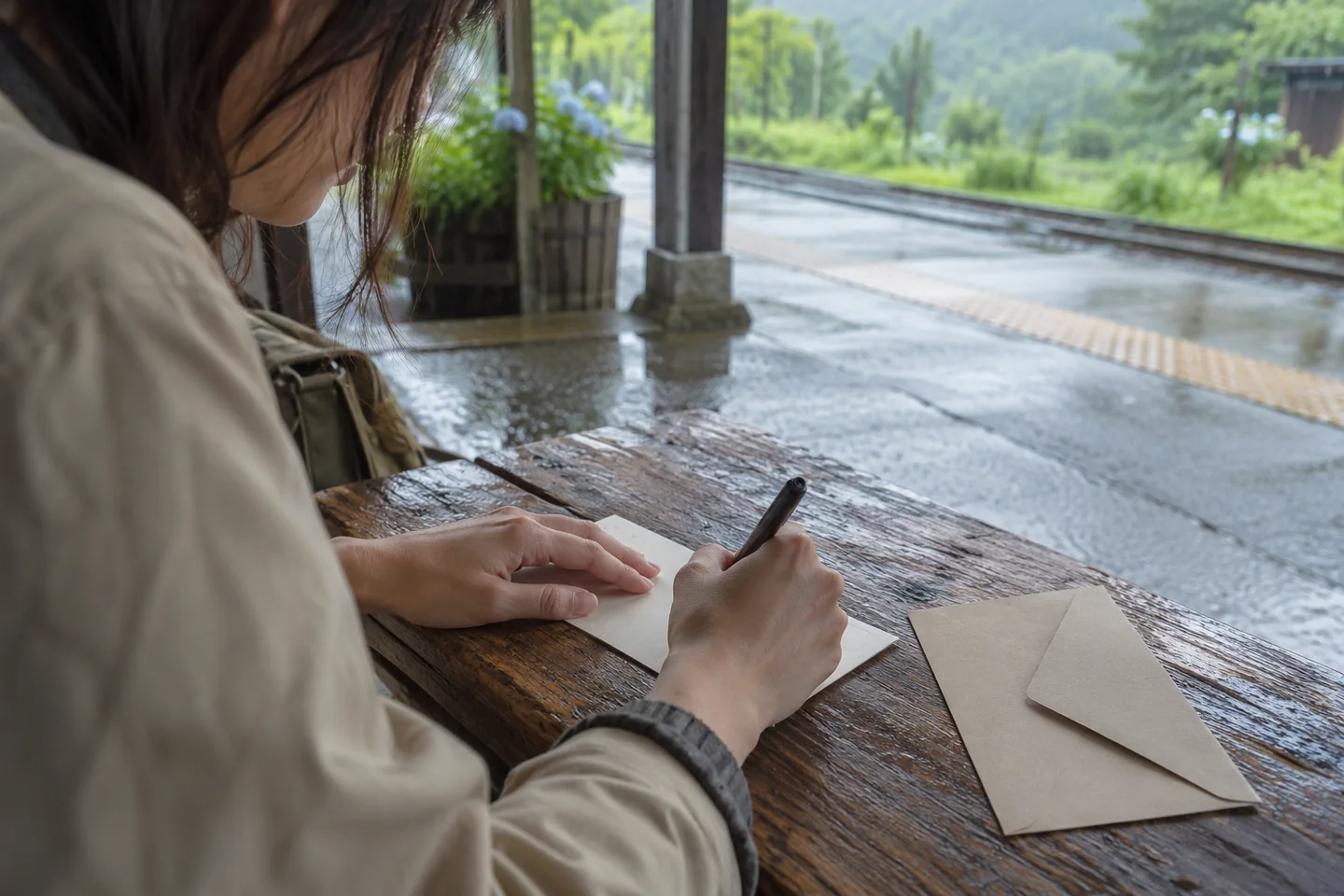
Five: no. In the supplied tomorrow plan, 帰った marks the return as completed relative to the following call, not as already completed now. Six: no precise minute or immediate adjacency is stated. The order is meeting → email. Our writing photograph is only an activity cue; it cannot supply a timestamp, a preceding meeting or the writer’s actual intention without a written scenario.
Practise one sequence from two viewpoints
Write “close window → go out” on a fresh sheet, then produce our before sentence without looking. On another sheet, write “return home → call friend” and produce the after sentence. Compare the event labels before correcting kana or romanisation. A beautifully written sentence with the wrong order needs a meaning repair, not merely another spelling exercise.
Next change only the time setting: yesterday for the before sentence and tomorrow for the after sentence. Keep the attached forms you have verified and adjust the final predicate as the model requires. Then try the meeting noun pair. This progression gives each attempt one clear decision. Mixing every verb, time and noun immediately makes it harder to identify why a sentence failed.
Finish with one error note: reversed sequence, wrong attachment, wrong ta-form or confused time setting. The Japanese practice guide can help you fit that target into a short session. You do not need to finish with a new rule for every time expression. Leave with two checked connections and the ability to explain which event happens first in each original sentence.
Questions about the method
Does ta before ato de always mean the event is past now?
No. In our tomorrow plan, the return is completed before the future call. Read the final predicate and time expression along with the linking clause. The ta-form in this pattern supplies a relative completion point; it does not independently establish that everything happened before the speaker began talking.
Can I put a polite masu-form directly before mae ni?
Not in the controlled verb pattern here. Use the dictionary form before 前に, while keeping the final predicate polite if appropriate. 出かける前に窓を閉めます combines a plain attached form with a polite main predicate. They perform different jobs within the same sentence.
Do ato de and te kara mean exactly the same thing?
They overlap in some sequences, but are not freely interchangeable in every context. We focus on ato de as a time relationship and do not practise a prerequisite or immediate-follow-up nuance. The linked Japan Foundation explanation develops that wider contrast. Learn this bounded pattern before extending the exercise.