

You recognise a loanword, read it aloud, and later write it without the long line. The meaning was familiar, but the Japanese spelling was not secure. Katakana long vowels deserve their own small practice task: notice ー, identify the vowel it extends, and retrieve the complete word when the answer is hidden. A familiar English word can help with meaning while also pulling your pronunciation in the wrong direction.
This is a focused reading-and-recall routine, rather than a complete pronunciation course. Our katakana chart supplies the wider character system. Here you will work with four checked words, separate a spelling omission from an uncertain sound, and decide what to revisit. You can practise on paper; later we explain a bounded way to use KanaWay’s review workflow without claiming that a correct typed answer proves correct pronunciation.
Start with the mark in katakana long vowels
The mark ー lengthens the vowel immediately before it. In ケーキ, meaning cake, ケ supplies the vowel e and the line preserves that vowel for another timing unit. The final キ remains ki. A useful beginner breakdown is ke-e-ki: three morae. These are rhythmic counting units, not three English-style stressed syllables and not three isolated noises.
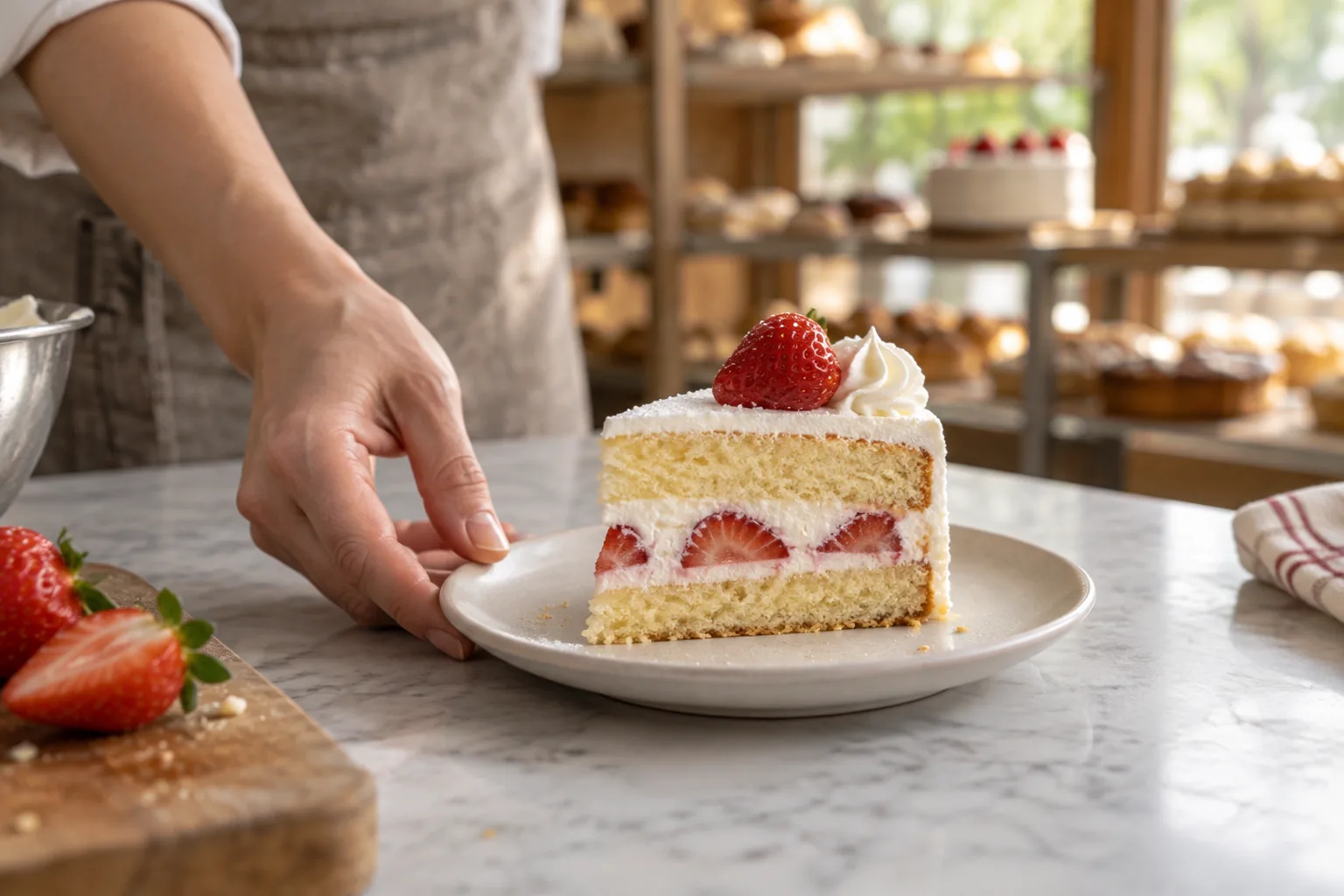
Look at the cake photograph and connect it with ケーキ. Read the complete written form, then look away and say it again. The image supplies a meaning cue; it does not show where the line belongs. That difference matters. Recognising the picture and recognising the spelling are two separate tasks, even when both feel easy while the answer is visible.
Use a light hand movement to follow the three units if that helps. Keep the vowel flowing through the first two; do not insert a silent gap between ke and its extension. A timing sketch is a learning aid, not an acoustic measurement. Real speech changes with context and pace, so no fixed number of milliseconds is promised here.
Build a checked set of four complete words
Our practice set is ケーキ, cake; テーブル, table; スーツ, suit; and スキー, skiing. For initial timing notes, use ke-e-ki, te-e-bu-ru, su-u-tsu and su-ki-i. The first, third and fourth have three morae; テーブル has four. The line does not always extend the same vowel: the preceding kana tells you which sound continues.
The MIT katakana introduction explains the written long-vowel mark in a broader loanword context. Use it to verify the principle, then return to the small set. You do not need to infer a rule for every foreign name or unfamiliar spelling today. Learn the established Japanese form of each word you choose.
Write each full word beside its meaning once, checking the characters carefully. Then shuffle the meaning cues. If you always rehearse cake, table, suit, skiing in that order, the sequence can conceal weak recall of one item. Ask for table first or skiing first. Retrieving a complete answer from a changed cue is more revealing than reciting the list from the top.
Keep vowel length separate from stress and pauses
A long vowel has more duration in the word’s rhythm; it is not an instruction to shout, raise pitch or pause. English stress habits can make one part of a loanword prominent while another part shrinks. For this exercise, preserve the written units without pretending that slow equal taps describe every detail of natural Japanese speech.
Say テーブル while looking at the whole table in the workshop photograph. The e in テ continues across the mark: te-e-bu-ru. Keep ブ and ル in the word. If you use the English pronunciation of “table” as your model, knowing the object will not automatically give you the Japanese sound sequence. Meaning recognition is helpful, but a checked Japanese recording remains the better sound model.
For the wider distinction between vowel length and other sound features, use our Japanese pronunciation guide. Pitch accent and fluent sentence rhythm need their own listening work. A spelling exercise should not claim to diagnose them. If your uncertainty is auditory, listen to a reliable model rather than repeatedly typing the same letters.

Use KanaWay for a bounded recall check
KanaWay’s documented review workflow provides an attempt, an answer reveal and a rating for stored learning cards. For a suitable available word card, try to retrieve the full written form before revealing it. Check the long-vowel mark against the stored answer, then rate the attempt honestly. This article does not claim that every word in our exercise appears in a dedicated built-in lesson.
If the available card asks for a different task, such as meaning recognition, respect that task. You can still keep a separate paper note for spelling. The application’s stored-card review is not an automatic judge of everything you did aloud. Saying a word privately and typing its spelling require different checks, and a correct entry does not establish accurate timing.
The existing typed-word confusion handling compares answers with known stored forms or readings within its supported scope. It is not general speech recognition or a promise to identify every missing long vowel. Use only the controls actually available to you. This editorial workflow adds a focused question to your review; it does not announce a new app feature or an automatic katakana pronunciation course.
Name the mistake before choosing the next attempt
Consider a learner who intends スーツ but writes スツ. The intended meaning is suit, yet the written long-vowel mark is missing. For this controlled exercise, mark the attempt as an incomplete spelling and rewrite スーツ after checking it. Do not describe スツ as a separately verified Japanese word merely to create a dramatic minimal pair.
Now consider someone who writes スーツ correctly but is unsure whether the first vowel was held long enough. That is an uncertainty about sound, not evidence of a spelling problem. Compare the spoken attempt with a dependable model or ask a qualified speaker for feedback. The clothing photograph establishes the meaning cue; it cannot verify pronunciation by itself.
Keep two small headings in your notes: “written form” and “sound to check”. Put a specific word under the relevant heading. A general entry such as “bad at katakana” gives you nothing concrete to repair. One accurate diagnosis can lead to a short useful next task, whereas repeating all four words equally may spend time on answers that were already clear.

Do not turn the long line into a small ッ
The long mark and the small ッ have different jobs. The first extends the preceding vowel. The second indicates a consonant closure in the relevant sound pattern. Swapping one for the other changes the written form and the sound instruction. Our four-word set keeps the focus on ー; it does not teach every special katakana combination at once.
The Japan Foundation’s kana teaching resource distinguishes long sounds, small consonant markers and combined kana. Consult the categories when you are unsure what kind of mark you are seeing. The aim is to identify the symbol’s role before inventing an explanation based on the appearance of an English word.
Also avoid copying the katakana long-line rule into every hiragana word. Other spellings and conventions require separate checking. Today’s controlled task is narrower: preserve the established line in these katakana words. You can finish this task successfully while still needing help with many other Japanese spellings. A limited goal makes the answer check clearer rather than making the language artificially simple.
Try four meaning cues and explain the answers
Hide the model list. A: write cake in katakana and identify the extended vowel. B: write table and count the units in the beginner timing breakdown. C: write suit and locate its long mark. D: write skiing and identify the vowel that the final line extends. Use the four photographs as meaning cues if helpful, but do not consult the spellings before attempting your answers.
The checked answers are A ケーキ, extending e; B テーブル, te-e-bu-ru, four morae; C スーツ, extending u after ス; and D スキー, extending i after キ. The word スキー names skiing here. These English meanings are prompts for the exercise, not a claim that every context or grammatical use can be translated with exactly one word.
Compare your actual attempt with each answer. A missing line needs a spelling correction; uncertainty about how long the vowel sounded needs listening feedback. If you chose the right word only after seeing its answer, record that as recognition after a hint. Do not silently upgrade it to unaided recall. That honest distinction makes your next practice choice more useful.

Return to the difficult word, then change the cue
For the next review, select the word whose answer was least secure. Retrieve it once without the model, check the whole form, and then use a different meaning cue or a short context. You do not need to start from the first item every time. A focused attempt can reveal whether the correction survived when the familiar list order disappeared.
Our Japanese vocabulary guide describes the broader connection between meaning, use and review. Keep that larger goal in view: accurate spelling should support understanding and communication. A perfect four-item chart alone is not a measure of fluency, and this article offers no guaranteed number of sessions or automatic pronunciation score.
Finish by stating what you can now check: the vowel before ー, the complete form of the chosen word, and whether your uncertainty belongs to spelling or sound. Add a new loanword only after verifying its established Japanese spelling and a suitable sound model. Small expansions are easier to evaluate than an unexamined list copied from familiar foreign words.
Questions about the method
Does ー always extend the same vowel?
No. Read the kana immediately before it. In ケーキ it extends e, in スーツ it extends u, and in スキー it extends i. Check the complete written word rather than treating the line as a separate fixed vowel.
Can a typed answer prove correct pronunciation?
No. A written answer can show whether you retrieved the spelling expected by a supported task. Timing, pitch and other sound details need an appropriate sound check. Keep spelling review and pronunciation feedback separate.
Must I copy every word many times?
No fixed number of copies is required here. Try an answer with the model hidden, check it, identify the error and choose a relevant next attempt. Copying can help you inspect characters but should not replace checking unaided recall.
Do the photographs show the Japanese spelling?
No. They provide meaning cues only. The cake, table, suit and skiing scenes support the four prompts without displaying letters. Use the original checked model list to verify spelling after making your own attempt.