
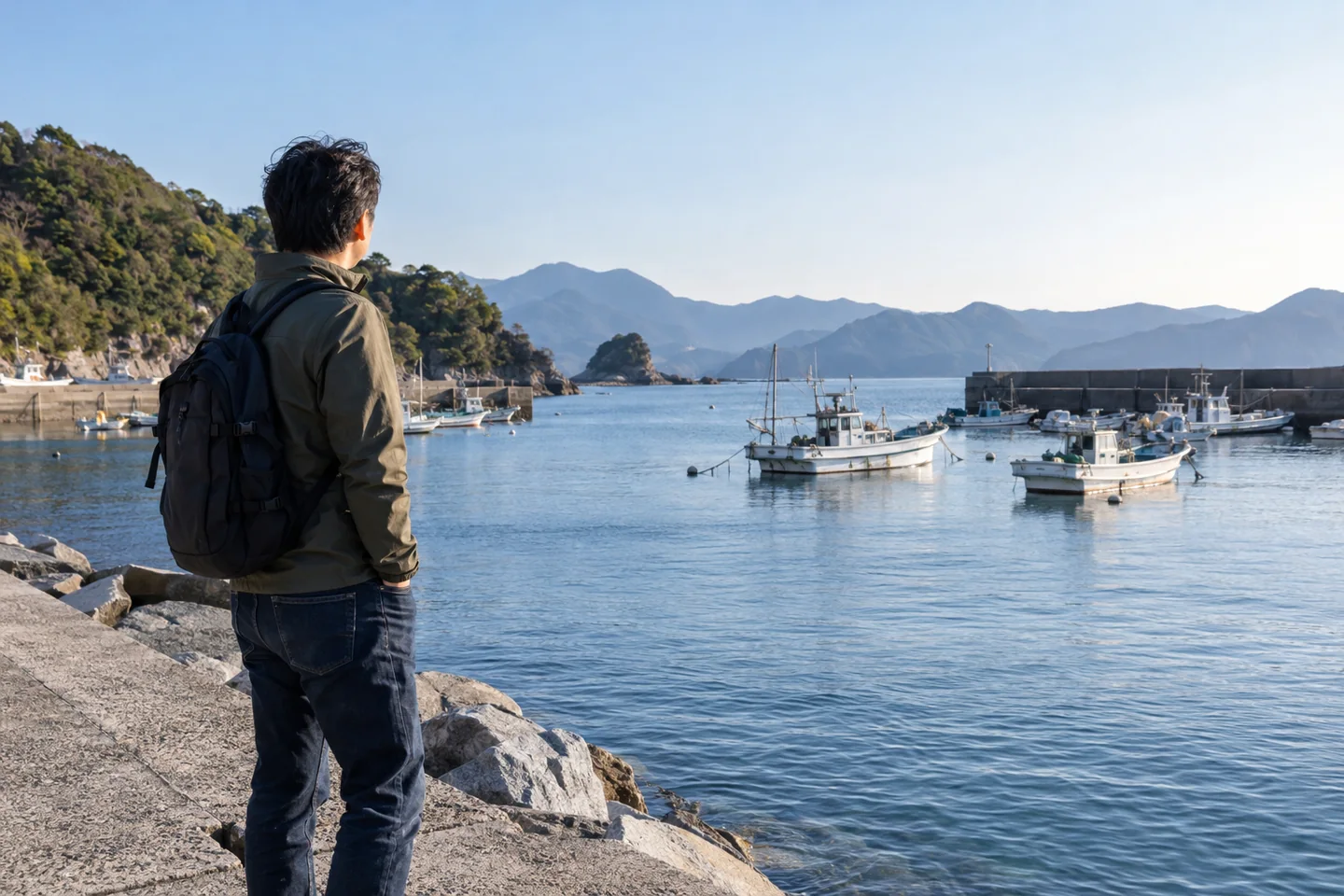
The Japanese tai form lets you say what you want to do, but remembering its translation is only the beginning. At a harbor, you might want to read, take photographs or go somewhere else. Those are possible messages, not facts that an observer can read from your expression. You need to choose your intended action before deciding which word and ending will express it.
This lesson keeps the speaker’s own wishes at the centre. You will build a small set of polite statements, contrast two changed meanings and answer six original questions. A verified KanaWay word-review flow can help with a missing verb when an appropriate stored card exists. The sentence choices stay separate: a successful card answer cannot decide whether you meant a wish, a completed action or an invitation.
Choose the action you actually want to describe
Write a short meaning cue in your own language: “I want to read this book.” Keep both parts visible: the activity is reading, and your message is a desire to do it. “I read this book” and “I have this book” are different messages. A sentence can contain the correct noun and still miss the purpose of the exercise if the action or desire is lost.
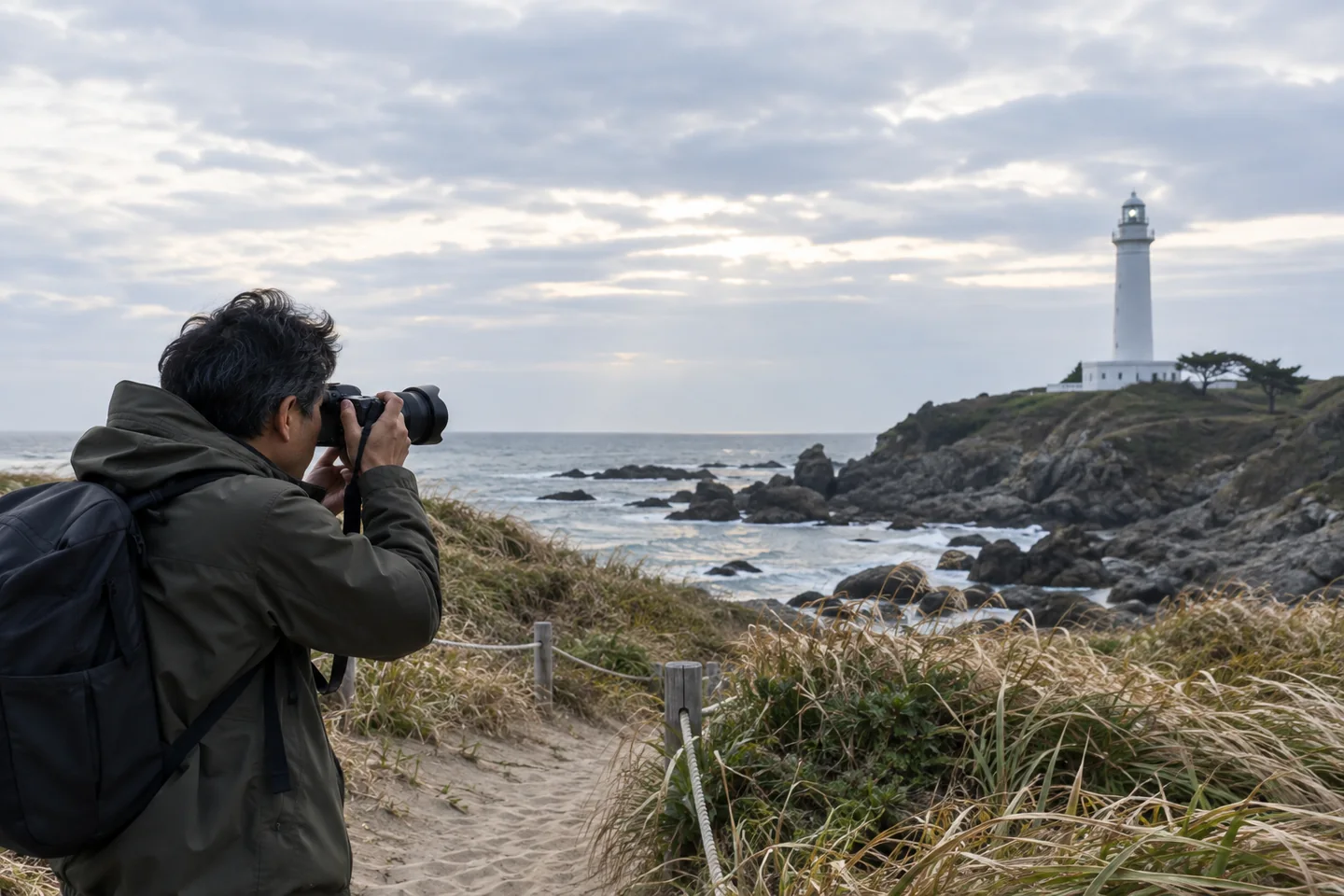
Use the coastal photographs as prompts for activities rather than evidence about people’s feelings. Someone holding a camera may be working, learning or simply carrying it. The exercise must explicitly supply “I want to take photographs” if that is the target. This is especially useful when practising with a partner: a clear cue makes the response checkable without guessing a private intention.
If the verb itself will not come back, mark that gap before changing the sentence. Our Japanese vocabulary guide explains learning words with a useful context. Here that context includes what you want to do with the word. A form problem and a missing-verb problem can occur together, but noting them separately makes the next practice step much easier to choose.
Japanese tai form: start from the supplied masu form
Use the polite form as your starting point, remove ます and add たいです. 読みます → 読みたいです, yomimasu → yomitai desu, gives “I want to read.” 飲みます → 飲みたいです, nomimasu → nomitai desu, gives “I want to drink.” The portion before ます stays. Do not keep ます and attach another ending after it; you are replacing that part in this exercise.
Two more useful pairs are 撮ります → 撮りたいです, torimasu → toritai desu, “I want to take photographs,” and 行きます → 行きたいです, ikimasu → ikitai desu, “I want to go.” The dictionary forms are 撮る and 行く, not 撮ります and 行きます. Starting with the supplied polite forms avoids pretending that every dictionary verb can simply lose its final character before tai.
The Japan Foundation’s lesson 18 grammar explanation describes this stem connection and the following inflection. Use it to check the small form list, then cover our answers and reconstruct one pair. Our verb conjugation guide develops the broader system. For this task, identify the given starting form correctly before applying the replacement; recognising a familiar-looking ending is not enough.

Keep the noun and its relationship in the sentence
Build the complete book sentence: この本を読みたいです。Kono hon o yomitai desu: “I want to read this book.” この本, kono hon, supplies “this book.” 読みたいです supplies the desired action. The sentence does not say that the reading has happened, that the book has been purchased or that somebody has agreed to lend it. Check the claim before adding a plausible story.
For water, use 水を飲みたいです。Mizu o nomitai desu: “I want to drink water.” In simple direct-object examples like these, you will also encounter が in place of を. We keep を in the controlled models so that the activity connection remains easy to inspect. This is not a rule saying that every particle before a tai-form can be changed to が.
A destination still needs its own relationship: 港に行きたいです。Minato ni ikitai desu means “I want to go to the harbor.” Do not replace destination に merely because you have seen が with a desired drink. Compare the whole message and the job of each noun. This gives you a useful boundary around the simple object variation without turning the exercise into a universal particle shortcut.

Change the wish without accidentally changing the action
The tai expression changes like an i-adjective. For the controlled negative, use 飲みたくないです, nomitakunai desu, “I do not want to drink.” 水を飲みたくないです。Mizu o nomitakunai desu means “I do not want to drink water.” It does not mean “I cannot drink water” or “There is no water.” Those are different explanations, none of which follows automatically from the wish statement.
For a past wish, use 読みたかったです, yomitakatta desu, “I wanted to read.” この本を読みたかったです。Kono hon o yomitakatta desu means “I wanted to read this book.” The past wish does not tell you whether the reading eventually happened. To answer that question, you need another statement. Keep “wanted” and “did” in different boxes on your practice sheet until the text actually connects them.
For taking photographs, 写真を撮りたいです。Shashin o toritai desu states your own desired activity. Adding polite です does not turn that statement into a complete request for permission or an invitation to somebody else. We practise its meaning as a wish. In a real exchange, purpose and relationship matter alongside the ending, so do not assume one familiar phrase performs every conversational job.
Use word review for the missing verb
Suppose you understand the message “I want to read this book” but cannot retrieve 読む, yomu. If a suitable stored word card is available in KanaWay, attempt the answer before revealing it. The existing local implementation retains an attempt draft, allows a reveal and accepts a self-rating with an interval preview. These are verified word-review steps; they do not establish that this exact lesson or a tai-form deck is publicly available.
After the reveal, compare your actual answer with the displayed word. Did you retrieve its reading before seeing it, or recognise it only afterward? Rate that attempt rather than the confidence you feel after the answer is visible. The interval preview belongs to review scheduling. It does not measure whether your own sentence correctly expresses a present wish or whether its social purpose fits an exchange.
Then leave the card and use the separate supplied form 読みます to construct 読みたいです. If you remembered the verb but wrote 読みますたいです, the next repair belongs to the replacement step, not another translation lookup. Publisher disclosure: KanaWay and Learn Japanese Hub share a publisher. This bounded source-verified workflow makes no download, release or result promise. Use the written models here when no suitable card exists.
Six cues that expose different mistakes
Cover the next section. One: you want to read this book. Start from 読みます and build the complete polite sentence with この本を. Two: you do not want to drink water. Start from 飲みたいです and change the wish while retaining 水を. Do not replace the activity with one that feels easier to conjugate; the intended message is fixed by the prompt.
Three: the meaning is “I wanted to read this book.” Choose the past wish, then state whether it proves the reading occurred. Four: repair この本を読みますたいです without changing the book or the intended present desire. Five: a person appears in a photograph holding a camera. Does that image alone establish “I want to take photographs” as their actual message?
Six: your message is “I want to go to the harbor.” A draft reads 港が行きたいです after an overgeneralised particle rule. Use our destination model to repair it. For each task, label the decision: verb retrieval, ending, noun relationship or missing evidence. A correct answer in one category does not mean that all the others have been checked. Keep a blank visible when you genuinely cannot retrieve the verb.
Read the finished statement for its actual claim
One: この本を読みたいです。Kono hon o yomitai desu. Replace ます with たいです. Two: 水を飲みたくないです。Mizu o nomitakunai desu. The negative belongs to the desire expression. Three: この本を読みたかったです。Kono hon o yomitakatta desu. This reports a past wish, but does not establish that the book was read. Keep that unanswered question open rather than adding an outcome.
Four: この本を読みたいです。Kono hon o yomitai desu. Remove the retained ます instead of placing a second form after it. Five: no. The camera provides an activity cue, not access to the person’s desire or voice. Six: 港に行きたいです。Minato ni ikitai desu. The harbor is the destination. A direct-object variation in the water example does not replace this destination relationship.
Now diagnose your own response. If yomu was unavailable before you looked, record a recall problem. If you knew yomimasu but retained masu, record the assembly step. If your sentence was accurate but you claimed that reading had happened, record an interpretation problem. The plain notebooks in our last image leave the activity open; their presence cannot choose a wish on your behalf.

Take one honest wish into a separate attempt
Choose one of the supplied activities and write its intended meaning before hiding the model. Produce the polite wish once, then explain the change from the given masu form. On another attempt change only the meaning to negative or past, using the relevant model. A short comparison is enough if you can say precisely what changed and what stayed the same.
Keep these exercises with the speaker’s own stated wishes. Broader Japanese can report other people’s desires through context, quotation and additional constructions, but a photograph is not that evidence. Likewise, this lesson is not a general script for asking strangers what they want. We deliberately practise a small first-person task so that form, meaning and missing information can be checked clearly.
Our Japanese practice guide can help you fit this distinction into a short session. End with one useful note: which verb was missing, which ending was wrong, or which claim you added. The next attempt should target that observation. Knowing the word, forming the wish and understanding what it commits you to saying are related skills, each with something concrete to practise.
Questions about the method
Can I attach tai directly to every dictionary form?
Not with the procedure taught here. Begin with a verified masu form, remove ます and add たいです. 読む has the polite form 読みます, giving 読みたいです. Starting from the correct form prevents a guessed dictionary-form shortcut from producing the wrong stem.
Does yomitakatta desu mean I read the book?
No. It means you wanted to read. The sentence reports the wish in the past and leaves the outcome unstated. A later sentence could explain what happened, but you should not insert that information just because it makes the story feel complete.
Does a correct KanaWay card answer check my whole wish sentence?
No. In the verified workflow it provides evidence about the answer you attempted on that stored word card. The stem replacement, negative or past meaning, noun relationship and conversational purpose need their own checks. Use the supplied sentence cues after leaving the card.