
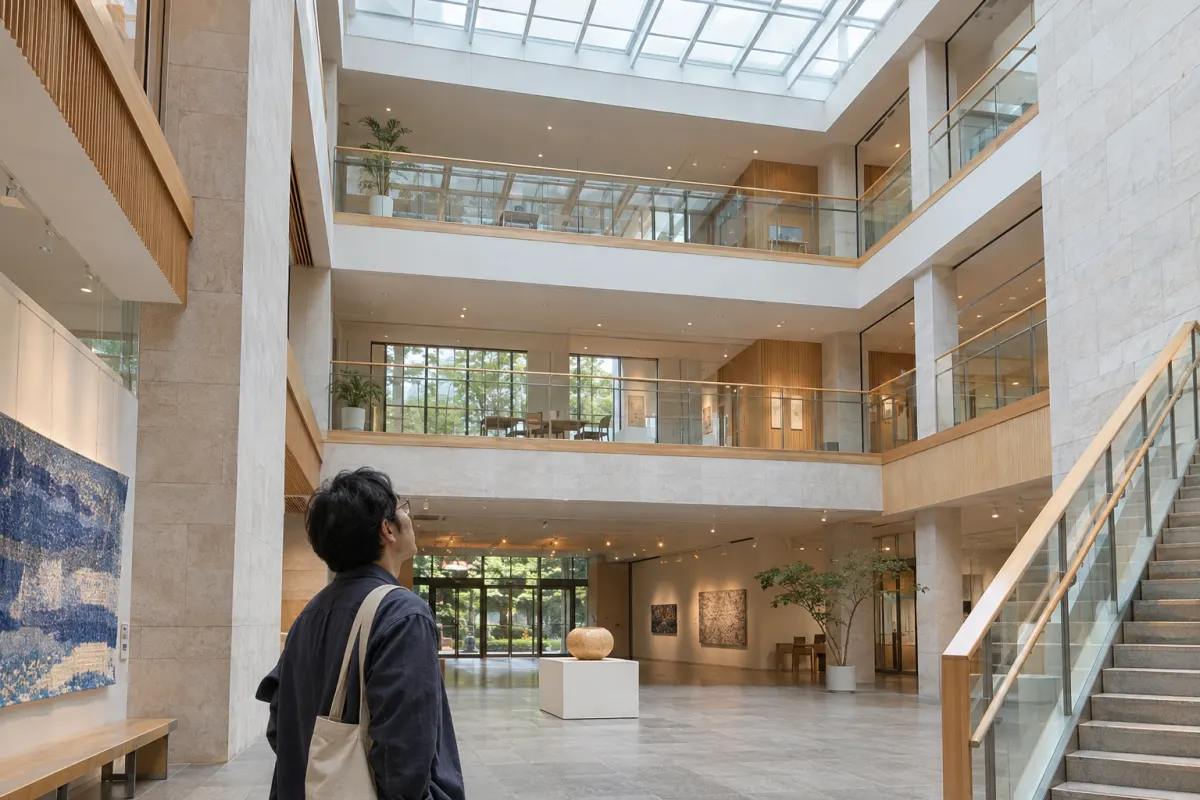
You enter a small arts centre and want to find the reception desk. The building has several levels, and your usual English floor label may not match its numbering. Japanese floor numbers use 階, generally read かい, after a number. Start with the actual level shown by the building, then listen for the whole expression. In our fictional centre, 受付は三階です (うけつけはさんがいです) says that reception is on level three. It does not tell you which staircase or lift to use. You can ask that next.
Japanese floor numbers connect a number with a level
The central task is simple: identify a level before choosing a route. 階 tells you that the number refers to a floor. 三階 means level three. It does not mean room three, three people or three visits. In a building with several activities happening at once, the surrounding noun helps you understand what is being located. 受付 (うけつけ) is reception. 展示室 (てんじしつ) is an exhibition room. Keep the place name and its level together in your notes rather than writing an isolated numeral.
In Japan, the ordinary street-level floor is generally numbered one. This agrees with common American usage, but differs from an English system where a ground floor comes before the first floor. Real buildings can have different entrances on sloping ground or special labels. Read the actual directory and ask staff when the layout is unclear. Learning the usual convention helps you interpret a number; it does not replace the building's own information or prove that every entrance opens onto the same level.
Imagine entering our fictional arts centre from its main entrance. Reception is on 三階. If you mentally translate that into “three floors above where I am,” you may go too far. The expression names a numbered level, not a number of flights to climb. Establish where you are first. Then use the building's route information to get to level three. This distinction becomes especially useful when a walkway brings you into an upper level.
Learn the changed sounds as complete words
Practise a small set before extending the range. 一階 is いっかい, ikkai; 二階 is にかい, nikai; 三階 is commonly さんがい, sangai. 四階 is よんかい, yonkai, and 五階 is ごかい, gokai. You can write the kanji or an Arabic numeral before 階. The number 3 on a directory may help you recognise the destination, but you still need the spoken form when asking someone. Treat the number and the counter as one useful sound unit.
六階 is ろっかい, rokkai. The small っ marks a held consonant, not an extra vowel. If you say roku and then add kai without adjustment, you have missed the normal sound change. For 七階, use ななかい, nanakai. For 八階, はっかい, hakkai, is a useful form to learn; はちかい also occurs. 九階 is きゅうかい, kyuukai. 十階 can be じゅっかい or じっかい. You do not need to resolve every variant before asking where reception is.
Start with three contrasts: 二階 versus 三階, 一階 versus 六階, and 六階 versus 八階. Say each pair while looking at the written destination, then cover the reading. Ask a partner to choose a level and read it aloud. Your job is to point to the matching written level, not simply repeat the sound. If you confuse two words, return to that pair rather than reciting the entire list faster. The Japanese pronunciation guide can help you focus on the held consonant.
Ask which floor before asking how to get there
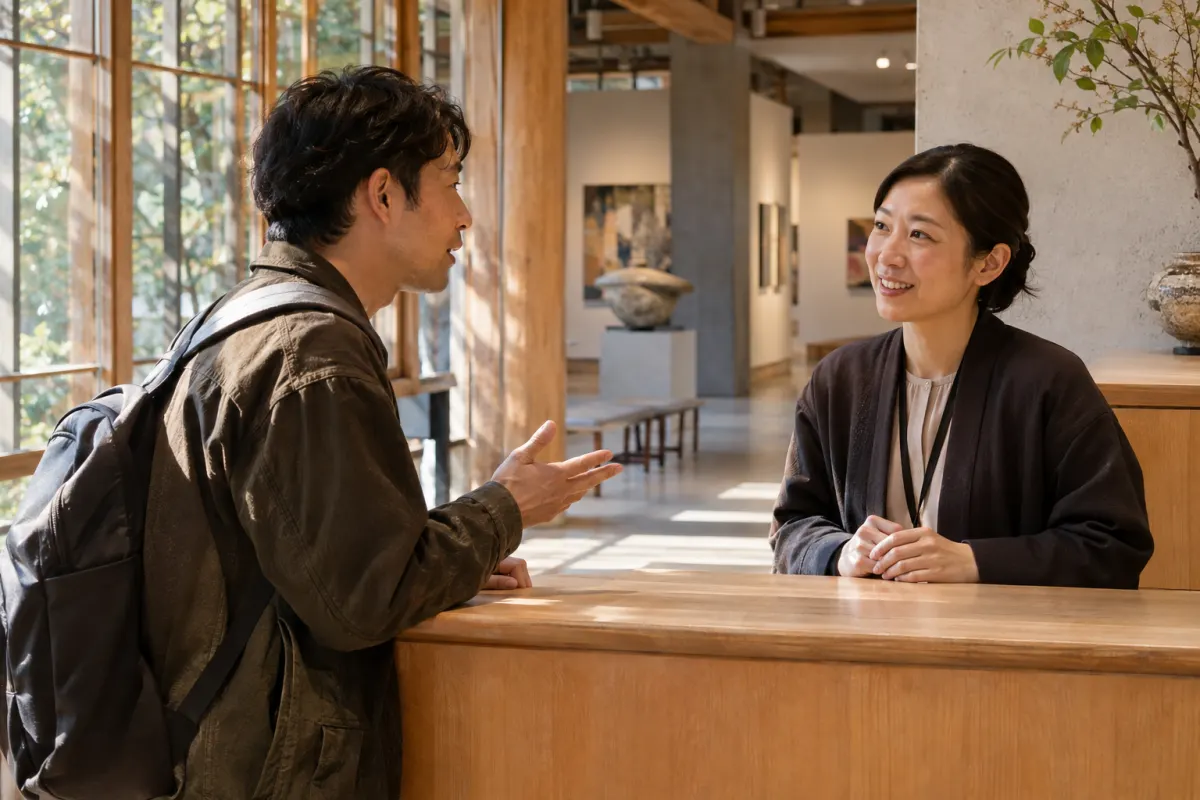
受付は何階ですか asks which floor reception is on. A common reading is うけつけはなんがいですか; なんかい is also heard for 何階. Learn one clear question and recognise the other pronunciation when listening. The answer might be 三階です, “Level three.” It may be shortened because the topic is already established. If you did not catch the number, request it again rather than guessing from a gesture towards the stairs.
For a polite repeat request, say もう一度お願いします (もういちどおねがいします), “Once more, please.” Then listen for the destination word. You can confirm 三階ですか, “Level three?” if that is what you think you heard. Your confirmation gives the other person a specific detail to correct. A vague nod can hide uncertainty, especially if you have confused 三階 and 六階. The goal is to leave the exchange with a usable level, not to avoid every follow-up question.
Once the floor is clear, ask about the route. エレベーターはどこですか (エレベーターはどこですか) asks where the lift is. This is a separate question from which level contains reception. Someone may correctly tell you the floor without telling you where the lift entrance is. In a real building, use the available access information and staff guidance. Our language exercise does not establish whether a particular route is open, accessible or appropriate for you.
Keep basement levels separate from levels above ground
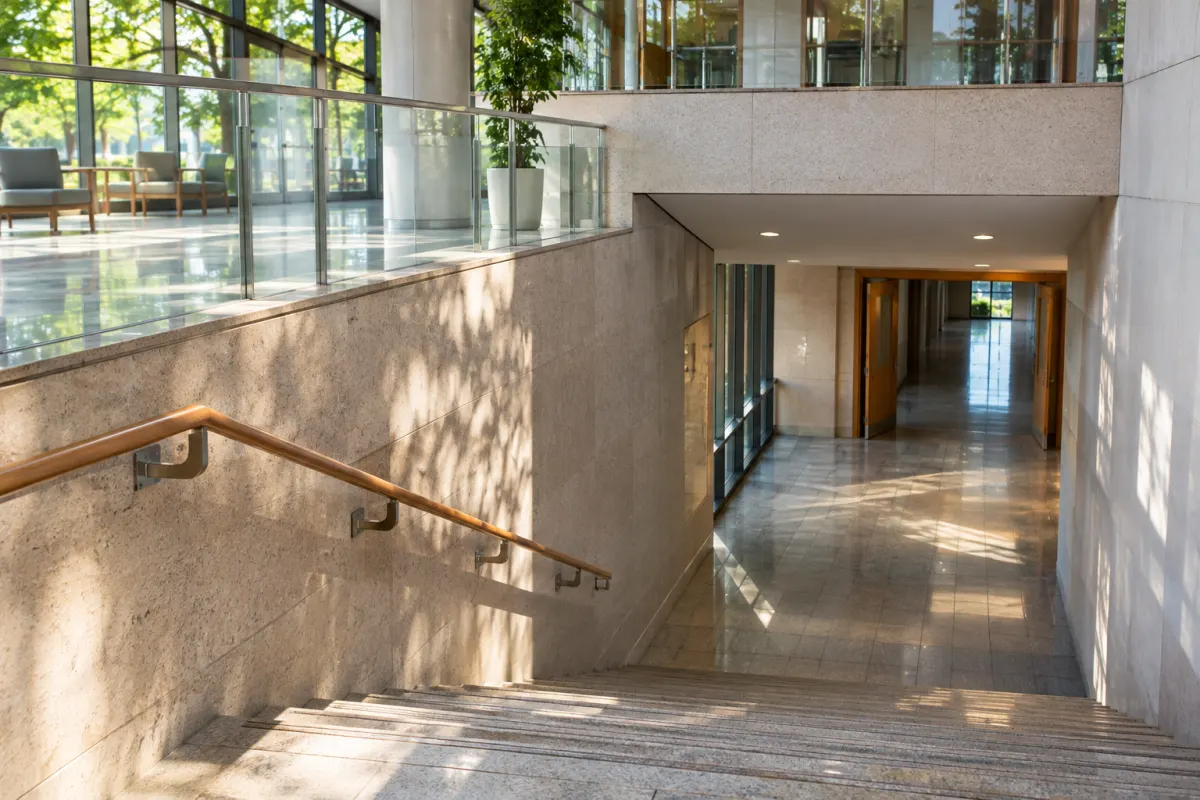
地下 (ちか) means underground or basement in this context. 地下一階 (ちかいっかい) identifies basement level one, often labelled B1. It is different from 一階. If a staff member says 地下一階, omitting 地下 in your notes changes the destination. Listen for that word before concentrating on the final number. A clearly pronounced counter cannot rescue a direction if you have missed the part that places it below ground.
In a practice dialogue, the cloakroom can be in the basement while reception is upstairs. Ask about one place at a time. First locate reception, then locate the cloakroom. Draw a simple vertical sketch with the places next to their levels. Avoid assuming that an upstairs reception means every facility is upstairs too. The exercise concerns two different destinations, and each reply has its own place name. Keeping those names visible prevents the second answer from overwriting the first.
Do not turn a floor into a room number or a count
A room identifier is different information. You might see 305号室 (さんびゃくごごうしつ), room 305. It is tempting to infer a floor from a room's first digit. Some buildings use that convention, but you cannot rely on it universally. Ask which floor the room is on if the directory does not make it clear. A language guide should teach you to request missing information rather than turn a familiar numbering pattern into a guarantee about an unfamiliar place.
階 is also different from 回, a counter for occurrences. They can sound alike, but their written forms and contexts differ. 三回 (さんかい) means three times; 三階 (commonly さんがい) names level three. A sentence about visiting a building three times is not locating a room. Read the surrounding action and the counter together. If you see the written kanji, use that distinction instead of trying to decide everything from the sound kai alone.
Try two questions in English before producing Japanese: “Which level is the exhibition room on?” and “How many times have you visited?” They ask for different facts even if both answers contain the number three. Write a short paraphrase of each answer. For the first, include a place and a level. For the second, include the action counted. Our Japanese grammar guide introduces how small sentence elements change the information being requested.
Rehearse a complete arrival conversation
Make a fictional directory with reception on 三階, an exhibition room on 二階 and a cloakroom on 地下一階. These are invented practice destinations, not claims about a real arts centre. Give the directory to one partner and keep your own page blank. Ask where reception is. Record the answer, confirm it and then ask about the lift. Your partner should answer only the question asked. This makes you notice when you have learned a destination but still lack a route.
Change one destination and repeat without warning. If reception has moved to 二階 in the new exercise, your old answer must change too. A memorised exchange is useful for pronunciation, but this variation checks whether you are listening to the actual number. Reverse roles after each round. As the person giving directions, read from the directory rather than improvising a floor that the other learner cannot check. Both people need a clear way to see whether the message was understood.
Finally, remove the directory and summarise what you know. Name the destination and its level, and mark any uncertainty. If you remember the floor but not the location of the lift, keep those facts separate. You have learned something useful even though the route is incomplete. In a real visit, ask for the missing detail before moving on. A short, accurate clarification is more practical than a long fluent sentence that sends you to the wrong level.
Questions about the method
Is 三階 always pronounced sangai?
Sangai is a common reading and the one used in this exercise. Sankai also occurs. Recognise both, while keeping the written floor and the place it locates clear. A pronunciation variation does not change level three into another level.
Does 一階 mean one floor above the entrance?
It names level one. The usual street-level floor in Japan is numbered one, but the entrance you use may open onto a different level. Check the actual building information instead of counting flights from an assumed starting point.
Should I guess the floor from a room number?
Use the directory or ask if the location is unclear. A room number can follow a building's own convention, and its first digit is not universal proof of a floor. Confirm the level before asking about the route.