
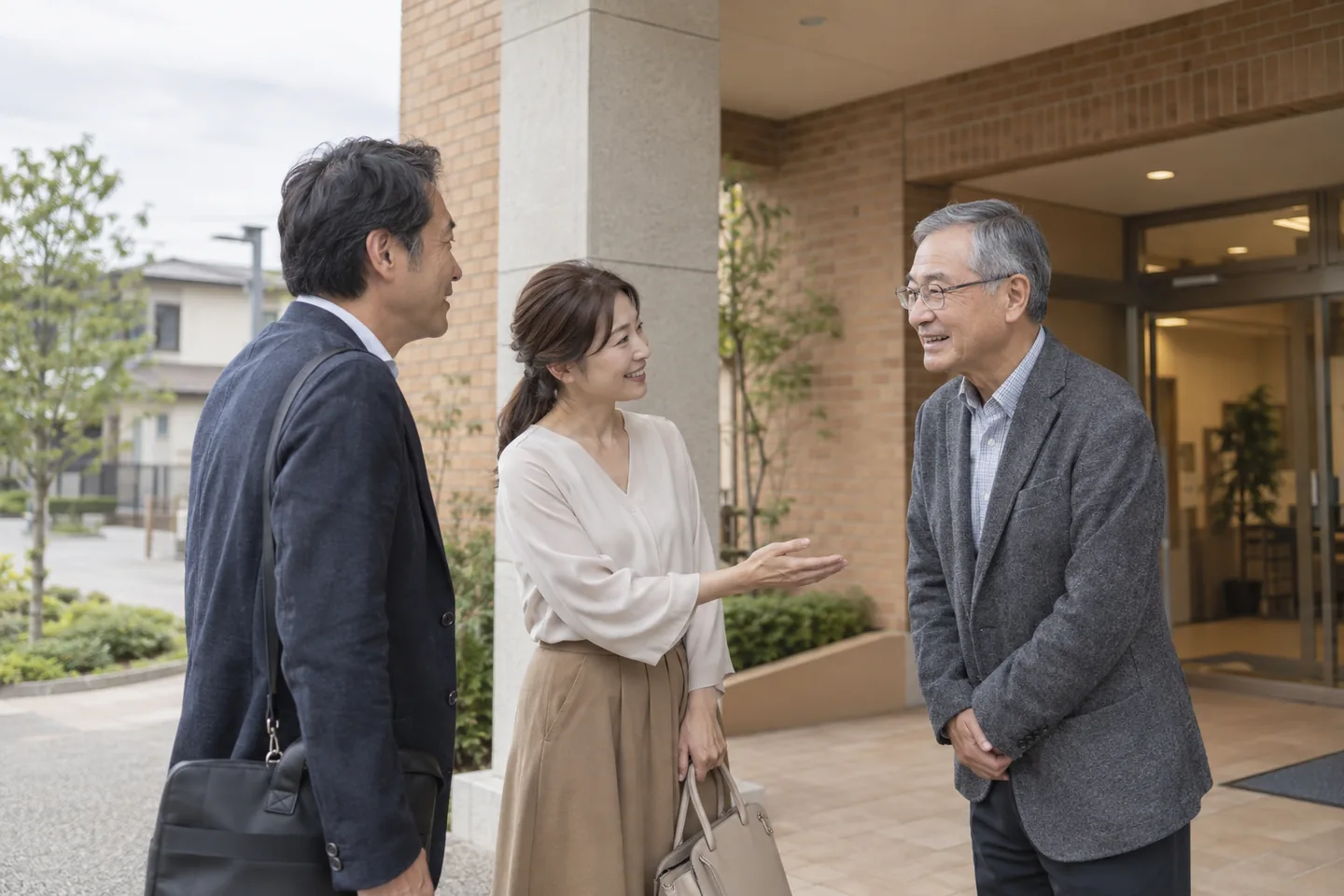
Japanese family terms become confusing when a dictionary gives you two words for “father” and you try to use them interchangeably. You recognise both, but during an introduction you hesitate: should this person be chichi or otōsan? The missing information is often the conversation, rather than another vocabulary item.
This guide uses a small, controlled task: talk politely about your own parent or older sibling to someone outside the family, refer respectfully to another person’s relative, or call your own parent directly. You will make that choice before producing the word. Later, an available KanaWay word card can support recall, while a separate written exercise checks the situation.
Japanese family terms begin with the conversation
Before looking at the Japanese, write three facts: who is speaking, whose relative is being discussed, and whether the speaker is talking about that person or speaking directly to them. “Father” alone leaves all three unanswered. A photograph of two adults also cannot establish their relationship; the fictional exercise must tell you who they are.
Imagine introducing your own father to a new classmate. Now imagine identifying the classmate’s father. Finally, imagine calling to your father across a room. The relative can be a father in every case, but the task changes. Keep those three situations separate rather than learning a single translation and adding politeness afterwards.
Our first task uses a polite introduction to someone outside your family. It is a useful beginner setting, not a claim that every informal conversation follows one rigid rule. Family habits and relationships can change actual address. Start with a clearly labelled scene so that a correction tells you something specific.
Two pairs for parents
For the controlled own-family introduction, use 父(ちち, chichi)for your father and 母(はは, haha)for your mother. For respectful reference to someone else’s parents, use お父さん(おとうさん, otōsan)and お母さん(おかあさん, okāsan). Learn the whole pair, including its context, rather than treating the longer form as an optional decoration.
The official Fukuroi family-language note illustrates introducing one’s father and provides the corresponding family terms. In an introduction, 父です。Chichi desu can mean “This is my father.” 母です。Haha desu similarly introduces your mother. The English “this” reflects the introduction scene; it is not an extra word hidden inside 父 or 母.
If you need to make the relationship explicit, 私の父です。Watashi no chichi desu means “This is my father” in that same scene. Here 私の identifies the speaker’s relationship. Do not assume that adding 私の automatically makes every choice of family noun appropriate. First choose the word for the task, then build the sentence.
Mark the long vowels in otōsan and okāsan when you write a reading aid. In kana, おとうさん and おかあさん show the spelling. Romanization supports the first attempt; it does not replace reading the Japanese. For a broader method of remembering meaningful word groups, use the Japanese vocabulary guide.

Older siblings need the relationship too
The same introductory contrast gives 兄(あに, ani)for your own older brother and 姉(あね, ane)for your own older sister. Respectful reference to someone else’s older brother or sister uses お兄さん(おにいさん, onīsan)or お姉さん(おねえさん, onēsan). “Older” belongs in the meaning; these are not generic words for any sibling.
In a fictional photo introduction, 私の兄です。Watashi no ani desu means “This is my older brother.” Change the relationship to an older sister and the target becomes 私の姉です。Watashi no ane desu. Keep the rest of the task steady while changing only the relative. That makes the vocabulary distinction visible.
Now label a different scene: you are identifying Tanaka’s older sister to another adult. 田中さんのお姉さんです。Tanaka-san no onēsan desu means “This is Tanaka’s older sister” in that context. Tanaka-san names the person whose relative you mean. You are describing the sister, not calling to your own sister.
Do not infer “older sibling” from an adult’s appearance or clothing. For these exercises, the relationship is given in words. A missing relationship is an incomplete prompt, not a test of cultural intuition. Leave younger relatives and more complex family relations for a separate, properly sourced task.
Addressing your own parent changes the task
Calling to your father is different from telling a classmate who he is. お父さん、ありがとう。Otōsan, arigatō means “Dad, thank you.” Here お父さん directly addresses your own father. It does not suddenly mean that he belongs to someone else’s family. The comma helps you see the call followed by the message.
The original Japan Society family-terms lesson separates reference to relatives from calling a family member directly. Its examples of parental address explain why the simple slogan “own family always takes chichi or haha” is too broad. The task matters. The brief thank-you here is familiar family speech, not a formal greeting for an unfamiliar adult.
For your mother, お母さん、ありがとう。Okāsan, arigatō uses the corresponding parental address. Families may use other names or nicknames; this exercise is not prescribing how every household must speak. It also does not train you to call unrelated adults otōsan or okāsan. Learn the intended relationship along with the phrase.
A useful contrast is to keep the same fictional father and change the listener. To the classmate, introduce him with 父です. To the father himself, use お父さん as the address in the thank-you. If you can explain that change without translating both as “father,” you have understood the central distinction.
Use word review for the question it actually asks
A vocabulary card can help you recall a word, but recognising its stored meaning does not prove that you chose it for a conversation. In the available KanaWay review flow, you attempt an available stored card, reveal its answer, and give a self-rating before continuing. That is a concrete review action; it is not automatic evaluation of family register.
If a relevant family-word card is available, answer the card as it is written. Reveal the stored answer and rate that attempt honestly. Then close or leave the card and do a separate context prompt on paper: “my father, polite introduction to a new classmate.” Write the chosen term and explain whether you are referring to someone or addressing them.
Keep two kinds of difficulty separate. You might know that the task needs chichi but forget ちち. That is a word-recall problem. You might recall otōsan perfectly but use it for the wrong controlled prompt. That is a context-selection problem. A single rating should not silently claim that both skills were tested.
This workflow does not promise a dedicated family deck, universal coverage, custom-card creation or correction of arbitrary Japanese sentences. If the needed card is unavailable, use a covered answer column in your own notes for recall and complete the same context exercise. The learning task remains usable. The Japanese practice guide offers ways to turn a specific mistake into a short follow-up task.
Six prompts with the answers covered
Read each situation and first write “reference” or “address.” For reference, add whose family it is. Only then choose the Japanese noun. Do not look at the next section until you have written all six attempts. You can answer in kana first and add kanji after checking.
A: You introduce your own father to a new classmate in a polite conversation. B: In the same setting, you introduce your own mother. C: You identify Tanaka’s mother to another adult; use a respectful family term. D: You introduce your own older brother to that classmate. E: You identify Tanaka’s older sister to another adult. F: You thank your own father directly in familiar family speech.
For A through E, give a short sentence ending in です. For F, use the thank-you pattern above. The exercises supply the relationship and setting explicitly. They do not ask you to guess what strangers in a photograph call one another, or to rank one form as universally more respectful in every possible situation.
After the first pass, change one detail in A: the father is now Tanaka’s, while the conversation stays a polite identification. Before writing anything, explain which part of your decision changes. This small alteration tests transfer more clearly than copying an entire vocabulary table.
Check the choice before checking the spelling
A: 父です。Chichi desu — “This is my father.” B: 母です。Haha desu — “This is my mother.” Both are introductions referring to your own relatives. You are speaking to the classmate, not calling your parent. An explicit 私の may be added when useful in the scene.
C: 田中さんのお母さんです。Tanaka-san no okāsan desu — “This is Tanaka’s mother.” D: 兄です。Ani desu — “This is my older brother.” E: 田中さんのお姉さんです。Tanaka-san no onēsan desu — “This is Tanaka’s older sister.” The answers retain the relationships supplied in the prompts.
F: お父さん、ありがとう。Otōsan, arigatō — “Dad, thank you.” This is direct address. For the altered A prompt, 田中さんのお父さんです。Tanaka-san no otōsan desu identifies Tanaka’s father. The changed relationship, rather than the length of the noun, explains the new choice.
Review in two passes. First compare the context label and family relationship. Then check the noun, kana and sentence. If a response differs, write the precise reason: wrong relative, wrong reference/address task, or forgotten form. Avoid recording only “family vocabulary wrong,” which does not identify the next useful practice.
Make the next attempt smaller
Choose one contrast that caused difficulty and write two new prompts for it. Keep the relationship fixed and change reference to direct address, or keep the introduction fixed and change whose parent it is. Give each prompt enough information to have an intended answer. A broad instruction such as “say mother politely” remains ambiguous.
At your next practice session, answer those prompts before uncovering the model. You are checking whether the decision can be made again, not claiming a particular retention score or a guaranteed improvement. If the scene falls outside the controlled setting, ask a teacher about that relationship and register rather than forcing this small chart onto it.
A complete introduction needs more than a family noun, but you can add details gradually after the basic choice is stable. The Japanese self-introduction guide covers that wider task. For today, success means naming the relationship, distinguishing reference from address, and choosing the form for the specified conversation.
Questions about the method
Is otōsan always someone else’s father?
No. In respectful reference it can refer to another person’s father, while direct address can call your own father otōsan. Identify the speech task before interpreting the relationship.
Should I attach san to chichi in these introductions?
For the controlled polite introduction of your own father, use chichi rather than constructing chichi-san. Learn the verified pair as complete terms, not a rule that attaches san to any noun.
Can a correct card answer prove correct register?
Only if that question actually tests the stated context. A stored meaning card may test word recall. Use a separate prompt with speaker, relationship and reference or address to examine the contextual choice.