
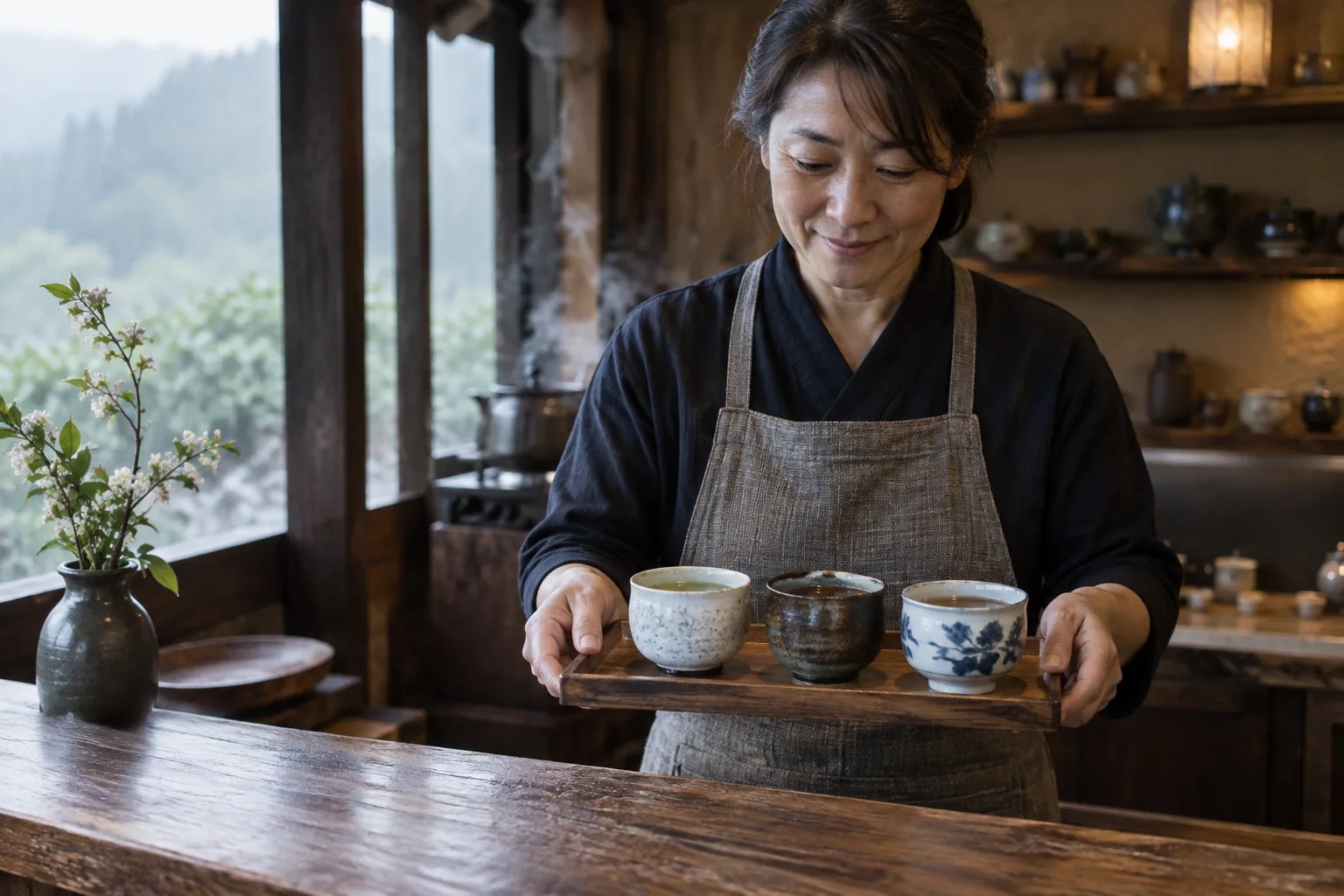
You can recognise the number three and still hesitate over three cups of tea. The Japanese cup counter 杯 changes its sound in common combinations, and it describes a serving rather than every object shaped like a cup. This guide keeps the task narrow: identify what is being counted, say a complete checked quantity, and use it in a short message. You need no special app or equipment. Pictures, a piece of paper and a reliable pronunciation model are enough. If counters themselves are unfamiliar, our Japanese numbers and counters guide explains the broader system. Here, the focus is the difference between a cupful, an empty vessel and a bottled drink.
Start with the Japanese cup counter’s unit
Look at the tray in the opening photograph. The useful quantity is three servings of tea. 杯, read はい as the counter name, can count cupfuls or glassfuls. It also has uses with bowlfuls, but you do not need every use today. Attach the word to a clear situation: tea served in cups or water served in glasses. A count of servings is not automatically a measurement in millilitres.
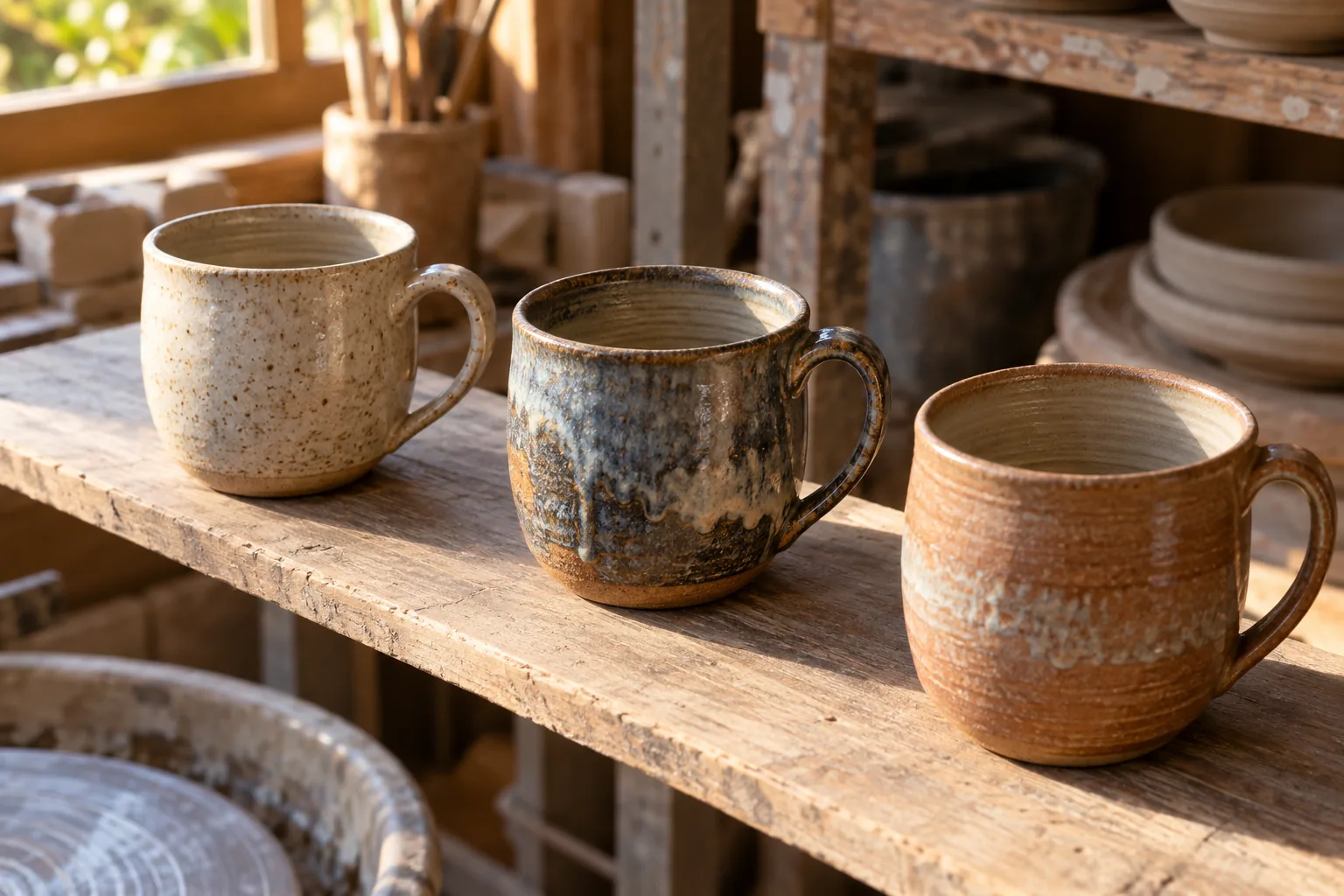
Imagine the same small cup being refilled. Two cupfuls can have been served even though only one physical cup was used. Conversely, three empty mugs on a shop shelf do not become three drinks just because they have handles. Ask what the speaker wants to count, not only what shape appears in the photograph. This choice comes before pronunciation.
Cup sizes also vary. “Two cups of tea” tells you a number of servings in context, not a universal volume. If a recipe requires a precise measure, use its stated unit and instructions rather than assuming the language exercise defines that measure. For our practice, each visible filled vessel represents one serving.

Learn the first three combinations as whole words
Start with 一杯, いっぱい, ippai: one cupful. Next comes 二杯, にはい, nihai: two cupfuls. Three is 三杯, さんばい, sanbai. The counter name はい does not remain unchanged after every number. Writing “ichi hai” for one and “san hai” for three misses the ordinary combinations you are trying to learn.
The small っ in いっぱい matters. It represents a consonant closure before the following p, not a new full vowel syllable. Use a reliable recording to hear the timing rather than relying entirely on English spelling. Romanisation can remind you which sounds to expect, but it cannot supply pitch, rhythm or every detail of pronunciation. Our Japanese pronunciation guide gives a broader starting point for kana timing.
Say the set in a changed order: two, one, three; then three, two, one. Point to a quantity before speaking. If you can only recite the familiar sequence, cover it and choose again. The goal is to connect the scene to the expression without counting upward through a memorised list.
Expand to ten without guessing the sound
The remaining practice forms are 四杯 よんはい, 五杯 ごはい, 六杯 ろっぱい, 七杯 ななはい, 八杯 はっぱい, 九杯 きゅうはい and 十杯 じゅっぱい. Another established reading of ten is じっぱい; choose one verified model for your initial practice. This is a counter pattern, not permission to add the same ending mechanically to every Japanese number.
Check the University of Texas JOSHU counter reference when you expand the set. The useful information here is the category and complete reading. Reference pages can also contain imperfect example translations, so compare the Japanese quantity with its explanation instead of copying everything without checking. Our exercises are original and use the combinations listed above.
Keep a compact two-column note: written expression and kana reading. Mark the forms that change to ぱい or ばい. Do not add several unrelated counters before you can reliably distinguish this set. A small checked range is easier to diagnose than a large table whose entries all feel equally uncertain.
Separate servings from empty vessels
Three empty ceramic mugs are three pieces of pottery, not three cupfuls of a drink. For a basic object-counting exercise, マグカップが三つあります, マグカップがみっつあります, means “There are three mugs.” The general つ expression is appropriate for this simple object example. It does not prove that every possible vessel or context must use つ.
Now change the message: お茶を三杯飲みました, おちゃをさんばいのみました, means “I drank three cups of tea.” The noun お茶 names tea, を marks the object of 飲みました, and 三杯 tells the amount consumed in servings. The sentence need not mean three different physical cups were involved. One cup could have been filled repeatedly.
Do not decide that 杯 is the only possible language around drinks. In a service setting, a general order count may use つ. The Japan Foundation’s Irodori ordering lesson includes that pattern. A general order quantity and a count of cupfuls serve different purposes; neither should be turned into a rule that excludes the other.
Change the container, check the counter
The two capped bottles in the photograph represent a different counting unit. A bottle of water is not automatically one glass of water. For this bottle-shaped object context, 水を二本ください, みずをにほんください, can request two bottles of water. 本, whose counter name is ほん, counts suitable long cylindrical objects. Learn 二本 as にほん in this example.
Compare the request with 水を二杯ください, みずをにはいください: “Two glasses of water, please”, in a setting where water is served that way. The drink name remains 水, but the quantity expression changes the intended unit. A listener may need the serving context to interpret it correctly. Counters organise meaning; they are not merely decorative syllables after digits.
For today, compare only 二杯 and 二本. Do not claim one pronunciation rule explains all forms of both counters. If you later need one bottle or three bottles, check 一本 いっぽん and 三本 さんぼん separately. Begin with the unit you actually need, then expand using a dependable reference.

Make a request, then listen for the quantity
A complete practice request is コーヒーを一杯ください, コーヒーをいっぱいください: “One cup of coffee, please.” Use it in a context where a served coffee is understood. Keep the item, quantity and request together. Avoid pausing so long between the number and counter that you lose the expression you have just learned.
For a quantity question, 何杯 is read なんばい, nanbai. お茶を何杯飲みましたか, おちゃをなんばいのみましたか, asks “How many cups of tea did you drink?” An answer such as 二杯です, にはいです, supplies two cupfuls when the topic is already clear. The question concerns servings consumed, not how many cups the person owns.
A shop interaction may use different wording or ask about temperature, size or takeaway service. This article does not teach a universal café script. Use our Japanese restaurant phrases guide for the wider exchange. In this exercise, listen for the amount and check it against what you meant to request.
Try six prompts before reading the answers
Cover the following paragraph. A: Give the complete reading of 一杯. B: Give the complete reading of 三杯. C: Say two glassfuls using 杯. D: Read 何杯. E: You describe three empty mugs using the general object pattern: complete マグカップが__あります. F: You request two bottle-shaped containers of water: choose 二杯 or 二本 for 水を__ください.
The answers are A いっぱい, B さんばい, C 二杯 にはい, D なんばい, E 三つ みっつ, and F 二本 にほん. Explain what each answer counts. If you chose 二杯 for the bottles, the difficulty is the unit, even if you pronounced it perfectly. If the unit was correct but you said “san hai”, practise the complete sound combination.
Return to the photograph with one coffee and two iced teas. Count each group separately: coffee is 一杯; iced tea is 二杯. The total number of visible drink servings is 三杯. Changing between a group count and a total checks whether you understood the task rather than just naming the number most obvious in the scene.
Keep the next practice session specific
Record two kinds of mistake separately: choosing the wrong counting unit and producing the wrong reading. A unit mistake needs a contrasting scene, such as filled tea cups beside empty mugs. A reading mistake needs a reliable sound model and another attempt at that exact combination. Recopying the whole chart is not automatically the best response to either problem.
In a later session, mix three quantities without showing their kana first. Say the expression, write its reading and explain the unit in your own words. Then check. There is no promised number of repetitions that makes every counter automatic. Expand only when the current examples are clear enough that a new item will not conceal the old difficulty.
You can finish with a practical goal: distinguish a serving from its container, produce 一杯, 二杯 and 三杯, and recognise what 何杯 asks. That is useful progress without pretending you have learned the entire counting system. Keep the reference available for the next situation that genuinely requires another form.
Questions about the method
Does 杯 count empty cups?
In the uses studied here it counts cupfuls or servings, not simply empty objects with a cup shape. An empty mug can be counted as an object using a suitable counter. Decide what the speaker means to count before selecting the expression.
Is 一杯 always one exact volume?
No. In ordinary drink examples it describes a serving whose size depends on the situation. A recipe or technical measurement may specify a defined unit; follow that information. Do not convert a language example into a fixed millilitre quantity.
Why can a coffee order use つ?
A general ordering pattern may count ordered items rather than explicitly naming cupfuls. The Japan Foundation provides examples of that pattern. 杯 remains useful for servings, especially when stating consumption or asking how many cupfuls. Context matters more than a single universal ordering rule.
Should I learn all counters before speaking?
No. Start with a small verified set connected to situations you understand. Check the full reading and unit for each new combination. You can use a reference and a clear example without claiming that your first counter replaces the rest of the system.