
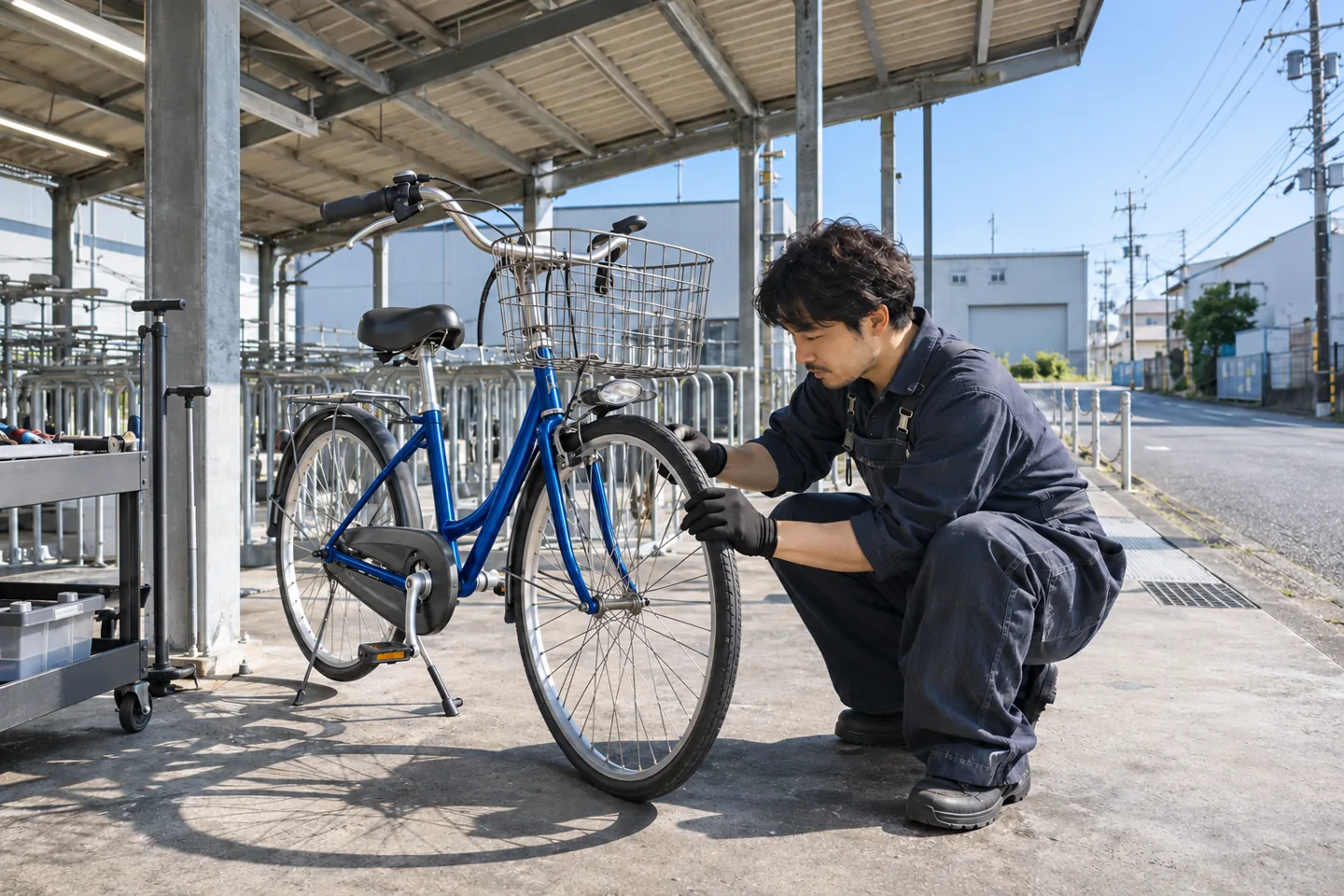
The Japanese counter dai helps you give a number for a whole vehicle or device. The difficult part is often deciding which objects belong in that number. At a bicycle pickup point, three bikes, two helmets and two adults do not make seven vehicles. A fluent number is still the wrong answer if it counts a different set from the one the question asks about.
This guide uses an imaginary bicycle hub to make that distinction practical. You will choose the category, read small quantities, place the quantity in a sentence and confirm what another person understood. The examples also transfer to computers in a workroom. Everything can be practiced with a simple sketch and a partner. No booking, rental service or application is required, and the fictional dialogue does not establish that any bicycle is actually available to borrow.
The Japanese counter dai identifies the category
台(だい, dai)is a counter commonly used with vehicles and machines. Bicycles, cars and computers are useful starting examples. One bicycle is 一台(いちだい, ichidai)when you are counting it as a whole vehicle. Its two wheels are parts of that one bicycle. You do not turn the bicycle into two 台 by looking at the number of wheels, and you do not count a rider as another vehicle.
Imagine three bicycles standing in a row. Two are blue and one is red. 自転車が三台あります(じてんしゃがさんだいあります, jitensha ga sandai arimasu)means “There are three bicycles.” Here, 自転車 names the things and 三台 gives their quantity. The sentence tells the listener what the number refers to. It is more useful than saying “three” while pointing at a crowded scene containing several different kinds of object.
Before saying a number, name the category to yourself. “Whole bicycles in this row” is precise enough for the first task. Leave the helmets, tools and people outside that set. If the question later changes to blue bicycles, you must select a smaller set before counting again. The counter does not perform that selection for you. It tells the listener the kind of unit you have counted; the noun and the surrounding conversation explain which particular objects belong to it.

Read the quantity as one useful expression
Start with the quantities needed for a small pickup: 一台(いちだい, ichidai), 二台(にだい, nidai)and 三台(さんだい, sandai). Say the complete number-and-counter expression rather than retrieving an English number and adding a disconnected sound. In these combinations, the counter remains だい. You do not borrow the sound changes of another counter just because you recently practiced a different counting lesson.
Useful next forms are 四台(よんだい, yondai), 五台(ごだい, godai), 六台(ろくだい, rokudai), 七台(ななだい, nanadai), 八台(はちだい, hachidai), 九台(きゅうだい, kyūdai)and 十台(じゅうだい, jūdai). These are common readings suitable for this exercise. Write Arabic numerals if that is easier while planning: 2台 still needs the spoken reading にだい. The written choice does not replace the counter or change the number of bicycles.
For “how many vehicles/devices,” use 何台(なんだい, nandai). The university lesson on counters gives the category and reading pattern alongside sentence examples. Cover your reading notes and try 2台, 4台 and 何台 in a different order. Then check the result. A fixed recital from one to ten can hide hesitation about an individual form. For careful sound practice, return to the pronunciation guide and keep the words familiar while you focus on saying them clearly.
Put the number where its job is clear
In the existence sentence 自転車が三台あります, the quantity comes after the noun with its particle and before the predicate. This is a helpful model for a beginner: identify the object, give the quantity and finish the statement. It is a useful pattern rather than a claim that Japanese allows only one word order. Keep the whole sentence together when checking what the listener understood.
A question using that model is 自転車が何台ありますか(じてんしゃがなんだいありますか, jitensha ga nandai arimasu ka), “How many bicycles are there?” For the three-bike row, answer 三台あります, “There are three,” because the category is already established. If the conversation has moved elsewhere, repeat the noun. A short answer works because of shared context, not because the counter itself identifies the exact objects in every possible situation.
You will also encounter 二台の自転車(にだいのじてんしゃ, nidai no jitensha), “two bicycles.” Here, number plus counter is connected to the noun with の. Contrast that noun phrase with the complete sentence 自転車が二台あります. Do not treat the two shapes as competing answers to the same grammar question: one names a group, and the other makes a statement about existence. The grammar guide helps place these smaller pieces inside a complete sentence when you need a broader review.
Keep vehicles and accessories on separate lines
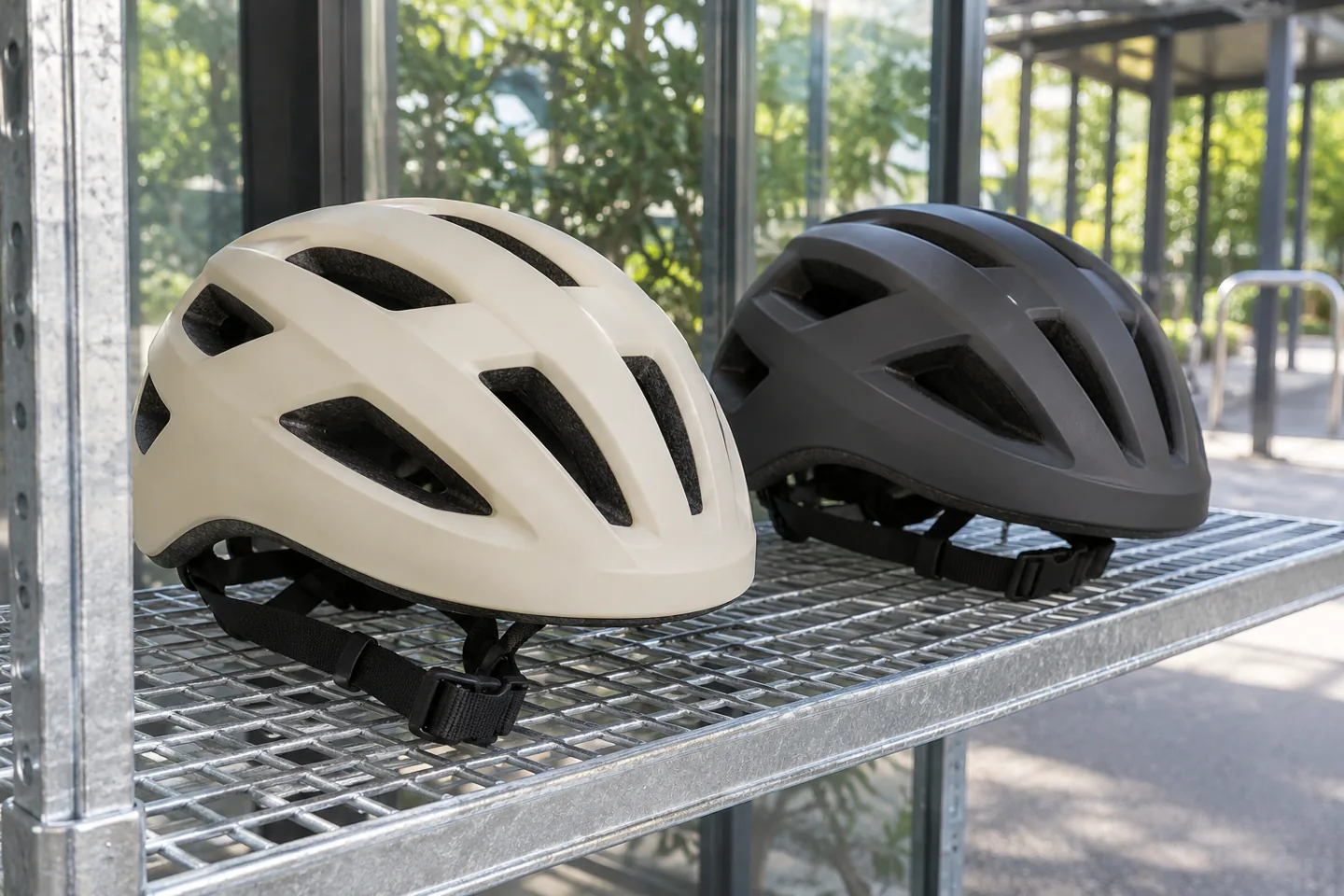
The helmets beside the bicycles are useful precisely because they should not be added to the bicycle total. In a sketch with three bicycles and two helmets, the answer to the bicycle question remains 三台. The scene contains more physical objects, but the question has not asked you to count everything visible. Give the accessories their own category when you need to discuss them, instead of stretching 台 into a universal word for “item.”
The same counter can appear with another suitable noun. パソコンが二台あります(ぱそこんがにだいあります, pasokon ga nidai arimasu)means “There are two computers.” The number is again a count of whole devices. It is not a count of people using them, open documents, connected cables or work sessions. Two closed laptops in a picture can provide two device units even though no screen is running and no software is visible.
Do not turn “vehicles and machines” into an invented physical test such as “anything with wheels” or “anything using electricity.” Counter choice follows Japanese usage, and specialized objects may have their own established counters. This lesson gives you a small reliable set of examples, not a classification algorithm for every noun. When you move beyond bicycles, cars and familiar devices, check the particular noun in a dependable reference and keep its example with the word you are learning.

Change the question before changing the answer
Return to the three-bike row: two blue bicycles and one red bicycle. The broad question asks about all three. 青い自転車が何台ありますか(あおいじてんしゃがなんだいありますか, aoi jitensha ga nandai arimasu ka)asks “How many blue bicycles are there?” The answer is 二台あります. You have not changed the counter's meaning. You have changed which bicycles qualify for the count by adding a description to the noun.
Now imagine your group plans to borrow the two blue bicycles. 自転車を何台借りますか(じてんしゃをなんだいかりますか, jitensha o nandai karimasu ka)asks “How many bicycles will you borrow?” 二台借ります means “I/we will borrow two.” The sentence expresses the intended action in this fictional exchange. It does not by itself confirm permission, a reservation or the condition of the vehicles. Keep those real-world questions separate from the grammar task.
Make three paper headings: present, blue and planned borrowing. Put the appropriate number under each heading before speaking: three, two and two. Ask a partner to choose a question without showing its heading. After you answer, reveal which heading you used. If they expected a total inventory and you reported a borrowing plan, repair the question or context first. Repeating the same number more loudly cannot fix a mismatch between the sets you and your listener are counting.
Check a pickup exchange and an ordinal trap
Try a short exchange with your notes hidden. Your partner asks how many bicycles are in the row; answer with the whole row. They then ask about the blue bicycles; answer with that subset. Finally, they ask how many you plan to borrow. Suitable answers are 三台あります, 二台あります and 二台借ります. Change the colors or the borrowing plan for a second round so that you are not simply remembering three answers in a fixed order.
Watch for another distinction when someone points to a particular bicycle. 二台 means two units, whereas 二台目(にだいめ, nidaime)can mean the second vehicle/device in an established sequence. Quantity and position are different questions. A request involving the second bicycle does not automatically request two bicycles. Agree what the ordering refers to before using it: the second from the entrance is a more specific idea than an unexplained “second.”
Finish by writing one complete question and its intended answer for a new scene, such as two computers in a room. Give the sketch to a partner and ask them to identify the counted category as well as the number. Check the noun, the selected set, the reading and the sentence pattern separately. Keep the part that worked and change only the mistaken part. The aim is a number attached to a clear unit and a clear question, not an impressive list of counters recited without a situation.
Questions about the method
Can dai count any object at the pickup point?
No. In these examples it counts the bicycles as whole vehicles, and it can also count suitable devices such as computers. Helmets, tools and people are not added to the bicycle total simply because they stand nearby. A different object may need a different counter. Name the category before giving the number, and check unfamiliar nouns instead of treating 台 as a universal substitute for “thing.”
Does two vehicles mean two people?
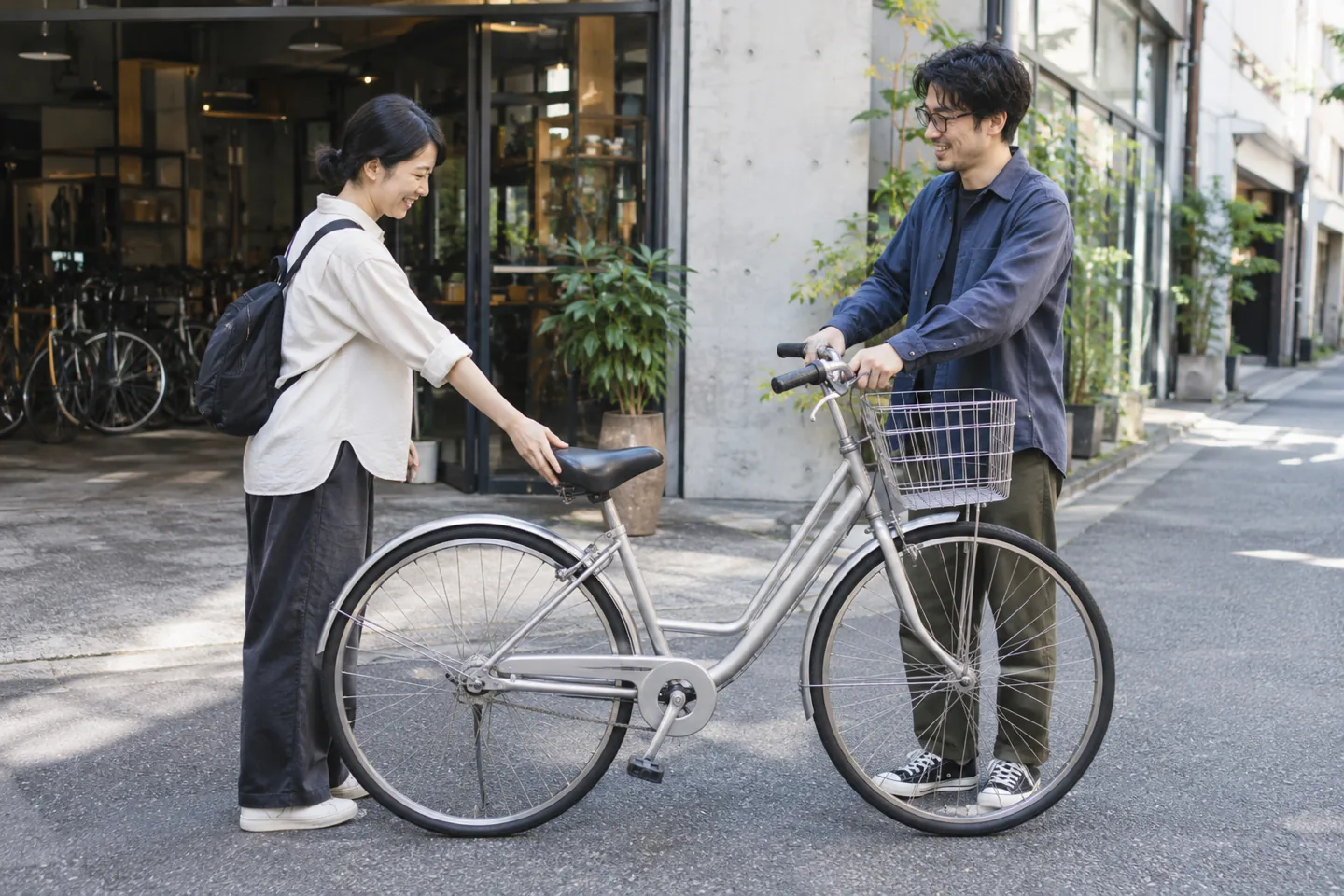
Not necessarily. A vehicle count gives the number of vehicles, not the number of riders, owners or staff. In the handover example, two adults can be involved with one foreground bicycle. Background stored bicycles can also be outside the task's selected set. If you need a number of people, ask a separate question with the relevant people counter and context. Do not infer attendance or seating needs from 台 alone.
Should I always answer with a full sentence?
A short answer such as 二台 can be sufficient when everyone knows the object and the question. A full sentence is helpful during practice because it reveals whether you mean existence, planned borrowing or another action. Use the shared context to decide how much to repeat. The polite model sentences here are a practical starting point; a fragment is not automatically rude, and a longer sentence is not automatically clearer if it answers the wrong question.